Pakistan president seeks Russia’s support for BRICS membership 

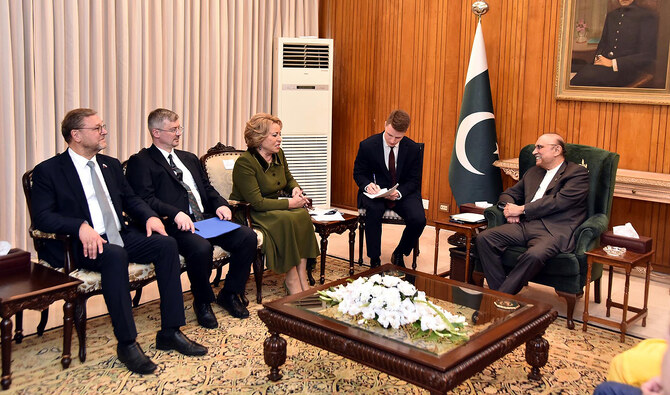
Pakistan’s President Asif Ali Zardari (left) meets Russian Federation Council Speaker Valentina Matvienko (third from left) in Islamabad, Pakistan, on October 28, 2024. (PID)
Short Url
Updated 29 October 2024
Follow

Pakistan president seeks Russia’s support for BRICS membership 

  • Pakistan President Asif Ali Zardari meets Russian Speaker Valentina Matvienko and her delegation in Islamabad 
  • Pakistan applied in 2023 to join BRICS, an informal group comprising Russia, Brazil, India, China and South Africa

ISLAMABAD: Pakistan’s President Asif Ali Zardari has sought Russia’s support to join the inter-governmental BRICS organization, state-run media reported on Monday, saying that Islamabad’s inclusion would help enhance its role in regional and global cooperation. 

In 2006, Brazil, Russia, India and China created the “BRIC” group before South Africa joined the alliance in 2010, making it BRICS. The bloc was founded as an informal club to provide a platform for its members to challenge a world order dominated by the United States and its Western allies.

Countries like Pakistan who want to join BRICS see it as an alternative to global bodies viewed as dominated by the traditional Western powers and hope membership will unlock benefits including development finance, and increased trade and investment. Pakistan had last year applied to become a member of BRICS. 

Zardari met Russian Federation Council Speaker Valentina Matvienko and members of the visiting delegation from Moscow in Pakistan’s capital Islamabad on Monday. Matvienko arrived in Pakistan on a three-day visit earlier this week to strengthen parliamentary ties between the two states. 

“He (Zardari) also sought Russia’s support for Pakistan’s bid to become a member of BRICS which would greatly help Pakistan to enhance its role in regional and global cooperation through the alliance,” the state-run Associated Press of Pakistan (APP) said.

“Pakistan and Russia reaffirmed their resolve to further strengthen bilateral ties in the areas of trade, commerce, investment, agriculture and energy for the mutual benefit of the two countries.”

During a visit to Pakistan in September, Russia’s Deputy Prime Minister Alexey Overchuk had said Moscow would support Pakistan’s bid to join BRICS.

Zardari said Pakistan’s and Russia’s relationship was marked by mutual respect and a commitment to expand bilateral cooperation, emphasizing strengthening cultural links through people-to-people contacts and scholarship programs.

He noted that Pakistan and Russia had a lot of potential to increase economic cooperation, urging the Russian delegation to invest in the South Asian country. 

“Both sides underscored the importance of diversifying trade and economic cooperation, besides enhancing regional connectivity and commercial relations through the Belt and Road Initiative (BRI) and the North-South Transport Corridor,” the state broadcaster added.

“The president expressed gratitude to Russia for its support of Pakistan’s candidacy for a non-permanent seat on the United Nations Security Council.”

Matvienko said Russia prioritized its relationship with Pakistan, expressing confidence in enhancing bilateral cooperation through her visit, APP said. 

“She hoped that the signing of a Memorandum of Understanding between the Parliaments of the two countries would further deepen bilateral relations,” the state-run media reported. 

Pakistan and Russia, once Cold War rivals, have warmed up to each other in recent years through regular business and trade interactions. Islamabad’s ties with Russia also significantly improved in 2023 after Pakistan started purchasing Russian crude oil at a discount rate. 

The South Asian country hopes it can use its strategic geographical location to improve trade and cooperation with Russia and other states as it fights to ward off a prolonged economic crisis.

Earlier this month, President Zardari met Russian counterpart Putin on the sidelines of an international forum in Ashgabat, Turkmenistan, where they pledged to further strengthen bilateral ties.


Pakistan Supreme Court halts trial of prominent lawyer over alleged anti-military tweets

Updated 57 min 11 sec ago
Follow

Pakistan Supreme Court halts trial of prominent lawyer over alleged anti-military tweets

  • Top court orders lower court to pause proceedings after lawyers allege due-process breaches
  • Mazari-Hazir, husband face charges under cybercrime law that carry up to 14 years in prison

ISLAMABAD: Pakistan’s Supreme Court on Thursday halted the cybercrime trial of prominent human rights lawyer Imaan Mazari-Hazir and her husband, Hadi Ali Chattha, after their lawyers argued that a lower court had recorded witness testimony in their absence, violating due-process rules.

Mazari-Hazir, one of Pakistan’s most outspoken civil liberties lawyers, and Chattha are being prosecuted under the Prevention of Electronic Crimes Act (PECA) over posts on X that authorities say incited ethnic divisions and portrayed the military as involved in “terrorism.” Both reject the allegations. If convicted under the relevant PECA provision, they face a prison term of up to 14 years.

The case has drawn broad attention in Pakistan’s legal community because Mazari-Hazir, who has been repeatedly detained over her criticism of the security establishment, argues that the trial court ignored basic procedural guarantees despite her medical leave request. The case also comes as Pakistan faces sustained scrutiny over the use of PECA against activists, journalists and political dissenters, with lawyers arguing that lower courts often move ahead without meeting minimum fair-trial standards.

The couple’s lawyer, Riasat Ali Azad, said his clients filed a petition in the Supreme Court because the lower court had moved ahead improperly.

“Today, the Supreme Court of Pakistan has stayed the lower court proceedings, the trial court proceedings and has said that the [Islamabad] High Court should decide our pending revision petition for which a date has already been fixed,” he told reporters.

Azad said the violation was clear under Pakistan’s Code of Criminal Procedure, which requires evidence to be recorded in the presence of the accused.

“Yet, on that very day, evidence of four witnesses was recorded in their absence, and a state counsel was appointed to conduct cross-examination on their behalf,” he said. “All these things are against the right to a fair trial under Articles 10 and 10-A.”

A three-judge bench led by Justice Muhammad Hashim Khan Kakar ordered the trial court to pause proceedings and instructed the Islamabad High Court to hear the couple’s pending criminal revision petition first.

The trial had been scheduled to resume on Dec.15, but the Supreme Court’s stay now freezes proceedings before both the additional sessions judge and the special PECA court. 

The Islamabad High Court is expected to hear the criminal revision petition next week.

Chattha, who is also a lawyer, said the SC ruling underscored the need for procedural safeguards.

“It is a victory for the constitution and the law,” he said, arguing that the trial court had ignored their request to re-record witness statements in their presence.