

Father of British-Pakistani girl admits killing her but denies intent

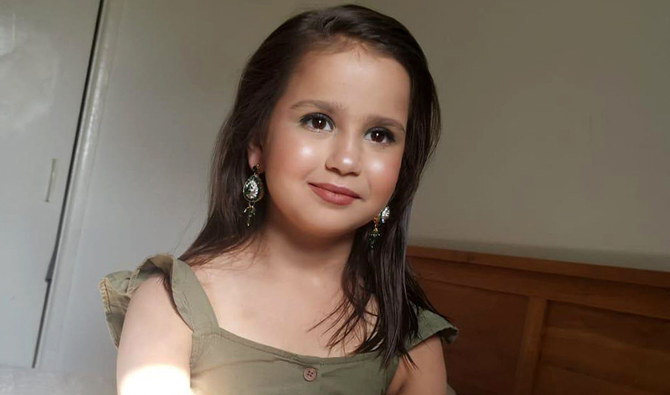
An undated handout photo released by Surrey Police in London on September 6, 2023, shows Sara Sharif, who was found dead in Woking, south west of London, on August 10. (Photo courtesy: SURREY POLICE/AFP)
Short Url
Updated 13 November 2024
Follow

Father of British-Pakistani girl admits killing her but denies intent

  • Sara Sharif, 10, was found dead in her bed in southwest London in August last year with serious injuries
  • Her father, Urfan Sharif, had fled to Pakistan a day before her body was found with his wife and Sara’s uncle

LONDON: The father of a 10-year-old British-Pakistani girl on Wednesday admitted that he killed his daughter but maintained he had not meant to harm her, even as he beat her when she lay dying.

Sara Sharif was found dead in her bed in Woking, southwest of London, on August 10, 2023, with extensive injuries including broken bones, burns and bite marks.

Her father, Urfan Sharif, 42, had fled to Pakistan a day before her body was found, with his wife Beinash Batool, 30, and the girl’s uncle, Faisal Malik, 29.

All three adults deny murder and a separate charge of allowing the death of a child.

Giving evidence at the Old Bailey court in central London, Urfan Sharif had previously blamed Batool, Sara’s stepmother, and said she had forced him to confess to killing her.

But under questioning from his wife’s lawyer on Wednesday the taxi driver said he took “full responsibility” for what had happened, but that he had not intended to hurt Sara.

Asked if he killed Sara by beating, he replied: “Yes, she died because of me.”

He also admitted causing multiple fractures in the weeks before Sara’s death, using a cricket bat on her as she was bound with packaging tape, throttling her with his bare hands and breaking the hyoid bone in her neck.

“I can take full responsibility. I accept every single thing,” he said, also accepting that he badly beat Sara on August 8 when she had collapsed and was dying.

He maintained however that he was not guilty of the murder charge. “I did not want to hurt her. I didn’t want to harm her,” he told the jury.

Sara’s body was discovered in her bed on August 10. Her father phoned British police after arriving in Islamabad and said he had beaten his daughter “too much.”

A written confession was found beside her. A post-mortem examination found she had suffered multiple injuries, including at least 25 broken bones.

She also had burns and human bite marks on her body but Urfan Sharif denied making them.

The defendants were arrested on September 13 when they flew back to the UK.


Pakistan seeks UK action over ‘incitement to violence’ against top military commander

Updated 7 sec ago
Follow

Pakistan seeks UK action over ‘incitement to violence’ against top military commander

  • Move follows a video that purportedly showed a PTI supporter in Bradford referencing violence against the army chief
  • Pakistan’s deputy interior minister says the government has written to the UK, saying the content breaches British law

ISLAMABAD: Pakistan’s State Minister for Interior Tallal Chaudhry said on Friday the government has written a letter to the United Kingdom to express concern over social media content circulating from British territory, which he said amounts to incitement to violence against the Pakistani state.

Speaking to a local news channel, Chaudhry said the government raised the issue after a video clip on social media purportedly showed a protester of former Prime Minister Imran Khan’s Pakistan Tehreek-e-Insaf (PTI) party criticizing Chief of Army Staff Field Marshal Asim Munir and referring to violence against him.

“This is not a political matter, nor is it a question of freedom of expression,” the minister said while speaking to Geo TV. “This is clearly a violation of international law and of Britain’s own laws, including the British Terrorism Act 2006.”

He said the material went beyond political dissent and amounted to incitement to violence, adding that Pakistan had conveyed to British authorities that states are responsible for ensuring that individuals residing on their territory — whether citizens, asylum seekers or others — do not incite rebellion or violence against another sovereign country.

“What is very dangerous is that a very specific act — a car bombing — has been referenced,” he continued. “It has not been generalized.”

A social media post by a Britain-based journalist claimed that the video was recorded during a protest outside Pakistan’s consulate in Bradford, though neither the authenticity of the footage nor the identity of the individual could be independently verified.

Chaudhry said Pakistan’s complaint to the UK was lodged under international law, British law and United Nations principles governing relations between states, stressing that the issue was one of incitement rather than protected speech.

“This is not about freedom of expression. This is about incitement and terrorism, which is against Britain’s own laws,” he said, adding that Islamabad expects British authorities to take action.

Pakistani officials have also previously voiced concerns over social media activity by PTI supporters abroad that they say fuels unrest and hostility toward state institutions.

British authorities have not publicly responded to the letter or Chaudhry’s statement.

PTI has not reacted to either of them as well.