

Toxic smog smothering India’s capital smashes WHO limit

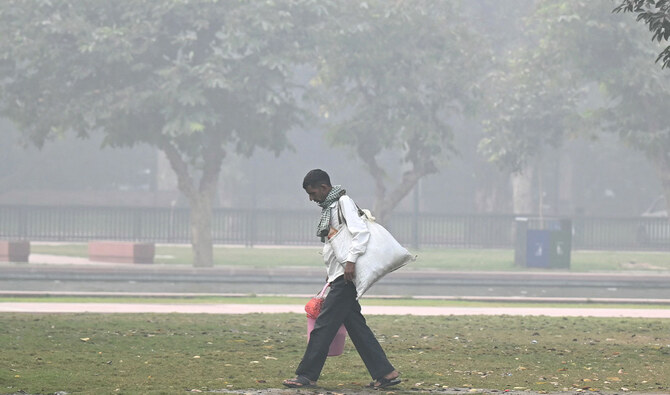
A hawker walks near India Gate engulfed in smog in New Delhi on November 13, 2024. (AFP)
Short Url
Updated 13 November 2024
Follow

Toxic smog smothering India’s capital smashes WHO limit

  • Pollutant levels in New Delhi topped 806 micrograms per cubic meter Wednesday morning 
  • This is over 53 times WHO recommended daily maximum of fine particulate matter

NEW DELHI: Residents of India’s capital New Delhi choked in a blanketing toxic smog Wednesday as worsening air pollution surged past 50 times the World Health Organization’s recommended daily maximum.

Many in the city cannot afford air filters, nor do they have homes they can effectively seal from the misery of foul smelling air blamed for thousands of premature deaths.

Cooler temperatures and slow-moving winds trap deadly pollutants each winter, stretching from mid-October until at least January.

At dawn on Wednesday, “hazardous” pollutant levels in parts of the sprawling urban area of more than 30 million people topped 806 micrograms per cubic meter, according to monitoring firm IQAir.

That is more than 53 times the World Health Organization recommended daily maximum of fine particulate matter — dangerous cancer-causing microparticles known as PM2.5 pollutants that enter the bloodstream through the lungs.

By midday, when air usually is at its best, it eased to about 25-35 times above danger levels, depending on different districts.

Bikramjeet Singh, 25, who works as an environmental health safety manager walking on the streets, said breathing in Delhi was like “smoking cigarettes” and he worried for those with asthma.

“Older people have difficulties breathing,” he said.

The city is blanketed in acrid smog each year, primarily blamed on stubble burning by farmers in neighboring regions to clear their fields for plowing, as well as factories and traffic fumes.

But a report by The New York Times this month, based on air and soil samples it collected over five years, revealed the dangerous fumes also spewing from a power plant incinerating the city’s landfill garbage mountains.

Experts the newspaper spoke to said that the levels of heavy metals found were “alarming.”

Swirling white clouds of smog also delayed several flights across northern India.

The India Meteorological Department said that at least 18 regional airports had a visibility lower than 1,000 meters (1,093 yards) — dropping below 500 meters in Delhi.

India’s Supreme Court last month ruled that clean air was a fundamental human right, ordering both the central government and state-level authorities to take action.

But critics say arguments between rival politicians heading neighboring states — as well as between central and state-level authorities — have compounded the problem.

Politicians are accused of not wanting to anger key figures in their constituencies, particularly powerful farming groups.

City authorities have launched several initiatives to tackle pollution, which have done little in practice.

Government trucks are regularly used to spray water to briefly dampen the pollution.

A new scheme unveiled earlier this month to use three small drones to spray water mist was derided by critics as another “band-aid” solution to a public health crisis.

The WHO says that air pollution can trigger strokes, heart disease, lung cancer and other respiratory diseases.

It is particularly punishing for babies, children and the elderly.

A study in The Lancet medical journal attributed 1.67 million premature deaths to air pollution in the world’s most populous country in 2019.

The choking carbon smog across Delhi came as researchers warned that planet-warming fossil fuel emissions would hit a record high this year, according to new findings from an international network of scientists at the Global Carbon Project.

Researchers said increases in CO2 emissions from India — as well as growth in international aviation — drove emissions up.

It found no sign the world was moving away from fossil fuels as planned.


Pakistani fighter jet crashes in Jalalabad, pilot captured: Afghan military, police

Updated 28 min 18 sec ago
Follow

Pakistani fighter jet crashes in Jalalabad, pilot captured: Afghan military, police

  • Fighting between Pakistan and Afghanistan’s Taliban military entered its third day on Saturday
  • Pakistan’s strikes on Friday hit Taliban military installations and posts, including in Kabul and Kandahar

JALALABAD: A Pakistani jet has crashed in Jalalabad city and the pilot captured alive, the Afghan military and police said Saturday, with residents telling AFP the man parachuted from the plane before being detained.
"A Pakistani fighter jet was shot down in the sixth district of Jalalabad city, and its pilot was captured alive," police spokesman Tayeb Hammad said.
Wahidullah Mohammadi, spokesman for the military in eastern Afghanistan, confirmed the Pakistani jet was downed by Afghan forces "and the pilot was captured alive".

The AFP journalist heard a jet overhead before blasts from the direction of the airport in Jalalabad, the capital of Nangarhar province, which sits on the road between Kabul and the Pakistani border.

Fighting between Pakistan and Afghanistan’s Taliban military entered its third day on Saturday, following overnight clashes as the international community expressed increasing concern about the conflict and called for urgent talks.

Pakistan’s strikes on Friday hit Taliban military installations and posts, including in Kabul and Kandahar, in one of the deepest Pakistani incursions into its western neighbor in years, officials said.

Islamabad accuses the Taliban of harboring Tehreek-e-Taliban Pakistan (TTP) militants, who it claims are waging an insurgency inside Pakistan, a charge the Taliban denies.

Pakistan described its actions as a response to cross-border assaults, while Kabul denounced them as a breach of its sovereignty, saying it remained open to dialogue but warned any wider conflict would result in serious consequences.

The fighting has raised ‌the risk ‌of a protracted conflict along the rugged 2,600-kilometer frontier.

Diplomatic efforts gathered ‌pace ⁠late on Friday ⁠as Afghanistan said its foreign minister, Amir Khan Muttaqi, spoke by telephone with Saudi Arabia’s Prince Faisal bin Farhan about reducing tensions and keeping diplomatic channels open.

The European Union called for both sides to de-escalate and engage in dialogue, while the United Nations urged an immediate end to hostilities.

Russia urged both sides to halt the clashes and return to talks, while China said it was deeply concerned and ready to help ease tensions.

The United States supports Pakistan’s right to defend itself against attacks by ⁠the Taliban, a State Department spokesperson said.

Border fighting continues

Exchanges of fire continued along ‌the border overnight.

Pakistani security sources said an operation dubbed “Ghazab Lil Haq” was ongoing and that Pakistani forces had destroyed multiple Taliban posts and camps in several sectors. Reuters could not independently verify the claims.

Both sides have reported heavy losses with conflicting tolls that Reuters could not verify. Pakistan said 12 of its ‌soldiers and 274 Taliban were killed while the Taliban said 13 of its fighters and 55 Pakistani soldiers died.

Taliban deputy spokesman Hamdullah Fitrat ⁠said 19 civilians were ⁠killed and 26 wounded in Khost and Paktika. Reuters could not verify the claim.

Pakistan’s Defense Minister Khawaja Muhammad Asif said “our cup of patience has overflowed” and described the fighting as “open war,” warning that Pakistan would respond to further attacks.

Taliban Interior Minister Sirajuddin Haqqani said in a speech in Khost province that the conflict “will be very costly,” and that Afghan forces had not deployed broadly beyond those already engaged.

He said the Taliban had defeated “the world, not through technology, but through unity and solidarity,” and through “great patience and perseverance,” rather than superior military power.

Pakistan’s military capabilities far exceed those of Afghanistan, with a standing army of hundreds of thousands and a modern air force.

In stark contrast, the Taliban lacks a conventional air force and relies largely on light weaponry and ground forces.

However, the Islamist group is battle-hardened after two decades of insurgency against US-led forces before returning to power in 2021.