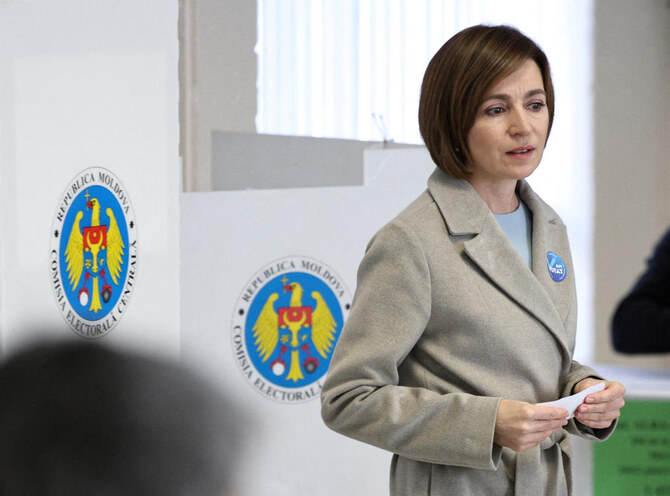

CHISINAU: Moldova handed Russia’s ambassador to Chisinau a protest note on Tuesday over alleged interference by Moscow in a presidential election and a referendum on joining the European Union.
The Moldovan foreign ministry said in a statement that Russia had sought to delegitimize the democratic process of the country’s presidential election, won by pro-Western President Maia Sandu, and an Oct. 20 referendum on inserting a clause in the constitution defining EU membership as a goal.
Moscow has denied the allegations.
“The Ministry of Foreign Affairs presented today to the Ambassador ... a note of protest in connection with the illegal and deliberate interference of the Russian Federation in the electoral process of the Republic of Moldova,” Moldova’s foreign ministry said.
Russian ambassador Oleg Ozerov said of the meeting: “The conversation made it possible to clarify issues related to our acute and complex bilateral relations.”
Moldova has accused Moscow and fugitive oligarch Ilan Shor of meddling throughout the run-up to voting, saying a scheme he ran sought to buy the votes of 300,000 people.
Shor, who lives in Russia, denies wrongdoing. Russia has said the election, in which there were two rounds of voting on Oct. 20 and Nov. 3, was unfair and that it does not see Sandu as the legitimate president.
Ties between Russia and Moldova, which was formerly part of the Soviet Union, have deteriorated as the Moldovan government accelerated the push to integrate with the EU. Last month’s referendum narrowly backed enshrining the wish to join the EU in Moldova’s constitution.
Violation of airspace
Moldova’s foreign ministry also used Tuesday’s meeting with Russia’s ambassador to condemn a violation of its airspace by two drones which it said crashed on its territory on Sunday.
Ozerov said there was no evidence the drones were Russian and that Moscow did not fly drones through countries neighboring Ukraine.
Russia has regularly attacked Ukraine with drones and missiles since its full-scale invasion of Moldova’s neighbor in 2022. Moldova has on several occasions recovered weapons debris on its territory.
It said on Sunday that two Russian “decoy” drones had been found in the northern village of Borosenii Noi and the southern village of Firladeni, after a Russian drone attack on Ukraine. No one was reported hurt.