Ukraine attacks Moscow with 34 drones, biggest strike on the Russian capital

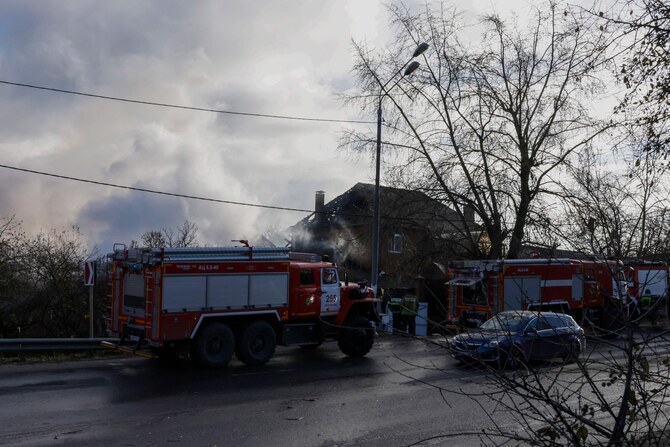
Rescuers stand next to a damaged house following a drone attack in the village of Stanovoye, Moscow region, on November 10, 2024 (AFP)
Short Url
Updated 10 November 2024
Follow

Ukraine attacks Moscow with 34 drones, biggest strike on the Russian capital

  • There was no immediate comment from Ukraine

MOSCOW:  Ukraine attacked Moscow on Sunday with at least 34 drones, the biggest drone strike on the Russian capital since the start of the war in 2022, forcing flights to be diverted from three of the city’s major airports and injuring at least one person.
Russian air defenses destroyed another 36 drones over other regions of Western Russia in three hours on Sunday, the defense ministry said.
“An attempt by the Kyiv regime to carry out a terrorist attack using an airplane-type drones on the territory of the Russian Federation was thwarted,” the ministry said.
Russia’s federal air transport agency said the airports of Domodedovo, Sheremetyevo and Zhukovsky diverted at least 36 flights, but then resumed operations. One person was reported injured in Moscow region.
Moscow and its surrounding region, with a population of at least 21 million people, is one of the biggest metropolitan areas in Europe, alongside Istanbul.
For its part, Russia launched a record 145 drones overnight, Ukraine said. Kyiv said its air defenses downed 62 of those. Ukraine also said it attacked an arsenal in the Bryansk region of Russia, which reported 14 drones had been downed in the region.
Unverified video posted on Russian Telegram channels showed drones buzzing across the skyline.
The 2-1/2-year-old war in Ukraine is entering what some officials say could be its final act after Moscow’s forces advanced at the fastest pace since the early days of the war and Donald Trump was elected 47th president of the United States.
Trump, who takes office in January, said during campaigning that he could bring peace in Ukraine within 24 hours, but has given few details on how he would seek to do this.
When Ukrainian President Volodymyr Zelensky called Trump to congratulate him on his presidential election victory, Tesla CEO and Trump supporter Elon Musk joined the call, according to media reports. Musk owns SpaceX, which provides Starlink satellite communication services that are vital for Ukraine’s defense effort.

Moscow 'Umbrellas'
Kyiv, itself the target of repeated mass drone strikes from Russian forces, has tried to strike back against its vastly larger eastern neighbor with repeated drone strikes against oil refineries, airfields and even the Russian strategic early-warning radar stations.
While the 1,000 km (620 mile) front has largely resembled grinding World War One trench and artillery warfare for much of the war, one of the biggest innovations of the conflict has been drone warfare.
Moscow and Kyiv have both sought to buy and develop new drones, deploy them in innovative ways, and seek new ways to destroy them — from using farmers’ shotguns to advanced electronic jamming systems.
Moscow has developed a series of electronic “umbrellas” over Moscow, with additional advanced internal layers over strategic buildings, and a complex web of air defenses which shoot down the drones before they reach the Kremlin at the heart of the Russian capital.
Both sides have turned cheap commercial drones into deadly weapons while ramping up their own production. Soldiers on both sides have reported the visceral fear of drones — and both sides have used macabre video footage of fatal drone strikes in their propaganda.
Russian President Vladimir Putin, who has sought to insulate Moscow from the grinding rigours of the war, has called Ukrainian drone attacks that target civilian infrastructure such as nuclear power plants “terrorism” and has vowed a response.
Moscow, by far Russia’s richest city, has boomed during the war, buoyed by the biggest defense spending splurge since the Cold War.
There was no sign of panic on Moscow’s boulevards. Muscovites walked their dogs while the bells of the onion-domed Russian Orthodox churches rang out across the capital.


Mistrial declared in the case of Stanford students charged after pro-Palestinian protests in 2024

Updated 6 sec ago
Follow

Mistrial declared in the case of Stanford students charged after pro-Palestinian protests in 2024

SAN FRANCISCO, US: A judge declared a mistrial Friday in the case of five current and former Stanford University students charged after pro-Palestinian protests in 2024, when they barricaded themselves inside the university president and provost executive offices.
The trial in Santa Clara County was a rare instance of demonstrators facing felony charges from protests over the Israel-Hamas war that roiled campuses across the country. The two sides argued over free speech, lawful dissent and crime during the three-week proceedings.
The jury voted 9 to 3 to convict on a felony charge of vandalism and 8 to 4 to convict on a felony charge of conspiracy to trespass. After deliberating for five days, jurors said they could not reach a verdict.
Judge Hanley Chew asked each one if more time deliberating would help break the impasse, and all answered, “No.”
“It appears that this jury is hopelessly deadlocked, and I’m now declaring a mistrial in counts one and two,” Chen said. He then dismissed the jurors.
Demonstrators barricaded themselves inside the offices for several hours on June 5, 2024, the last day of spring classes at the university.
Prosecutors said the defendants spray-painted the building, broke windows and furniture, disabled security cameras and splattered a red liquid described as fake blood on items throughout the offices.
Defense attorneys said the protest was protected speech and there was insufficient evidence of an intent to damage the property. They also said the students wore protective gear and barricaded the offices out of fear of being injured by police and campus security.
If convicted, the defendants would have faced up to three years in prison and been obligated to pay restitution of over $300,000.
Santa Clara County District Attorney Jeff Rosen said he would pursue a new trial.
“This case is about a group of people who destroyed someone else’s property and caused hundreds of thousands of dollars in damage,” Rosen said in a statement. “That is against the law and that is why we will retry the case.”
As the mistrial was announced, the students, some wearing kaffiyehs, sat on a bench in the courtroom and did not show a visible reaction.
“The District Attorney’s Office had Stanford University supporting them and other multibillion-dollar institutions behind them, and even then the district attorney was unable to convict us,” Germán González, who was a sophomore at Stanford when he was arrested, told The Associated Press by phone later. “No matter what happens, we will continue to fight tooth and nail for as long as possible, because at the end of the day, this is for Palestine.”
Authorities initially arrested and charged 12 people in the case, but one pleaded no contest under an agreement that allows some young people to have their cases dismissed and records sealed if they successfully complete probation.
He testified for the prosecution, leading to a grand jury indictment of the others in October of the others. Six of those accepted pretrial plea deals or diversion programs, and the remaining five pleaded not guilty and sought a jury trial.
Protests sprung up on campuses across the country over the Israel-Hamas conflict, with students setting up camps and demanding their universities stop doing business with Israel or companies that support its war efforts against Hamas.
About 3,200 people were arrested in 2024 nationwide. While some colleges ended demonstrations by striking deals with students or simply waited them out, others called in police. Most criminal charges were ultimately dismissed.