BAKU: The first Afghan official to attend UN climate talks since the Taliban came to power told AFP Monday that his country hopes to benefit from a global finance deal under negotiation at COP29 in Baku.
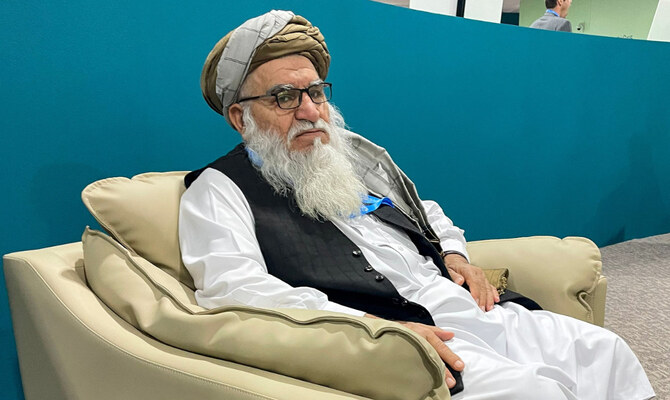
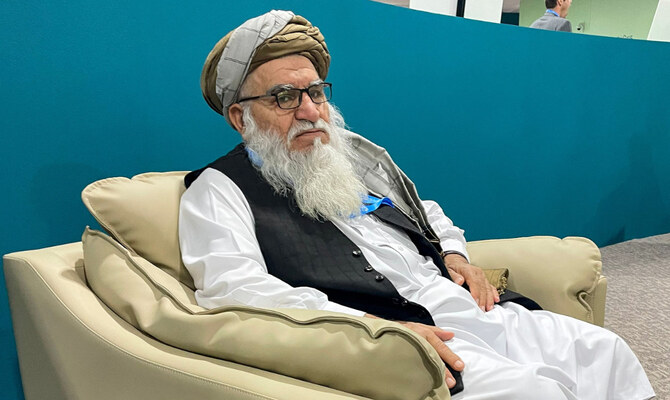
Heading a three-person team, former Taliban negotiator Matiul Haq Khalis stood out in the bustling halls of the conference in Azerbaijan’s capital where delegates from nearly 200 countries began two weeks of talks.
The Taliban-led government, which is not internationally recognized, tried and failed to attend the previous COP (Conference of the Parties) meetings held in Egypt and the United Arab Emirates.
Khalis, director general of Afghanistan’s National Environmental Protection Agency (NEPA), said his team was invited to attend the talks by Azerbaijan’s ecology minister and COP29 president Mukhtar Babayev.
The Afghan delegation is in Baku as “guests” of the hosts, not as a party directly involved in the negotiations.
“I really appreciate” Babayev’s invitation and the Azerbaijani government’s facilitation of visas, said Khalis, son of prominent jihadist figure Mawlawi Yunus Khalis.
His delegation, he told AFP through an interpreter, aims to “deliver the message ... to the world community that climate change is a global issue and it does not know transboundary issues.”
With Afghanistan among the countries most vulnerable to global warming, the Taliban have argued that their political isolation should not bar them from international climate talks.
Khalis said COP29 participants should take into consideration vulnerable countries such as Afghanistan, which are most affected from the effects of climate change, “in their decisions.”
The Taliban treatment of women, however, could be controversial at climate conferences where gender rights always play a part of the discussions.
“Afghan people, especially the most vulnerable, urgently need support from climate finance to recover and adapt,” climate activist Harjeet Singh told AFP.
“However, as the Taliban government seeks to engage in the international process, it is essential that they respect and promote universal fundamental rights — particularly women’s rights within the country,” he said.
Women and children in particular “are bearing the brunt” of climate change, Sanjay Vashist, director of the Climate Action Network South Asia (CANSA) told AFP.
While the Taliban are barred from the negotiations, “the world cannot abandon the people of Afghanistan who are suffering from the triple whammy of the climate crises, gross human rights violations and extreme poverty,” Vashist said.
Asked about the gender issue, Khalis told AFP that the implementation of climate change projects “boost” women as well.
Azerbaijan’s COP29 presidency did not immediately respond to a request for comment on the invitation.
Azerbaijan reopened its embassy in Kabul in February this year, though it has not officially recognized the Taliban government.
Developed countries have committed to providing $100 billion per year in climate finance through 2025 to help developing nations prepare for worsening climate impacts and wean their economies off fossil fuels.
Developing nations are calling for trillions of dollars, but Babayev said Monday a more “realistic goal” was somewhere in the hundreds of billions.
“Our people in Afghanistan also should access” such funds “as a right (over) climate change,” Khalis said, describing it has his country’s “main expectation” at COP29.
Among the poorest countries in the world after decades of war, Afghanistan is particularly exposed to the effects of climate change, which scientists say is spurring extreme weather.
Drought, floods, land degradation and declining agricultural productivity are key threats, the UN development agency’s representative in Afghanistan, Stephen Rodriques, said in 2023.
Flash floods in May killed hundreds and swamped swaths of agricultural land in Afghanistan, where 80 percent of people depend on farming to survive.
Khalis said Afghanistan was seeking to attend next year’s climate summit in Brazil as an official party to the talks.
“We are very interested to be as a party in the COP30 in Brazil,” he said.
“This is the right of the people, the climate justice for the people that’s actually most vulnerable communities to the impact of climate change.”


Taliban eye aid at their first UN climate talks since 2021 takeover
https://arab.news/8jwke
Taliban eye aid at their first UN climate talks since 2021 takeover
- The Afghan delegation is in Baku as “guests” of the hosts, not as a party directly involved in the negotiations


94 million need cataract surgery, but access lacking: WHO
- Of the 94 million affected, fewer than 20 percent are blind, while the rest suffer from impaired vision
GENEVA: More than 94 million people suffer from cataracts, but half of them do not have access to the surgery needed to fix it, the World Health Organization said Wednesday.
Cataracts — the clouding of the eye’s lens that causes blurred vision and can lead to blindness — are on the rise as populations get older, with age being the main risk factor.
“Cataract surgery — a simple, 15-minute procedure — is one of the most cost-effective medical procedures, providing immediate and lasting restoration of sight,” the WHO said.
It is one of the most frequently performed surgeries undertaken in high-income countries.
However, “half of the world’s population in need of cataract surgery don’t have access to it,” said Stuart Keel, the UN health agency’s technical lead for eye care.
The situation is worst in the WHO’s Africa region, where three in four people needing cataract surgery remain untreated.
In Kenya, at the current rate, 77 percent of people needing cataract surgery are likely to die with their cataract blindness or vision impairment, said Keel.
Across all regions, women consistently experience lower access to care than men.
Of the 94 million affected, fewer than 20 percent are blind, while the rest suffer from impaired vision.
- 2030 vision -
The WHO said that over the past two decades, global cataract surgery coverage had increased by 15 percent.
In 2021, WHO member states set a target of a 30-percent increase by 2030.
However, current modelling predicts that cataract surgery coverage will rise by only about 8.4 percent this decade.
To close the gap, the WHO urged countries to integrate eye examinations into primary health care and invest in the required surgical equipment.
States should also expand the eye-care workforce, training surgeons in a standardised manner and then distributing them throughout the country, notably outside major cities.
The WHO was on Wednesday launching new guidance for countries on how to provide quality cataract surgery services.
It will also issue guidance to help support workforce development.
Keel said the main issue was capacity and financing.
“We do need money invested to get rid of this backlog, which is nearly 100 million people,” he told a press conference.
While age is the primary risk factor for cataracts, others include prolonged UV-B light exposure, tobacco use, prolonged corticosteroid use and diabetes.
Keel urged people to keep up regular eye checks as they get older, with most problems able to be either prevented or diagnosed and treated.
The cost of the new lens that goes inside the eye can be under $100.
However, out-of-pocket costs can be higher when not covered by health insurance.
“Cataract surgery is one of the most powerful tools we have to restore vision and transform lives,” said Devora Kestel, head of the WHO’s noncommunicable diseases and mental health department.
“When people regain their sight, they regain independence, dignity, and opportunity.”


