



RIYADH: Global leaders called for increased funding, more carbon markets, and greater international cooperation to address the escalating environmental crisis, as the 29th UN Climate Summit officially began in Azerbaijan.
During the opening day of COP29, Azerbaijan’s Minister of Ecology and Natural Resources, Mukhtar Babayev, took over the presidency from Sultan Ahmed Al-Jaber, who led the previous summit in Dubai last year.
In his address at the gathering in Baku, Babayev stated that the world is already experiencing the negative impacts of climate change and stressed the importance of international collaboration to combat these challenges.
He emphasized that the primary goal of the COP29 presidency is to agree on a fair, ambitious, and collective climate finance target that is both effective and sufficient to address the scale and urgency of the crisis.
“We understand the political and financial constraints. These numbers may sound big, but they are nothing compared to the cost of inaction. These investments pay off,” he said.
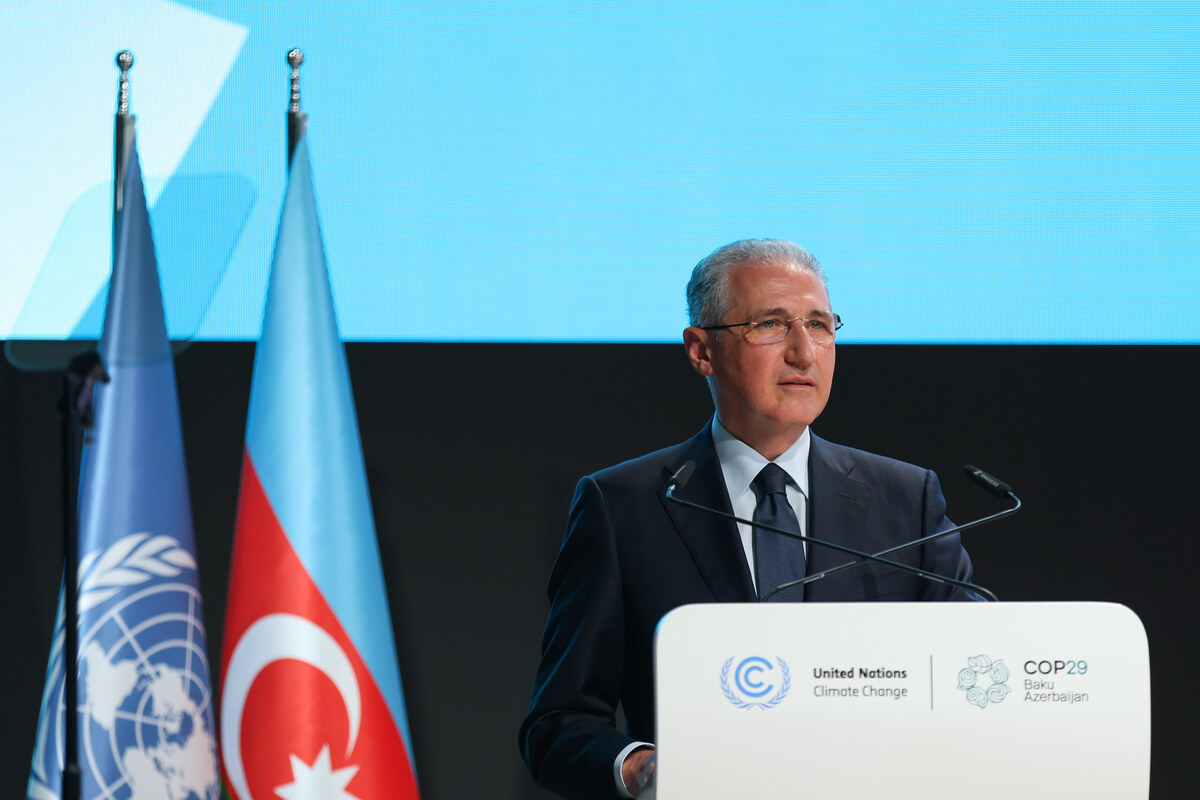
Azerbaijan’s Minister of Ecology and Natural Resources, Mukhtar Babayev. UN Climate Change
Babayev also highlighted the importance of finalizing Article 6 of the 2015 Paris Agreement, which focuses on the development of carbon markets where countries, companies and individuals can trade greenhouse gas emissions credits.
That deal called for limiting the global temperature increase to 1.5 degrees Celsius above pre-industrial levels.
“We are determined to get Article 6 in high-integrity carbon markets over the line. Article 6 is long overdue, and it will help protect the planet by matching buyers and sellers efficiently. We need to get this right, and we need to get this done on time, including transitioning away from fossil fuels in a just and orderly manner,” added the COP29 president.
Babayev also underscored the critical need for increased funding for climate efforts, urging governments, the private sector, and multilateral financial institutions to collaborate to meet the Paris Agreement’s goals.
“COP29 is a moment of truth for the Paris Agreement. It will test our commitment to the multilateral climate system. We must now demonstrate that we are prepared to meet the goals we have set for ourselves,” said Babayev.
He added that the world should accelerate investments in the energy sector today to save tomorrow.
“We are on a road to ruin. But these are not future problems. Climate change is already here. Whether you see it or not, people are suffering in the shadows. They are dying in the dark, and they need more than compassion, more than prayers, and more than paperwork. They are crying out for leadership and action,” said Babayev.
He added: “No single country or initiative can solve this crisis. This is everyone’s conference. Success or failure will be collective. Azerbaijan can build a bridge, but you all need to walk across it. In fact, we need to start running. Let us move forward in solidarity for a green world.”

Babayev took over the presidency from the UAE’s Sultan Ahmed Al-Jaber. UN Climate Change
Impacts of climate change
During the opening ceremony, Simon Stiell, executive secretary of the UN Framework Convention on Climate Change, warned that global warming is affecting every aspect of human life, urging immediate action to mitigate further damage.
“Do you want your grocery and energy bills to go up even more? Do you want your country to become economically uncompetitive? Do you really want even further global instability, costing precious lives? This crisis is affecting every single individual in the world in one way or another,” said Stiell.
He added: “We must agree on a new global climate finance goal. If at least two-thirds of the world’s nations cannot afford to cut emissions quickly, then every nation pays a brutal price.”
Stiell emphasized that climate finance is not charity but a matter of self-interest for every nation, including the wealthiest.
“We must work harder to reform the global financial system, giving countries the fiscal space they so desperately need,” he said.
Stiell also highlighted the importance of finalizing Article 6 and said that international carbon markets will play a crucial role in accelerating the energy transition journey.
“We need to move forward on mitigation, so targets from Dubai are realized. We mustn’t let 1.5 degrees Celsius slip out of reach. And even as temperatures rise, the implementation of our agreements must claw them back,” said Stiell.
He noted that clean energy infrastructure investments are expected to reach $2 trillion in 2024, nearly double that of fossil fuels.
Stiell also emphasized the global responsibility to accelerate the transition to renewable energy and ensure that the benefits are shared by all countries and people.
“We must agree on adaptation indicators. You can’t manage what you don’t measure. We need to know if we’re on a pathway to increasing resilience. We must continue to improve the new mechanisms for financial and technical support on loss and damage,” he said.
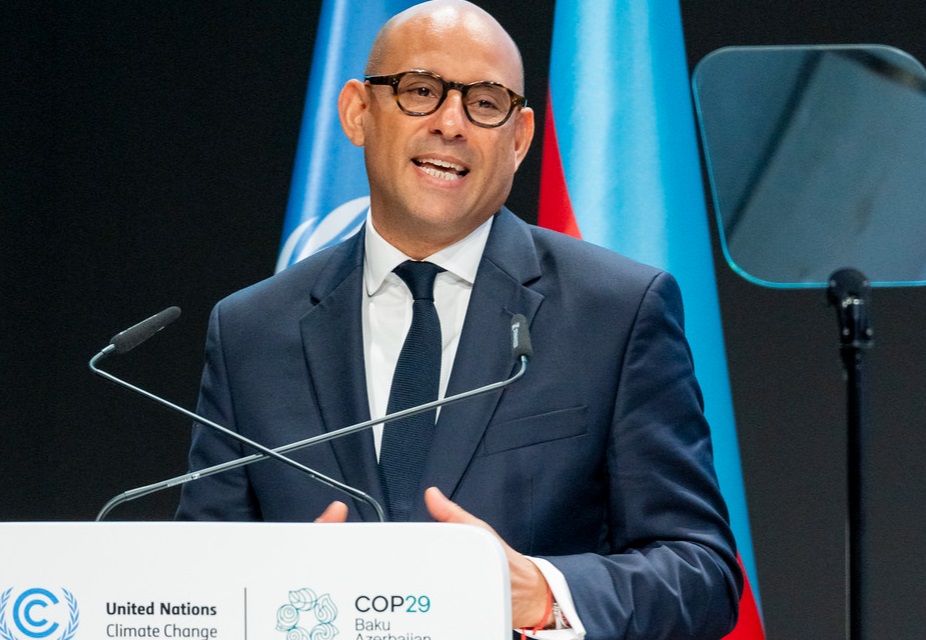
Simon Stiell, executive secretary of the UN Framework Convention on Climate Change. UN Climate Change
Stiell also stressed the importance of transparency to meet climate goals, with Biennial Transparency Reports, due this year, expected to provide a clearer picture of progress in the climate action journey.
Stiell added: “Now is the time to show that global cooperation is not down for the count. It’s rising to this moment. So, let’s rise together.”
Journey since COP28
In a brief address during the opening ceremony, Sultan Al-Jaber, president of COP28, reflected on the successes of last year’s summit, noting the momentum gained through climate initiatives launched in Dubai.
“By delivering the historic, comprehensive, balanced, and groundbreaking UAE Consensus, we accomplished what many thought was impossible. In the months since COP28, the initiatives we launched have gathered real momentum and pace,” said Al-Jaber.
He added that the world is set to break another record on renewable energy growth this year, adding over 500 gigawatts to global capacity.
“Fifty-five companies have now joined the oil and gas decarbonization charter, committing to zero methane emissions by 2030, and net zero by or before 2050,” said Al-Jaber.
During COP28, nearly 200 countries agreed to work toward an ambitious set of global energy objectives as part of the outcome known as the UAE Consensus, pledging to achieve net zero emissions from the global energy sector by 2050.
The promise also includes transitioning away from fossil fuels, tripling renewable energy capacity, and doubling the rate of energy efficiency improvements by the end of this decade.
Al-Jaber, who is also the UAE Minister of Industry and Advanced Technology, stressed the importance of cross-sector cooperation to meet climate goals.
“Earlier this month in Abu Dhabi, we convened experts in climate, energy, artificial intelligence, finance, and investment in an integrated effort to drive low-carbon growth. When sectors work together, we can lift economies and lower emissions. We can make climate and socio-economic progress together at the same time,” he said.
Al-Jaber also highlighted the progress of Alterra, the world’s largest global catalytic climate fund, which has already allocated $6.5 billion of its $30 billion fund.
“We have also made progress on the loss and damage fund. $853 million has been pledged to date. The consensus we achieved in Dubai was truly historic. History will judge us by our actions, not by our words,” said Al-Jaber.
“Let positivity prevail and let it power the process. Let actions speak louder than words. Let results outlast the rhetoric. We are what we do, not what we say,” he added.


