Child, pregnant woman among 7 killed in Israeli strikes on Tyre

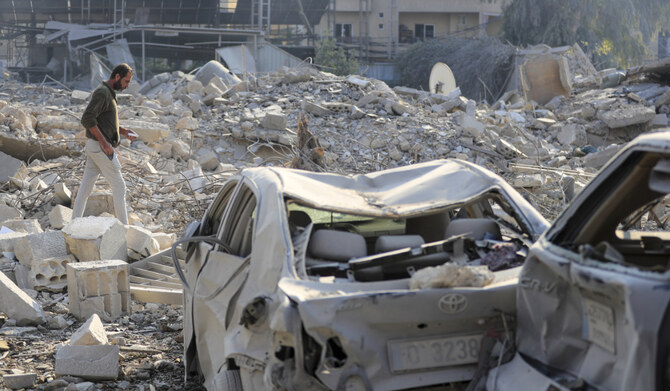
A resident checks the site of an Israeli airstrike in Tyre, southern Lebanon, Saturday, Nov. 9, 2024. (AP)
Short Url
Updated 09 November 2024
Follow

Child, pregnant woman among 7 killed in Israeli strikes on Tyre

  • PM Mikati gains support in efforts to end Lebanon conflict on eve of OIC summit
  • Israel accused of ‘scorched-earth policy’ after 22 border towns devastated

BEIRUT: Lebanon’s Health Ministry said on Saturday that seven people, including a child and a pregnant woman, were killed and 46 others injured in Israeli strikes on the southern city of Tyre the previous day, with rescuers still searching for those missing under the rubble.

Repeated airstrikes on the city’s neighborhoods brought down buildings, trapping residents.

The strikes hampered civil defense rescue efforts during the night. Rescuers resumed work early on Saturday in search of the missing.

Israeli airstrikes on the city of Nabatieh devastated one of the country’s most important heritage homes owned by the late former minister Rafiq Shaheen.

Another heritage home belonging to Kamal Daher, which previously served as the headquarters for the Cultural Council of South Lebanon, was also destroyed.

Airstrikes targeting the western Bekaa region killed six people.

Hezbollah continued its military operations, and Israeli media reported in the afternoon that several rockets landed in Metula, damaging a house.

The group said it targeted a military gathering on the border of the settlement.

Airstrikes on the south continued along with Hezbollah’s responses.

Mohammed Shamseddine, a researcher from Information International, said that Israel had so far destroyed 22 border towns out of 29 locations along the 120 km front stretching from Ras Al-Naqoura in the west, through the western and central sectors, and reaching the Shebaa farms in the east, near the Syrian border.

Shamseddine accused Israel of “adopting a scorched-earth policy in these areas.”

He said Israel was “destroying everything and leaving no signs of life to prevent residents from returning to any potential settlement in the future.”

Shamseddine estimated that up to 44,000 housing units had been destroyed, with the cost of reconstruction reaching $4.2 billion.

Hostilities continued as the Supreme Islamic Shariah Council emphasized Lebanon’s need to “restore its decision, role, power, and status, and implement the constitution and the Taif agreement.”

The council said that it stands by “caretaker Prime Minister Najib Mikati’s efforts to overcome the ordeal faced by Lebanon and contain the consequences of the Israeli aggression against the country.”

The council’s stance came on the eve of Miktai’s departure for Riyadh to take part in the extraordinary summit of the Organization of Islamic Cooperation.

Saudi Arabia is convening the talks to address Israel’s aggression in Gaza and Lebanon, as well as the resulting devastation.

The Shariah Council, which includes all Sunni segments, called for “the need to live within the state, accept the idea of the state, respect its laws and constitution, and subject oneself to its authority.”

The council said that “outside the state, we are conflicting groups, communities, and tribes,” adding that “the state of the constitution, institutions, and human dignity can save Lebanon and restore its economic stability, advancement, and prosperity.”

The council, led by Lebanon’s Grand Mufti Sheikh Abdul Latif Derian, met on Saturday with Mikati.

It called on the UN Security Council to “secure an immediate ceasefire in Lebanon, compel Israel to implement the ceasefire, and apply the UN Charter, which calls for pacific settlement of disputes.”

It added that Israel no longer abided by the charter, and should lose its UN membership.

The Shariah Council urged “the Security Council to answer the Lebanese state’s call and immediately implement UN Resolution 1701 in full, thereby ensuring the end of the war and enabling the Lebanese armed forces to exercise their national right to defend Lebanon, while providing them with all the capabilities and possibilities to fulfill this role.”

The council criticized Hezbollah’s support indirectly, saying that “what has happened and is still happening now is a challenging test that we hope we have learned from, as it has led to the destruction of the whole country.”

The council urged “the state, with all its institutions, and all Lebanese to support the displaced people, provide them with resilience and health care means, and preserve civil peace.”

Israeli hostilities against Lebanon escalated in the past 24 hours.

A video featuring several Israeli soldiers invading houses in southern Lebanon was shared on social media, prompting widespread anger among Lebanese.

Israeli media reported on Saturday afternoon that explosions were heard after sirens sounded in the Krayot and Western Galilee, adding that Hezbollah fired 10 rockets targeting Nahariya, Acre, and Krayot.

Hezbollah said that it shot down a Hermes 450 drone with a surface-to-air missile over Deir Seriane and that Israeli warplanes attacked the town.

The southern suburbs of Beirut and the southern region experienced intense Israeli assaults from Friday night into early Saturday.

For two hours, 14 airstrikes targeted the southern suburbs of Beirut.

Targeted locations included Hadath, Burj Al-Barajneh, Haret Hreik, and the Al-Jamous neighborhood, with operations extending to the area surrounding the Lebanese University building in Hadath.

Israeli army spokesperson Avichay Adraee said that the “airstrikes, guided by precise intelligence from the military intelligence agency, targeted command centers, a weapons production site, and other infrastructure belonging to the terrorist organization Hezbollah in the southern suburbs of Beirut.”

The assertion made by the Israeli army that it avoids targeting civilians by issuing prior evacuation warnings did not hold for the southern region, particularly in Tyre.


Israel plans large camp for Palestinians in southern Gaza, retired general says

Updated 7 sec ago
Follow

Israel plans large camp for Palestinians in southern Gaza, retired general says

  • Avivi said the camp would be used to house Palestinians who wish to leave Gaza and cross into Egypt as well as those who wish to stay

JERUSALEM, Jan 27 : Israel has cleared land in southern Gaza for the construction of a camp for Palestinians potentially equipped with surveillance and facial recognition technology at its entrance, a retired Israeli general who advises the military said on Tuesday.
Retired reservist Brig.-General Amir Avivi told Reuters in ​an interview that the camp would be built in an area of Rafah cleared of tunnels built by Hamas, with entry and exit tracked by Israeli personnel.
Avivi is founder of the influential Israel Defense and Security Forum, a group representing thousands of Israeli military reservists. He does not speak on behalf of Israel’s military, which declined to comment. The Israeli prime minister’s office did not immediately provide comment on any plans to build a camp in Rafah.
Avivi said the camp would be used to house Palestinians who wish to leave Gaza and cross into Egypt as well as those who wish to stay.
His comments come as Israel prepares for a “limited reopening” of Gaza’s Rafah border crossing with Egypt, a key requirement under US President Donald Trump’s plan to end the Gaza war.
Sources told Reuters this month that Israel wants to ensure more Palestinians leave ‌Gaza than are allowed ‌in. Israeli officials have spoken in the past about encouraging Gazans to emigrate, though they deny ‌intending ⁠to ​transfer the ‌population out by force — a highly sensitive issue for Palestinians.
“There are no Gazans, almost at all, in Rafah,” Avivi said. The area fell under complete Israeli military control following an October Israel-Hamas ceasefire, and most Palestinians fled for areas held by Hamas.
“You need to build infrastructure in Rafah that can host them, and then they can choose if they want to go or not,” Avivi said. He said the structure would likely be “a big, organized camp” capable of hosting hundreds of thousands of people that could enforce ID checks including facial recognition.
In July, Israel’s Defense Minister Israel Katz told Israeli media that he had ordered troops to prepare a camp in Rafah to house Gaza’s population. Officials have not spoken publicly about such plans since then.
Ismail Al-Thawabta, head ⁠of the Hamas-run Gaza government media office, told Reuters in a statement that the idea amounted to cover for “forced displacement.”

POTENTIAL RETURN TO WAR
Palestinians in Gaza, shattered by two years of Israeli attacks ‌in the enclave, have long faced restrictions on their movement and monitoring of their ‍online activity and phone calls by Israeli surveillance agencies.
Nearly all of Gaza’s ‍2 million people have been forced into a narrow coastal strip from which Israeli forces withdrew under the ceasefire and where Hamas ‍has retained control.
Trump’s plan for Gaza, now in its second phase, calls for Gaza’s reconstruction to start in Rafah and for Hamas to lay down its arms in exchange for further Israeli troop withdrawals from the territory.
Avivi said Israel’s military was preparing for a new offensive against Hamas if it refuses to give up its weapons. This could include relaunching attacks on Gaza City, the enclave’s largest.
The camp in Gaza could be used to house Palestinians fleeing a renewed Israeli ​assault, Avivi said.
“Plans are set. The army is ready to get the command from the government, from the cabinet to renew its maneuvers in Gaza,” Avivi said.
Israel’s military says it has continued to carry out operations in Gaza since ⁠the ceasefire to thwart what it describes as planned attacks by militants and destroy Hamas’ tunnel network under Gaza.
Israeli attacks since the ceasefire have killed more than 480 Palestinians in Gaza, health authorities there say, while the military says four soldiers have been killed in militant attacks.
Avi Dichter, a minister in Israeli Prime Minister Benjamin Netanyahu’s cabinet and former head of Israel’s domestic intelligence service, said disputes over disarmament could lead Israel back into war in Gaza.
“We have to get prepared for the war in Gaza,” Dichter told Reuters, adding that the disarmament issue “will have to be solved by Israeli troops, the hard way.”

DEMILITARIZATION GOAL
Hamas has publicly refused to lay down its weapons. Two Hamas officials told Reuters this week that neither Washington nor the mediators had presented the group with any detailed or concrete disarmament proposal.
According to a document shared by the White House last week, the Trump administration wants to see heavy weapons decommissioned immediately, with “personal arms registered and decommissioned by sector” as the police under an interim technocratic administration in Gaza “become capable of guaranteeing personal security.”
Trump has repeatedly warned Hamas that it would have “hell to pay” if it does not lay down its weapons.
A US official said on Tuesday that disarmament ‌could come along with some sort of amnesty for Hamas members.
Speaking to Israel’s parliament on Monday night, Netanyahu said the next phase of the ceasefire would not include reconstruction of Gaza.
“The next phase is demilitarization of the Strip and disarming Hamas,” Netanyahu said.