Officials say Qatar decides to suspend Gaza mediation efforts

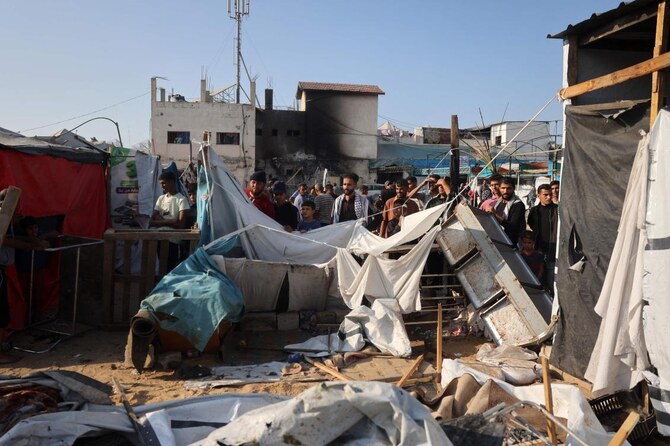
Displaced Palestinians check the damage following an Israeli strike that hit tents set up in the vicinity of the Al-Aqsa Martyrs hospital in Deir el-Balah in the central Gaza Strip on November 9, 2024, amid the ongoing war between Israel and Hamas. (AFP)
Short Url
Updated 09 November 2024
Follow

Officials say Qatar decides to suspend Gaza mediation efforts

  • Qatar’s announcement comes after growing frustration with the lack of progress on a ceasefire deal
  • Senior Hamas official said aware of decision, “but no one told us to leave”

DEIR AL-BALAH, Gaza Strip: Qatar has decided to suspend its key mediation efforts between Hamas and Israel, officials said Saturday.
However, Qatar is highly likely to return to the efforts if both sides show “serious political willingness” to reach a deal on the war in Gaza, according to one official with Egypt, the other key mediator.
A diplomatic source briefed on the matter said Israel and Hamas, along with the United States, were informed after the decision was made. The source added that “as a consequence, the Hamas political office no longer serves its purpose” in Qatar.
A senior Hamas official said they were aware of Qatar’s decision to suspend mediation efforts, “but no one told us to leave.”
Qatar’s announcement comes after growing frustration with the lack of progress on a ceasefire deal.
“After rejecting repeated proposals to release hostages, (Hamas) leaders should no longer be welcome in the capitals of any American partner. We made that clear to Qatar following Hamas’ rejection weeks ago of another hostage release proposal,” a US senior administration official said.
The officials spoke on condition of anonymity because of the sensitivity of the issue. The Israeli prime minister’s office had no comment.
Meanwhile, three separate Israeli strikes killed at least 16 people, including women and children, in Gaza on Saturday, Palestinian medical officials said, and Israel announced the first delivery of humanitarian aid in weeks to hungry, devastated northern Gaza.
There continued to be no end in sight to Israel’s campaigns against Hamas militants in Gaza or Hezbollah in Lebanon, where Israel’s military said that it struck command centers and other militant infrastructure overnight in Beirut’s southern suburbs. An Israeli airstrike on the southern port city of Tyre late Friday left at least seven dead, officials and a resident said.
One of the strikes in Gaza hit a school-turned-shelter in Gaza City’s eastern Tufah neighborhood, killing at least six people, the territory’s Health Ministry said. Two local journalists, a pregnant woman and a child were among the dead, it said. The Israeli army said the strike targeted a militant belonging to the Palestinian Islamic Jihad group, offering no evidence or details.
Seven people were killed when an Israeli strike hit a tent in the southern city of Khan Younis where displaced people were sheltering, according to Nasser Hospital. It said the dead included two women and a child. The Israeli army didn’t immediately respond to a request for comment.
And Palestinian medical officials said an Israeli strike hit tents in the courtyard of central Gaza’s main hospital, including one serving as a police point. At least three people were killed and a local journalist was wounded, Al-Aqsa Martyrs hospital in Deir Al-Balah said. It was the eighth Israeli attack on the compound since March.
Israel says aid trucks reach northern Gaza
The Israeli military body in charge of humanitarian aid to Gaza, COGAT, said Saturday that 11 aid trucks containing food, water and medical equipment reached the enclave’s far north on Thursday. It’s the first time any aid has reached the far north since Israel began a new military campaign there last month.
But not all the aid reached the agreed drop-off points, according to the the UN World Food Program, which was involved in the delivery process. In the urban refugee camp of Jabaliya, Israeli troops stopped one convoy bound for nearby Beit Lahiya and ordered the supplies to be offloaded, WFP spokesperson Alia Zaki said.
Israel’s offensive has focused on Jabaliya, where Israel says Hamas had regrouped. Other areas affected include Beit Lahiya and Beit Hanoun just north of Gaza City.
US deadline is looming for Israel
The aid announcement came days before a US deadline demanding that Israel improve aid deliveries across Gaza or risk losing access to US weapons funding.
The US says Israel must allow a minimum of 350 trucks a day carrying food and other supplies.
Meanwhile, a report by the Integrated Food Security Phase Classification, or IPC, issued Thursday said there’s a strong likelihood that famine is imminent in parts of northern Gaza, the territory’s most isolated area.
COGAT rejected the IPC’s finding and said the report relied “on partial, biased data and superficial sources with vested interests.”
No emergency services functioning north of Gaza City
The UN estimates that tens of thousands of people remain in northern Gaza. Earlier this week, the Health Ministry said there were no ambulances or emergency crews operating north of Gaza City.
The conflict has left 90 percent of Palestinians in Gaza displaced, according to UN figures. Israel’s army has struck several schools and tent camps packed with tens of thousands of Palestinians driven from their homes by Israeli offensives and evacuation orders.
The military has accused Hamas of operating from within civilian infrastructure in Gaza, including schools, UN facilities and hospitals.
More than a year of war in Gaza has killed more than 43,000 people, Palestinian health officials say. They don’t distinguish between civilians and combatants, but say more than half of those killed were women and children.
The war began after Palestinian militants stormed into Israel on Oct. 7, 2023, killing around 1,200 people — mostly civilians — and abducting 250 others.
___
Samy Magdy reported from Cairo. Matthew Lee in Washington, and Jack Jeffery in Ramallah, West Bank, contributed to this report.
___
Follow AP’s war coverage at https://apnews.com/hub/israel-hamas-war


A father awaits Rafah crossing reopening after 2-year separation from family in Gaza

Updated 4 sec ago
Follow

A father awaits Rafah crossing reopening after 2-year separation from family in Gaza

  • Belal, 51, has packed his suitcases, bought gifts for his children, and is ready to go as soon as he is allowed
  • Gaza has been closed to entry for Palestinians since Israel launched its retaliatory campaign against Hamas for its Oct. 7, 2023, attack on southern Israel

BADRASHIN, Egypt: Stranded in Egypt for the past two years, Raed Belal has had to watch helplessly as his wife and children in the Gaza Strip endured bombardment, displacement and hunger. Now he finally has hope he might return to them.
With Israel preparing to reopen the vital Rafah crossing between Egypt and Gaza, Belal, 51, has packed his suitcases, bought gifts for his children, and is ready to go as soon as he is allowed.
“It’s the moment I have been waiting for,” he said, speaking at the rented apartment where he has been living in the Egyptian village of Badrashin. “The moment when I reunite with my children, when I return to my home and homeland, even if everything is destroyed.”
Belal, who left Gaza to get treated for back pain three months before the war broke out, is one of tens of thousands of Palestinians eager to return to the territory, despite the vast destruction wreaked by Israel’s military campaign against Hamas. The Rafah border crossing is expected to reopen within days, a process jump-started by Israel’s recovery on Monday of the last hostage’s remains in Gaza, where a ceasefire with Hamas has held for four months.
Gaza has been closed to entry for Palestinians since Israel launched its retaliatory campaign against Hamas for its Oct. 7, 2023, attack on southern Israel. In the first months of the war, some 110,000 Palestinians were able to leave Gaza. The Rafah crossing was completely closed in May 2024 when Israeli troops took it over.
Since then, people like Belal have been trapped abroad – most of them in Egypt. Many feared Israel would never allow them back to Gaza.
A ‘limited opening’ of the Rafah crossing
Still, Palestinians will likely face a long wait before going home even after Rafah reopens. Israel intends to keep returns to a trickle.
The exact date of Rafah’s reopening has not been announced. Israeli Prime Minister Benjamin Netanyahu on Tuesday called it a “limited opening,” saying 50 Palestinians a day would be allowed into Gaza and that Israel will keep tight control over who enters, subject to security inspections. Before the war, several hundred people a day would enter Gaza from Egypt.
So far, some 30,000 Palestinians have registered with the Palestinian Embassy in Egypt to return to Gaza, according to an embassy official, speaking on condition of anonymity because details of the reopening remain under discussion.
Hamas in a statement Monday called on Israel to open the Rafah crossing in both directions “without restrictions.” Ali Shaath, head of the new Palestinian committee administering Gaza’s daily affairs, last week said the crossing would be opened this week to facilitate movement into and out of the territory.
Palestinians are also hoping that the crossing’s reopening will mean medical evacuations out of Gaza will increase. Some 20,000 Palestinians needing urgent treatment abroad for war wounds or chronic medical conditions have been waiting for evacuation, according to the Gaza Health Ministry.
Throughout the war, the numbers allowed out have been low. The ceasefire since October brought only a tiny uptick, with an average of only 25 medical evacuations a week, according to UN figures.
Watching his family’s trauma from afar
Belal, who owned a mobile phone store in the northern Gaza town of Beit Lahiya, left the territory in July 2023 to get treatment for his back. Weeks later, Hamas launched its attack on Israel, Israel’s massive bombardment of Gaza began, and Gaza’s borders slammed shut.
Belal was stranded, struggling to keep up with the turmoil that had enveloped his loved ones.
A few days into the war, he got a video call from his sons, who were rushing to move the merchandise out of the shop after they got a warning from the Israeli military that it was about to bomb the building, where both the shop and their family home was located.
The strike demolished the building, and Belal’s 15-year-old son Younis was wounded in the back, he said. At first, doctors said he might be paralyzed, but after months of treatment he was able to walk again.
That began a long trek for his wife and children, who were displaced 12 times over the course of the war. They first moved to a neighbor’s house, but that was bombed the next day. They sheltered for several weeks along with other displaced families in the nearby Indonesian Hospital, until Israeli forces besieged and raided the facility, forcing them to flee again in November 2023.
They eventually made it to a school-turned-shelter in the southern city of Khan Younis, but soon after Israeli forces invaded the area and they had to move again.
Sometimes, Belal spent days unable to reach his family because of communication blackouts.
One of his brothers, Mohammed, was killed along with his 2-year-old child when Israel bombed the school where they were sheltering in the Shati Refugee camp in northern Gaza in mid-2025.
At one point last year, Belal got a phone call from Gaza City’s Shifa Hospital telling him that his son Younis had been killed. They sent him a photo of the body of someone who looked like Younis. He couldn’t reach his family, and it was only after a day of torment that he was able to call them and learned it was a case of mistaken identity.
“Being far away, while your children and family were in such a situation is awful. You live in constant fear; you don’t eat because you’re thinking about your hungry children,” Belal said. “Sometimes you wake up at night, terrified. You rush to the phone and call them to make sure that they are OK.”
A family reunion that can’t come soon enough
Belal’s wife and five children now shelter in a tent in Gaza City, depending on charity kitchens for food. Belal has been sending them money when he can, but his wife, Asmahan, told the AP their savings have almost run out and they’ve had to borrow money from others to get by.
Asmahan said she has had to bear the burden of moving from place to place and keeping her children fed and safe.
“I’m mentally exhausted. The responsibility is immense,” she said. “We have been humiliated and degraded.”
“God willing, the crossing will open, my husband will return, and we will be reunited,” she said.
Belal’s brother, Jaber, left Gaza on Oct. 1, 2023, seeking a job in the West Bank. After the war began, Israel launched a crackdown in the occupied territory, carrying out destructive raids targeting armed groups and imposing tough restrictions on movement.
“Life became impossible in the West Bank,” Jabel said. So in February he joined his brother in Egypt, and he married an Egyptian woman in June. He, too, has registered to return to Gaza with his wife.
“This is our land. Our house is there, even though it’s destroyed. We will rebuild it and rebuild Gaza,” Jaber said.
Raed Belal knows it may still be a long time. After news of Rafah’s opening came, he said, his children “think it will happen tomorrow.” But it could be months, he said, before he presents the gifts he has bought for his children – shoes and clothes for his teenage sons, and makeup and perfume requested by his 8-year-old daughter.
With his bags packed, he is ready.