India’s Modi rejects calls to restore Kashmir’s partial autonomy

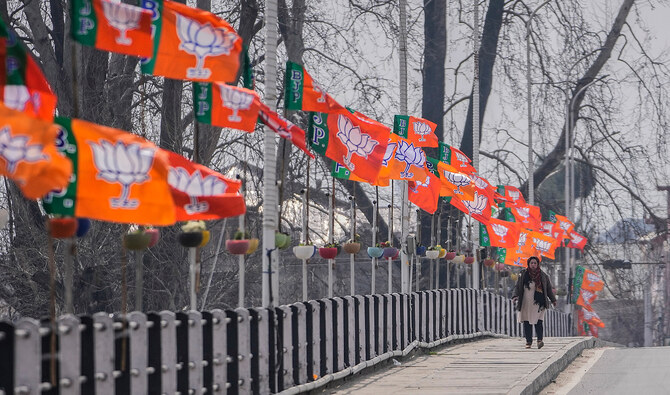
A woman walks past India’s ruling Bharatiya Janata Party (BJP) party flags displayed ahead of the Indian Prime Minister Narendra Modi’s visit to Srinagar, Indian administered Kashmir, on March 6, 2024. (AP/File)
Short Url
Updated 08 November 2024
Follow

India’s Modi rejects calls to restore Kashmir’s partial autonomy

  • Modi revoked partial autonomy in 2019 and split the state into the two federally administered territories of Jammu and Kashmir and Ladakh 
  • Jammu and Kashmir held its first local election in a decade this year, newly-elected lawmakers passed resolution this week seeking restoration

NEW DELHI: Indian Prime Minister Narendra Modi strongly backed his government’s contentious 2019 decision to revoke the partial autonomy of Jammu and Kashmir, days after the territory’s newly elected lawmakers sought its restoration.
“Only the constitution of Babasaheb Ambedkar will operate in Kashmir... No power in the world can restore Article 370 (partial autonomy) in Kashmir,” Modi said, referring to one of the founding fathers of the Indian constitution.
Modi was speaking at a state election rally in the western state of Maharashtra, where Ambedkar was from.
Modi’s Bharatiya Janata Party (BJP) government revoked partial autonomy in 2019 and split the state into the two federally administered territories of Jammu and Kashmir and Ladakh — a move that was opposed by many political groups in the Himalayan region.
Jammu and Kashmir held its first local election in a decade in September and October and the newly-elected lawmakers passed a resolution this week seeking the restoration.
Jammu and Kashmir’s ruling National Conference party had promised in its election manifesto that it would restore the partial autonomy, although the power to do so lies with Modi’s federal government.
Jammu and Kashmir’s new lawmakers can legislate on local issues like other Indian states, except matters regarding public order and policing. They will also need the approval of the federally-appointed administrator on all policy decisions that have financial implications.
Under the system of partial autonomy, Kashmir had its own constitution and the freedom to make laws on all issues except foreign affairs, defense and communications.
The troubled region, where separatist militants have fought security forces since 1989, is India’s only Muslim-majority territory.
It has been at the center of a territorial dispute with Pakistan since the neighbors gained independence from British colonial rule in 1947.
Kashmir is claimed in full but ruled in part by both India and Pakistan, which have fought two of their three wars over the region.


UN’s top court opens Myanmar Rohingya genocide case

Updated 12 January 2026
Follow

UN’s top court opens Myanmar Rohingya genocide case

  • The Gambia filed a case against Myanmar at the UN’s top court in 2019
  • Verdict expected to impact Israel’s genocide case over war on Gaza

DHAKA: The International Court of Justice on Monday opened a landmark case accusing Myanmar of genocide against its mostly Muslim Rohingya minority.

The Gambia filed a case against Myanmar at the UN’s top court in 2019, two years after a military offensive forced hundreds of thousands of Rohingya from their homes into neighboring Bangladesh.

The hearings will last three weeks and conclude on Jan. 29.

“The ICJ must secure justice for the persecuted Rohingya. This process should not take much longer, as we all know that justice delayed is justice denied,” said Asma Begum, who has been living in the Kutupalong refugee camp in Bangladesh’s Cox’s Bazar district since 2017.

A mostly Muslim ethnic minority, the Rohingya have lived for centuries in Myanmar’s western Rakhine state but were stripped of their citizenship in the 1980s and have faced systemic persecution ever since.

In 2017 alone, some 750,000 of them fled military atrocities and crossed to Bangladesh, in what the UN has called a textbook case of ethnic cleansing by Myanmar.

Today, about 1.3 million Rohingya shelter in 33 camps in Cox’s Bazar, turning the coastal district into the world’s largest refugee settlement.

“We experienced horrific acts such as arson, killings and rape in 2017, and fled to Bangladesh,” Begum told Arab News.

“I believe the ICJ verdict will pave the way for our repatriation to our homeland. The world should not forget us.”

A UN fact-finding mission has concluded that the Myanmar 2017 offensive included “genocidal acts” — an accusation rejected by Myanmar, which said it was a “clearance operation” against militants.

Now, there is hope for justice and a new future for those who have been displaced for years.

“We also have the right to live with dignity. I want to return to my homeland and live the rest of my life in my ancestral land. My children will reconnect with their roots and be able to build their own future,” said Syed Ahmed, who fled Myanmar in 2017 and has since been raising his four children in the Kutupalong camp.

“Despite the delay, I am optimistic that the perpetrators will be held accountable through the ICJ verdict. It will set a strong precedent for the world.”

The Myanmar trial is the first genocide case in more than a decade to be taken up by the ICJ. The outcome will also impact the genocide case that Israel is facing over its war on Gaza.

“The momentum of this case at the ICJ will send a strong message to all those (places) around the world where crimes against humanity have been committed,” Nur Khan, a Bangladeshi lawyer and human rights activist, told Arab News.

“The ICJ will play a significant role in ensuring justice regarding accusations of genocide in other parts of the world, such as the genocide and crimes against humanity committed by Israel against the people of Gaza.”