

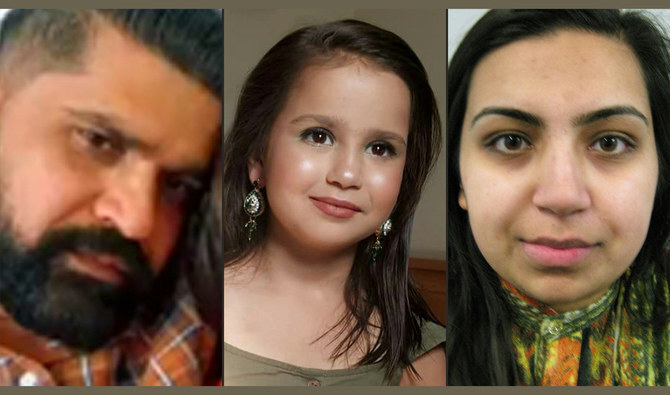

LONDON: The father of a 10-year-old British-Pakistani girl on Thursday denied her murder and instead blamed the girl’s stepmother, calling her “evil” and “psycho.”
Sara Sharif was found dead in her bed in Woking, southwest of London, on August 10, 2023 with injuries including broken bones, burns and bite marks.
Her father, Urfan Sharif, 42, had fled to Pakistan a day before the body was found, along with his wife Beinash Batool, 30, and the girl’s uncle, Faisal Malik, 29.
Sharif then called police in the UK shortly after arriving in Islamabad and said he had “beat her up too much.” During the trial, Sharif said he made up this and another confession to “protect my family.”
All three adults were arrested upon their return to the UK a month later. They deny charges of murder and allowing the death of a child.
Details of the extent of Sara’s injuries have been detailed at London’s Old Bailey court, including claims from Batool that Sharif would beat his daughter badly.
Giving evidence for a third day, Sharif admitted slapping Sara “multiple times” but denied beating, burning, or biting her, insisting that he was “never at home” when she was injured.
Sharif broke down when his lawyer, Naeem Mian, questioned him about beating Sara, who was home schooled, with a cricket bat.
The taxi driver denied burning his daughter with an iron and instead said he was “made to” slap Sara by Batool, who constantly accused the girl of behaving badly.
Pointing to Batool sitting in the dock, Sharif shouted: “I should not have believed her... I didn’t realize I’m living with evil and a psycho.”
He also suggested that Batool was the one who bit her “like an animal.”
The jury was previously told that Sharif and Malik had provided their dental impressions but Batool had refused.
“I didn’t do it. Faisal didn’t do it. Who else was at home?” Sharif said.
He denied ever being aware of Sara being in pain. “She never told me that,” he said and indicated that he did not see injuries because Sara wore full-sleeve tops and long bottoms as well as a hijab head covering.
In the month leading up to Sara’s death, Mian said Sharif was out of the house at work from early in the morning to late at night while holing frequent telephone conversations with Batool, who would largely be at home.
Sharif wept as he recalled a time he came home and saw that Sara’s hands had been tied behind her back with brown packaging tape, accusing Batool of the act.
Asked why he did not call the police or ask Batool to leave, Sharif said that his wife was “manipulative” and that he believed her apology.
“I have been an idiot,” he added.
Forensic evidence shown to court included bundles of packaging tape and a white plastic carrier bag fashioned into a hood that could have been used on Sara’s head.
The bag had packaging tape stuck to it as well as long, brown hairs that matched Sara’s DNA, the court was told.
Both the bag and the non-sticky side of the tape had fingerprints that matched Sharif’s, who denied fashioning a hood out of the plastic bag or using it on Sara.
He said the fingerprints could be a result of him handling the items while sorting the garbage.
Sharif had previously accused Batool of being abusive toward him and preventing him from asking Sara about how she obtained her injuries.
In 2022, Batool texted her sister that Sharif had suggested using make-up to cover up bruises after beating Sara, to which the sister replied: “LOL it was going to happen you can tell.”
In the days before her death, Sharif said Sara, who did chores around the house, had asked him to “not go to work.”


