

First artwork by humanoid robot sells for $1.3 million

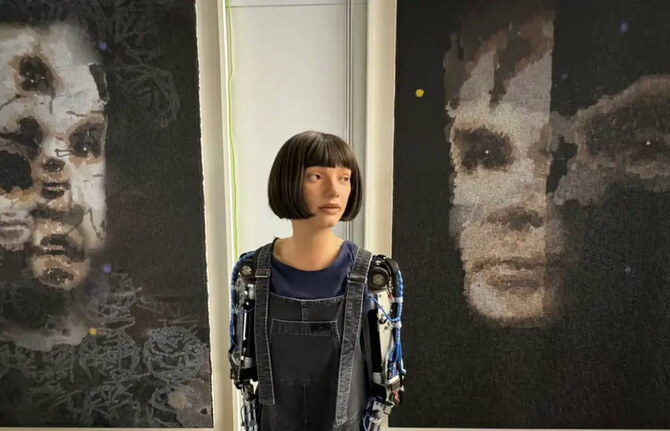
Humanoid robot Ai-Da (center) is pictured with her painting of renowned English mathematician Alan Turing. (Social media photo)
Short Url
Updated 08 November 2024
Follow

First artwork by humanoid robot sells for $1.3 million

REUTERS: A portrait of English mathematician Alan Turing became the first artwork by a humanoid robot to be sold at auction, fetching $1,320,000 on Thursday.
The 2.2 meter (7.5 feet) portrait “A.I. God” by “Ai-Da,” the world’s first ultra-realistic robot artist, smashed pre-sale expectations of $180,000 when it went under the hammer at London auction house Sotheby’s Digital Art Sale.
“Today’s record-breaking sale price for the first artwork by a humanoid robot artist to go up for auction marks a moment in the history of modern and contemporary art and reflects the growing intersection between A.I. technology and the global art market,” said the auction house.
Ai-Da Robot, which uses AI to speak, said: “The key value of my work is its capacity to serve as a catalyst for dialogue about emerging technologies.”
Ai-Da added that a “portrait of pioneer Alan Turing invites viewers to reflect on the god-like nature of AI and computing while considering the ethical and societal implications of these advancements.”
The ultra-realistic robot, one of the most advanced in the world, is designed to resemble a human woman with a face, large eyes and a brown wig.
Ai-Da is named after Ada Lovelace, the world’s first computer programmer and was devised by Aidan Meller, a specialist in modern and contemporary art.
“The greatest artists in history grappled with their period of time, and both celebrated and questioned society’s shifts,” said Meller.
“Ai-Da Robot as technology, is the perfect artist today to discuss the current developments with technology and its unfolding legacy,” he added.
Ai-Da generates ideas through conversations with members of the studio, and suggested creating an image of Turing during a discussion about “A.I. for good.”
The robot was then asked what style, color, content, tone and texture to use, before using cameras in its eyes to look at a picture of Turing and create the painting.
Meller led the team that created Ai-Da with artificial intelligence specialists at the universities of Oxford and Birmingham in England.
Meller said Turing, who made his name as a World War II codebreaker, mathematician and early computer scientist, had raised concerns about the use of AI in the 1950s.
The artwork’s “muted tones and broken facial planes” seemingly suggested “the struggles Turing warned we will face when it comes to managing AI,” he said.
Ai-Da’s works were “ethereal and haunting” and “continue to question where the power of AI will take us, and the global race to harness its power,” he added.


@AIGOD_Aida

A portrait of renowned English mathematician Alan Turing became the first artwork by a humanoid robot to be sold at auction, fetching $1,320,000 on Thursday. the world’s first ultra-realistic robot artist,


Second doctor in Matthew Perry overdose case sentenced to home confinement

Updated 17 December 2025
Follow

Second doctor in Matthew Perry overdose case sentenced to home confinement

  • Dr. Mark Chavez, 55, a onetime San Diego-based physician, pleaded guilty in federal court in October
  • Judge Sherilyn Peace Garnett also sentenced Chavez to 300 hours of community service

LOS ANGELES: A second California doctor was sentenced on Tuesday to eight months of home confinement for illegally supplying “Friends” star Matthew Perry with ketamine, the powerful sedative that caused the actor’s fatal drug overdose in a hot tub in 2023.
Dr. Mark Chavez, 55, a onetime San Diego-based physician, pleaded guilty in federal court in October to a single felony count of conspiracy to distribute the prescription anesthetic and surrendered his medical license in November.
Judge Sherilyn Peace Garnett also sentenced Chavez to 300 hours of community service. As part of his plea agreement, Chavez admitted to selling ketamine to another physician Dr. Salvador Plasencia, 44, who in turn supplied the drug to Perry, though not the dose that ultimately killed the performer. Plasencia, who pleaded guilty to four counts of unlawful drug distribution, was sentenced earlier this month to 2 1/2 years behind bars.
He and Chavez were the first two of five people convicted in connection with Perry’s ketamine-induced death to be sent off to prison.
The three others scheduled to be sentenced in the coming weeks — Jasveen Sangha, 42, a drug dealer known as the “Ketamine Queen;” a go-between dealer Erik Fleming, 56; and Perry’s former personal assistant, Iwamasa, 60.
Sangha admitted to supplying the ketamine dose that killed Perry, and Iwamasa acknowledged injecting Perry with it. It was Iwamasa who later found Perry, aged 54, face down and lifeless, in the jacuzzi of his Los Angeles home on October 28, 2023.
An autopsy report concluded the actor died from the acute effects of ketamine,” which combined with other factors in causing him to lose consciousness and drown.
Perry had publicly acknowledged decades of substance abuse, including the years he starred as Chandler Bing on the hit 1990s NBC television series “Friends.”
According to federal law enforcement officials, Perry had been receiving ketamine infusions for treatment of depression and anxiety at a clinic where he became addicted to the drug.
When doctors there refused to increase his dosage, he turned to unscrupulous providers elsewhere willing to exploit Perry’s drug dependency as a way to make quick money, authorities said. Ketamine is a short-acting anesthetic with hallucinogenic properties that is sometimes prescribed to treat depression and other psychiatric disorders. It also has seen widespread abuse as an illicit party drug.