

Pakistani province announces monetary rewards for whistleblowers exposing proxy ownership of assets

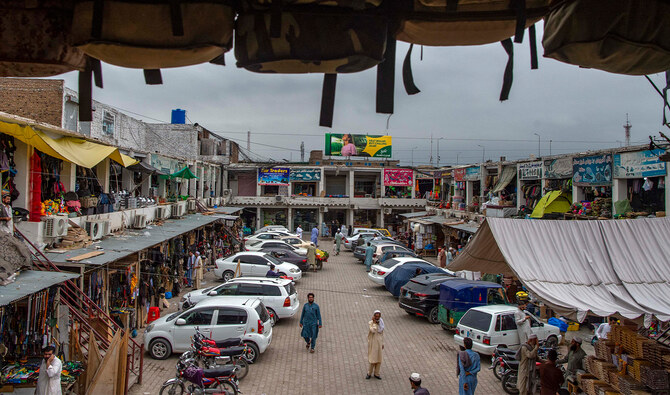
In this picture taken on July 14, 2021, a general view of Sitara market is pictured in the Karkhano area on the outskirts of Peshawar. (AFP/File)
Short Url
Updated 07 November 2024
Follow

Pakistani province announces monetary rewards for whistleblowers exposing proxy ownership of assets

  • KP chief minister promises 40% share of value of assets to people who identify ‘benami’ properties
  • Despite several donor-supported reform attempts, tax-to-GDP ratio remains at about 10% of GDP

PESHAWAR: In an effort to document the economy and broaden the tax net, a Pakistani provincial chief minister has announced a novel scheme this week: whistleblowers who assist the government in identifying ‘benami,’ in which property purchases conceal the identity of the true buyer, will be rewarded with 40% of the value of the asset.

Benami properties, or assets registered under another person’s name to disguise the actual owner’s identity, are often used to conceal movable or immovable assets for tax evasion or other purposes.

Addressing a ceremony on Wednesday evening, Khyber Pakhtunkhwa Chief Minister Ali Amin Gandapur outlined his plan to introduce a whistleblower law.

“We will give 40% [of the amount] to the person who identifies and informs us that this item belongs to Ali Amin and is registered under his driver’s name,” Gandapur said, explaining the scheme.

“When someone won’t be able to show the money trail, which we refer to as benami or nameless, it will be established through the transaction that this person doesn’t have the capability to own a fuel station, this property, this building or this vehicle. Either he will reveal who the culprit is or if he won’t tell, the government will seize it. But whoever will point it out, they will get 40% [value of the asset].”

The chief minister said public cooperation was crucial to the government, which could not advance in its tax collection targets without their support.

Pakistan’s tax collection body, the Federal Board of Revenue, announced in 2019 it would confiscate vehicles and properties with proxy ownership, as well as fictitious bank accounts.

Despite public resistance, Pakistan is pushing ahead with plans for new taxes in line with ambitious revenue targets adopted to clinch a staff-level deal on a 37-month IMF program this September. Pakistani authorities have recently taken stringent measures to broaden the country’s tax net, including blocking mobile phone connections of individuals and registering retailers.

Despite several donor-supported reform attempts, Pakistan’s tax-to-GDP ratio continues to hover at around 10% of GDP. The inability to expand tax revenue contributes to significant public service delivery gaps: over 20 million people live without clean water, almost one in every three people do not have a decent toilet, and about 40% children under the age of five have stunted growth.


Pakistan’s OGDC ramps up unconventional gas plans

Updated 4 sec ago
Follow

Pakistan’s OGDC ramps up unconventional gas plans

  • Pakistan has long been viewed as having potential in tight and shale gas but commercial output has yet to be proved
  • OGDC says has tripled tight-gas study area to 4,500 square km after new seismic, reservoir analysis indicates potential

ISLAMABAD: Pakistan’s state-run Oil & Gas Development Company is planning a major expansion of unconventional gas developments from early next year, aiming to boost production and reduce reliance on imported liquefied natural gas.

Pakistan has long been viewed as having potential in both tight and shale gas, which are trapped in rock and can only be released with specialized drilling, but commercial output has yet to be proved.

Managing Director Ahmed Lak told Reuters that OGDC had tripled its tight-gas study area to 4,500 square kilometers (1,737 square miles) after new seismic and reservoir analysis indicated larger potential. Phase two of a technical evaluation will finish by end-January, followed by full development plans.

The renewed push comes after US President Donald Trump said Pakistan held “massive” oil reserves in July, a statement analysts said lacked credible geological evidence, but which prompted Islamabad to underscore that it is pursuing its own efforts to unlock unconventional resources.

“We started with 85 wells, but the footprint has expanded massively,” Lak said, adding that OGDC’s next five-year plan would look “drastically different.”

Early results point to a “significant” resource across parts of Sindh and Balochistan, where multiple reservoirs show tight-gas characteristics, he said.

SHALE PILOT RAMPS UP

OGDC is also fast-tracking its shale program, shifting from a single test well to a five- to six-well plan in 2026–27, with expected flows of 3–4 million standard cubic feet per day (mmcfd) per well.

If successful, the development could scale to hundreds or even more than 1,000 wells, Lak said.

He said shale alone could eventually add 600 mmcfd to 1 billion standard cubic feet per day of incremental supply, though partners would be needed if the pilot proves viable.

The company is open to partners “on a reciprocal basis,” potentially exchanging acreage abroad for participation in Pakistan, he said.

A 2015 US Energy Information Administration study estimated Pakistan had 9.1 billion barrels of technically recoverable shale oil, the largest such resource outside China and the United States.

A 2022 assessment found parts of the Indus Basin geologically comparable to North American shale plays, though analysts say commercial viability still hinges on better geomechanical data, expanded fracking capacity and water availability.

OGDC plans to begin drilling a deep-water offshore well in the Indus Basin, known as the Deepal prospect, in the fourth quarter of 2026, Lak said. In October, Turkiye’s TPAO with PPL and its consortium partners, including OGDC, were awarded a block for offshore exploration.

A combination of weak gas demand, rising solar uptake and a rigid LNG import schedule has created a surplus of gas that forced OGDC to curb output and pushed Pakistan to divert cargoes from Italy’s ENI and seek revised terms with Qatar.