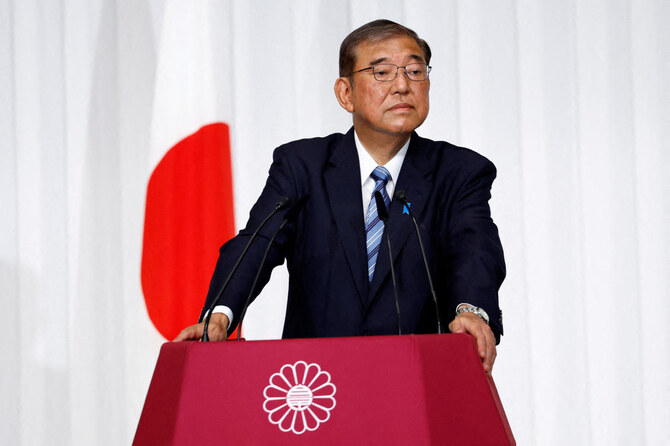
TOKYO: Japanese Prime Minister Shigeru Ishiba said Thursday he had agreed with US president-elect Donald Trump in a phone call to strengthen the nations’ alliance, after the tycoon’s victory sent defense-related shares surging.
Trump’s “America First” approach could mean less cash from Washington for security in the Asia-Pacific region, analysts say — with investors betting on Japan upgrading its own military capacities.
Key allies Japan and the United States are each other’s top foreign investors, and 54,000 US military personnel are stationed in Japan, mostly in Okinawa east of Taiwan.
Ishiba, who took office just over a month ago, said he and Trump hoped to organize a face-to-face meeting “as soon as possible,” describing the president-elect as “very friendly.”
“He is the kind of person I will be able to talk to candidly,” Ishiba told reporters.
“I would like to hold active discussions on the strengthening of the Japan-US alliance from various standpoints including specific equipment, operations and integration, not just money,” he added.
Shares in Japanese defense contractor IHI ended up nearly 20 percent Wednesday, as Trump’s victory began to look secure, and Mitsubishi Heavy Industries gained almost 10 percent.
The expectation is “that Trump will demand that allies do more and spend more to defend themselves,” said Claudia Junghyun Kim, an assistant professor of international affairs at City University of Hong Kong.
Japan is already in the process of doubling its military spending to the NATO standard of two percent of GDP.
“This pressure from Trump doesn’t exactly clash with Ishiba’s hope to increase defense spending,” Kim told AFP, and it “should be good news for Japan’s defense industry.”
US elections
When Trump last won a US election in 2016, then-prime minister Shinzo Abe was the first foreign leader to meet the president-elect at his Manhattan skyscraper.
Japanese media said Ishiba could arrange a trip to the United States around the time he attends the Asia-Pacific Economic Cooperation (APEC) summit in Peru this month.
“On a personal level, Ishiba might be in a challenging position” when he meets Trump, Daisuke Kawai, deputy director of the University of Tokyo’s economic security research program, told AFP.
“Ishiba is a railway enthusiast who doesn’t enjoy golf or social dinners, and unlike Abe, he’s not particularly adept at engaging in social or entertaining conversations. This could mean their personal chemistry may not align well.”
Both Ishiba and Trump perceive the US-Japan alliance as unequal — but in opposite directions — so “initiating productive discussions could be difficult,” Kawai added.
Ishiba led his ruling coalition to a disastrous loss of its majority in snap elections last month.
He is expected to lead a minority government or widen the coalition to include other parties.
Japan and the EU announced a sweeping new security and defense pact on Friday.
Kawai said it was important for Tokyo to build a defense ecosystem “that generates profits through joint production with other countries.”
Japan, which for decades has relied on the United States for military hardware, is also developing a new fighter jet with EU member Italy and Britain set to be airborne by 2035.


![]()

Japan PM to boost defense alliance with ‘very friendly’ Trump
Short Url
https://arab.news/ghrg3
Japan PM to boost defense alliance with ‘very friendly’ Trump
- Key allies Japan and the United States are each other’s top foreign investors


Latest updates


© 2026 SAUDI RESEARCH & PUBLISHING COMPANY, All Rights Reserved And subject to Terms of Use Agreement.