


LONDON: In case you missed it, slasher films are back! Sure, it’s not quite that late Nineties/early Noughties heyday of “Scream” and “I Know What You Did Last Summer,” but they’re back, nonetheless. Because it’s 2024, though, the humble slasher now rarely exists in its original form. Rather, an increasing number of writers and directors are fusing the tropes of classic slasher films with other genres. “Freaky” added body-swap magic to the mix, “Happy Death Day” was part-slasher, part-“Groundhog Day,” and “It’s A Wonderful Knife” blended Christmas classic with horror comedy.
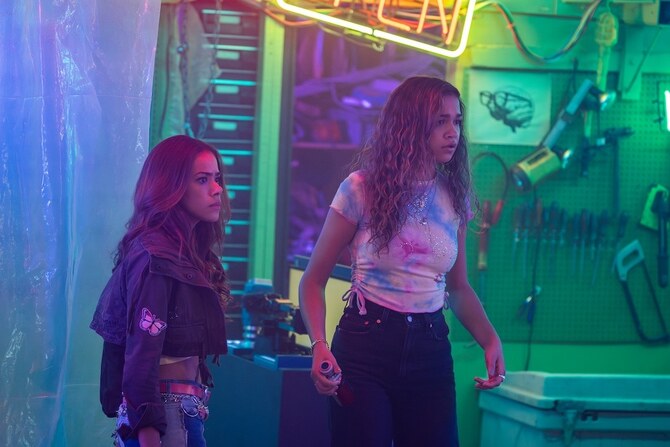
So it’s no real surprise to learn that Netflix’s uninspiringly named “Time Cut” is a time-travel-meets-slasher-meets-nostalgia-romp which sees “Outer Banks” star Madison Bailey play Lucy, a high-school student inadvertently transported back in time to 2003, just days before her sister Summer (“Ginny & Georgia” star Antonia Gentry) was murdered by an unknown serial killer.
Director and co-writer Hannah MacPherson (working with “Freaky” and “It’s A Wonderful Knife” writer Michael Kennedy) leans heavily into the nostalgia, draping the smalltown-America setting with velour tracksuits, Sony Discmans and a soundtrack that includes Vanessa Carlton, Wheatus, Hilary Duff, Avril Lavigne. And dial-up modems, much to Lucy’s disgust. There’s a joke or two to be had at the foibles of the time period, but, to be honest, the world was pretty good back then, so some of the more pointed sneers feel a little unnecessary.
And it’s not MacPherson’s last odd decision. Despite the best efforts of the two fairly likable leads, “Time Cut” feels largely populated by cookie-cutter characters who represent the worst of some pretty dated stereotypes — sending up boorish jocks, disconnected parents and cliquey high schoolers feels a little mean-spirited.
And, for a film with a surprising amount of attention on the mechanics of time travel, there seems scant regard for how it actually works. Rather, there’s a series of unimaginative (and relatively tame) kills, a predictable villain, and no real big idea — unless you count ‘Wouldn’t it be funny to send a teenager from 2024 back to a time when her iPhone doesn’t work?’


