Saudi Arabia’s KSrelief completes distribution of 50,000 shelters, winter kits in Pakistan

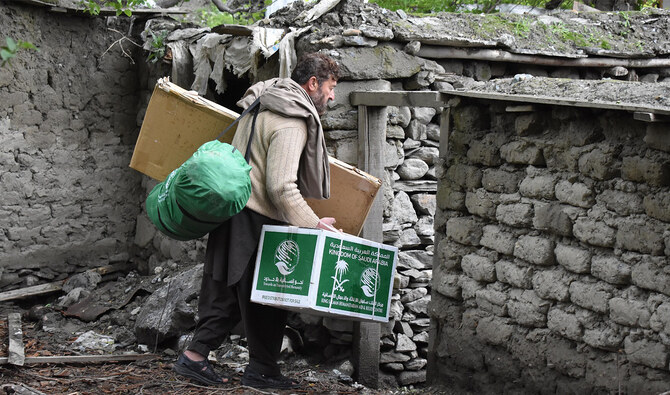
The picture shared by KSrelief on November 5, 2024 shows a Pakistani man carrying winter supplies provided by KSrelief. (KSrelief)
Short Url
Updated 06 November 2024
Follow

Saudi Arabia’s KSrelief completes distribution of 50,000 shelters, winter kits in Pakistan

  • The initiative targeted areas severely affected by flash floods, heavy rain and snowfall in the South Asian country
  • It provided essential support to over 350,000 individuals, enabling communities to recover and regain stability

ISLAMABAD: The King Salman Humanitarian Aid and Relief Center (KSrelief) has completed the distribution of 50,000 shelters and winter kits among Pakistan’s most vulnerable communities, the Saudi charity said on Tuesday.
The aid distribution was part of KSrelief’s Shelter, Non-Food Items (NFIs) and Winter Kit Project for 2023-24, according to a statement issued by the charity organization.
By focusing on the disaster-stricken regions, the project provided essential support to over 350,000 individuals across Pakistan, enabling communities to recover and regain stability.
“Spanning four phases from September 2023 to October 2024, the initiative targeted areas severely affected by flash floods, heavy rainfall, and snowfall across 44 high-need districts in Pakistan,” KSrelief said in a statement.
“Through this effort, KSrelief distributed a total of 25,000 Shelter NFIs and 25,000 Winter Kits, aimed at helping communities withstand harsh winter conditions and rebuild their lives in the aftermath of these disasters.”
KSrelief coordinated with Pakistan’s national and provincial disaster management authorities and United Nations (UN) agencies for the effort, according to the statement.
“This approach ensured a cohesive, well-targeted response to meet the immediate needs of those impacted,” it read.
The Saudi charity organization has one of the largest humanitarian budgets available to any aid agency across the world, which has allowed its officials to undertake a wide variety of projects in more than 80 countries.
Pakistan is the fifth largest beneficiary of its aid and humanitarian activities and has greatly benefited from its assistance since 2022 monsoon floods.


Pakistan welcomes Afghan scholars’ reported resolution against use of soil for cross-border attacks

Updated 11 December 2025
Follow

Pakistan welcomes Afghan scholars’ reported resolution against use of soil for cross-border attacks

  • Around 1,000 Afghan scholars passed a resolution this week prohibiting use of Afghan soil for cross-border attacks against another country, Afghan media reported
  • Development takes place as tensions persist between Pakistan and Afghanistan amid Islamabad’s allegations of Taliban supporting cross-border attacks against it 

ISLAMABAD: Pakistan’s foreign office spokesperson on Thursday welcomed a resolution reportedly passed by Afghan scholars against allowing the use of Afghan soil for attacks against any other country, but still demanded written assurances of the same from the Afghan leadership. 

According to a report published by Afghan news channel Tolo News, around 1,000 Afghan scholars gathered in Kabul on Wednesday to pass a resolution that, among other things, said no one will be allowed to use Afghanistan’s soil against other countries for attacks. The resolution also said that if anyone fails to comply with this decision, the Afghan government has the right to take action against them.

The development takes place as tensions persist between Afghanistan and Pakistan. Both countries have engaged in border clashes since October, with Islamabad accusing Kabul of harboring militants that launch attacks on Pakistan.

Afghanistan denies the allegation and says it cannot be held responsible for Pakistan’s security. 

Speaking to reporters during a weekly press briefing, Foreign Office spokesperson Tahir Andrabi said he had not seen the full text of the resolution. 

“Any developments with regards to the fact that Afghan leadership, the segment of Afghan society, realized the gravity of the situation that their soil is being used by not just TTP, but also by their own nationals to perpetrate terrorism in Pakistan — any realization to this effect is positive and one would certainly welcome it,” Andrabi said.

However, he said similar commitments by Kabul on preventing cross-border attacks have been made in the past but were not honored. 

Pakistan and Kabul engaged in a series of peace talks in Istanbul and Doha recently after their deadly border clashes in October. Andrabi pointed out that Islamabad had insisted on getting written assurances from the Afghan leadership that they would prevent Afghan soil from being used by the Pakistani Taliban and other militant groups. However, he said Islamabad had not received any. 

He said the resolution by Afghan scholars does not qualify as a proper written assurance from Kabul as it does not explicitly mention Pakistan or the Pakistani Taliban.

’NO FORMAL EXTRADITION TREATY’

Commenting on media reports of Islamabad seeking extradition of certain individuals from the UK, Andrabi confirmed that there exists no formal extradition treaty between Pakistan and the UK. However, he said cases can still be processed individually.

“In the absence of a formal treaty, the extradition cases can be processed on a case-to-case basis,” the FO spokesperson said. “And certain cases were submitted to the British High Commission in Islamabad for their consideration.”

Pakistan last week asked the UK to extradite two prominent pro-Imran Khan figures, former accountability aide Shehzad Akbar and YouTuber-commentator Adil Raja, saying they were wanted on charges of anti-state propaganda.

The issue had been brought up during Pakistan Interior Minister Mohsin Naqvi’s meeting with British High Commissioner Jane Marriott in Islamabad. The Interior Ministry said Naqvi had formally handed over Pakistan’s extradition documents, requesting that Raja and Akbar be returned to Pakistan without delay.