VALENCIA: Spain on Tuesday announced an aid package worth 10.6 billion euros ($11.5 billion) to rebuild regions devastated by its worst floods in a generation that have killed 219 people.
The exceptional Mediterranean storm that lashed eastern Spain a week ago triggered surging torrents of muddy water that have left a trail of destruction and an unknown number of missing.
Prime Minister Pedro Sanchez announced a series of measures including aid to small and midsize businesses, self-employed workers and households that have suffered deaths, incapacity and damage to homes and belongings.
Tax relief and a three-month postponement to repaying mortgages and loans were also among the announcements, which Sanchez likened to the state’s intervention during the Covid-19 pandemic to protect the economy and livelihoods.
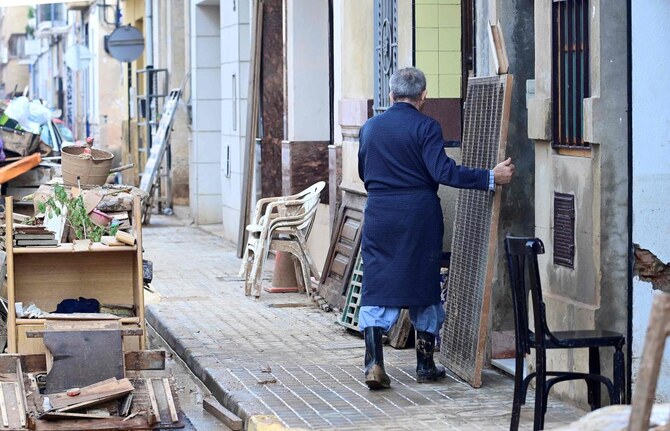
The government would take on all emergency spending by local councils linked to clearing mud, debris and ruined property and restoring drinking water, Sanchez told a news conference.
Spain has also requested aid from the EU solidarity fund, he added.
Security forces and emergency services personnel are working around the clock to repair damaged infrastructure, distribute aid and search for bodies in Spain’s largest peacetime deployment of its armed forces.
Sanchez said almost 15,000 troops, police officers and civil guards were in the eastern Valencia region that has suffered most of the deaths and destruction, up from 7,300 on Saturday.
Firefighters combed through piles of damaged vehicles and pumped water from inundated garages and car parks where more victims may be discovered, AFP journalists saw.
Maribel Albalat, mayor of the ground-zero town of Paiporta, told public broadcaster TVE they were doing “better, but not well” with many streets still inaccessible and residents struggling to get a phone signal.
Rescuers in the southeastern town of Letur have found one of the missing bodies they were looking for, announced the central government’s representative in the Castilla-La Mancha region, Pedro Antonio Ruiz.
Two Chinese citizens, two Romanians and an Ecuadorian are among the dead, authorities in those countries have said. The floods also claimed three British victims, UK media have reported.
Many survivors are furious with the authorities for failing to warn the population on time last Tuesday and provide urgent rescue and relief work.
That anger reached a breaking point in Paiporta on Sunday when crowds heckled and hurled mud at King Felipe VI, Queen Letizia and Sanchez.
The outrage was also palpable in Valencia — Spain’s third-largest city that was unharmed despite being a stone’s throw from the hardest-hit zones — when AFP visited on Tuesday.
Local humorist Jose Antonio Lopez-Guitian, 61, had just returned from the town of Massanassa with his boots covered in mud and said residents were left to fend for themselves.
The situation was “a national disgrace” and “a dereliction of duty by all the institutions,” he said.
The floods affected more than 4,100 hectares (10,100 acres), the civil protection service said on X, using a map provided by the European Union’s Copernicus satellite.
Storms coming off the Mediterranean are common during this season. But scientists have warned that human-induced climate change is increasing the ferocity, length and frequency of extreme weather events.
“Climate change kills... we have to adapt to this reality,” Sanchez said at his news conference, lashing out at the “irresponsible discourse of deniers.”

Spain unveils $11 billion aid plan after catastrophic floods
https://arab.news/zbaa8
Spain unveils $11 billion aid plan after catastrophic floods
- Prime Minister Pedro Sanchez announced a series of measures including aid to small and midsize businesses, self-employed workers and households
- Tax relief and a three-month postponement to repaying mortgages and loans were also among the announcements
Two high-speed trains derail in Spain, police sources say 21 people killed
- The accident happened near Adamuz, in Cordoba province. So far, 21 people have been confirmed dead by police
MADRID: A high-speed train derailed and smashed into another oncoming train in southern Spain on Sunday, pushing the second train off the tracks in a collision that police sources confirmed to Reuters had killed at least 21 people.
The accident happened near Adamuz, in Cordoba province. So far, 21 people have been confirmed dead by police, with state broadcaster Television Espanola adding that 100 people had been injured, 25 seriously. The driver of one of the trains, which was traveling from Madrid to Huelva, was among those who died, the TV station added.
“The Iryo 6189 Malaga — (to Madrid) train has derailed from the track at Adamuz, crashing onto the adjacent track. The (Madrid) to Huelva train which was traveling on the adjacent track has also derailed,” said Adif, which runs the rail network, in a social media post.
Adif said the accident happened at 6:40 p.m. (1740 GMT), about 10 minutes after the Iryo train left Cordoba heading toward Madrid.
Iryo is a private rail operator, majority-owned by Italian state-controlled railway group Ferrovie dello Stato. The train involved was a Freccia 1000 train which was traveling between Malaga and Madrid, a spokesperson for Ferrovie dello Stato said.
The company said in a statement that it deeply regretted what had happened and had activated all emergency protocols to work closely with the relevant authorities to manage the situation.
The second train was operated by Renfe, which also did not respond to a request for comment.
Adif has suspended all rail services between Madrid and Andalusia.
HORRIFIC SCENE
The Iryo train had more than 300 passengers on board, while the Renfe train had around 100.
Paco Carmona, Cordoba fire chief, told TVE the first train heading to Madrid from Malaga had been evacuated.
The other train’s carriages were badly damaged, he said, with twisted metal and seats. “There are still people trapped. We don’t know how many people have died and the operation is concentrating on getting people out of areas which are very narrow,” he said. “We have to remove the bodies to reach anyone who is still alive. It is proving to be a complicated task.”
Transport Minister Oscar Puente said he was following events from rail operator Adif’s headquarters in Madrid.
“The latest information is very serious,” he posted on X. “The impact was terrible, causing the first two carriages of the Renfe train to be thrown off the track. The number of victims cannot be confirmed at this time. The most important thing now is to help the victims.”
The mayor of Adamuz, Rafael Moreno, told El Pais newspaper that he had been among the first to arrive at the scene of the accident alongside the local police and saw what he believed to be a badly lacerated body several meters from the accident site.
“The scene is horrific,” he said. “I don’t think they were on the same track, but it’s not clear. Now the mayors and residents of the area are focused on helping the passengers.”
CALLS FOR MEDICS
Images on local television showed a reception center set up for passengers in the town of Adamuz, population 5,000, with locals coming and going with food and blankets amid nighttime temperatures of around 42 degrees Fahrenheit (6 degrees Celsius).
A woman named Carmen posted on X that she had been on board the Iryo train to Madrid. “Ten minutes after departing (from Cordoba) the train started to shake a lot, and it derailed from coach 6 behind us. The lights went out.”
Footage posted by another Iryo train passenger, also on X, showed an Iryo staffer in a fluorescent jacket instructing passengers to remain in their seats in the darkened carriages, and those with first aid training to keep watch over fellow passengers. He also urged people to maintain mobile phone batteries to be able to use their torches when they disembarked.
Salvador Jimenez, a journalist for RTVE who was on board the Iryo train, shared images showing the nose of the rear carriage of the train lying on its side, with evacuated passengers sitting on the side of the carriage facing upwards.
Jimenez told TVE by phone from beside the stricken trains that passengers had used emergency hammers to smash the windows and climb out, and they had seen two people taken out of the overturned carriages on stretchers.
“There’s a certain uncertainty about when we’ll get to Madrid, where we’ll spend the night, we’ve had no message from the train company yet,” he said. “It’s very cold but here we are.”


