

Toxic smog wreathes India’s capital, Pakistan’s Lahore as winter nears

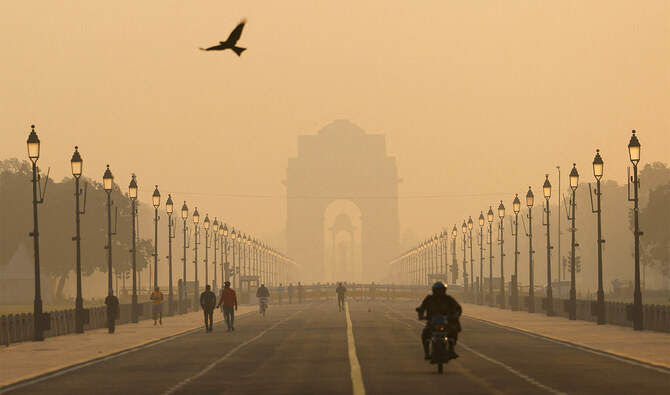
People walk on Kartavyapath near India Gate on a hazy morning in New Delhi, India, on November 1, 2024.
Short Url
Updated 05 November 2024
Follow

Toxic smog wreathes India’s capital, Pakistan’s Lahore as winter nears

  • Punjab government has blamed pollution wafting in from India for Lahore’s worsening air quality 
  • Authorities in Punjab have taken emergency measures in wake of unprecedented pollution levels

NEW DELHI: A toxic smog shrouded the Indian capital on Tuesday, driving air quality in some areas into the “severe” range ahead of winter, when cold air traps pollutants and brings a spike in respiratory illnesses.

The mix of smoke, emissions, and dust is an annual problem for authorities in New Delhi, with vehicles, construction dust, and smoke from farm fires in the adjoining northern states of Punjab and Haryana among the major contributors.

“The outlook for the subsequent six days: the air quality is likely to be in the ‘very poor’ to ‘severe’ category,” said the earth sciences ministry.

The city’s overall score on an air quality index kept by India’s top pollution authorities was ‘very poor’ at 384, the ministry added, and was likely to stay there until Thursday.

An index range of 401 to 500 falls into the ‘severe’ category, implying it affects healthy people, but is more serious for those already fighting disease.

Ministry data showed farm fires have increasingly swelled the pollution over the last three days, for a share of more than 23 percent on Monday, from about 15 percent on Saturday.

About a third of the city’s 39 monitoring stations showed a ‘severe’ score of more than 400 on Tuesday, said the Central Pollution Control Board (CPCB), well short of an air quality score of zero to 50 that it rates as ‘good’.

Swiss group IQAir also rated Delhi the world’s second most polluted city on Tuesday, after Lahore in neighboring Pakistan, where authorities also took emergency measures in the wake of Sunday’s unprecedented pollution levels.

The government in the eastern province of Punjab, home to Lahore, has blamed deteriorating air quality on pollution wafting in from India, an issue it has vowed to take up with its neighbor through the foreign ministry.


Pakistan drops 8,000 MW power procurement, claims $17 billion savings amid IMF-driven reforms

Updated 11 sec ago
Follow

Pakistan drops 8,000 MW power procurement, claims $17 billion savings amid IMF-driven reforms

  • Government says decision taken “on merit” as it seeks to cut losses, circular debt, ease consumer pressure 
  • Power minister says losses fell from $2.1 billion to $1.4 billion, circular debt dropped by $2.8 billion

ISLAMABAD: Pakistan has abandoned plans to procure around 8,000 megawatts of expensive electricity, the power minister said on Sunday, adding that the decision was taken “purely on merit” and would save about $17 billion.

The power sector has long been a major source of Pakistan’s fiscal stress, driven by surplus generation capacity, costly contracts and mounting circular debt. Reforming electricity pricing, reducing losses and limiting new liabilities are central conditions under an ongoing $7 billion IMF program approved in 2024.

Pakistan has historically contracted more power generation than it consumes, forcing the government to make large capacity payments even for unused electricity. These obligations have contributed to rising tariffs, budgetary pressure and repeated IMF bailouts over the past two decades.

“The government has abandoned the procurement of around 8000 megawatts of expensive electricity purely on merit, which will likely to save 17 billion dollars,” Power Minister Sardar Awais Ahmed Khan Leghari said while addressing a news conference in Islamabad, according to state broadcaster Radio Pakistan.

He said the federal government was also absorbing losses incurred by power distribution companies rather than passing them on to consumers.

The minister said the government’s reform drive was already showing results, with losses reduced from Rs586 billion ($2.1 billion) to Rs393 billion ($1.4 billion), while circular debt declined by Rs780 billion ($2.8 billion) last year. Recoveries, he added, had improved by Rs183 billion ($660 million).

Leghari said electricity tariffs had been reduced by 20 percent at the national level over the past two years and expressed confidence that prices would be aligned with international levels within the next 18 months.

Power sector reform has been one of the most politically sensitive elements of Pakistan’s IMF-backed adjustment program, with higher tariffs and tighter enforcement weighing on households and industry. The government says cutting losses, improving recoveries and avoiding costly new capacity are essential to stabilizing public finances and restoring investor confidence.