

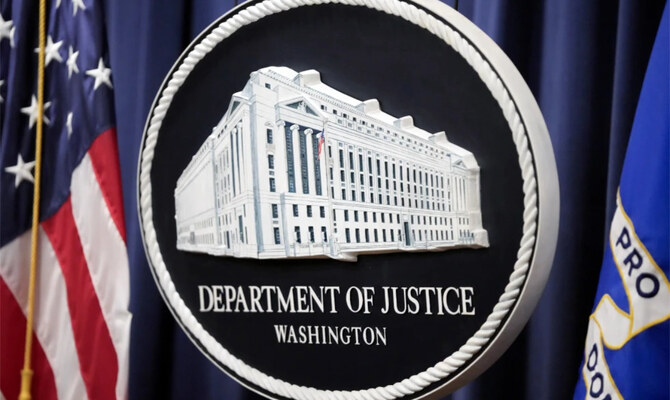

WASHINGTON: Some Republican-led states say they will block the Justice Department’s election monitors from going inside polling places on Election Day, pushing back on federal authorities’ decades-long practice of watching for violations of federal voting laws.
Officials in Florida and Texas have said they won’t allow federal election monitors into polling sites on Tuesday. And on Monday, Missouri filed a federal lawsuit seeking a court order to block federal officials from observing inside polling places.
The Justice Department announced last week that it’s deploying election monitors in 86 jurisdictions across 27 states on Election Day. The Justice Department declined to comment on Monday on the Missouri lawsuit and the moves by other Republican-led states.
The race between Democratic nominee Kamala Harris and Republican nominee Donald Trump is a dead heat, and both sides are bracing for potential legal challenges to vote tallies. The Justice Department’s election monitoring effort, a long practice under both Democratic and Republican administrations, is meant to ensure that federal voting rights are being followed.
Here’s a look at election monitors and the states’ actions:
Who are the election monitors?
Election monitors are lawyers who work for the Justice Department, including in the civil rights division and US attorney’s offices across the country. They are not law enforcement officers or federal agents.
For decades, the Justice Department’s civil rights division has sent attorneys and staff members to monitor polling places across the country in both federal and non-federal elections. The monitors are tasked with ensuring the compliance of federal voting rights laws.
The Justice Department’s Civil Rights Division enforces a number of statutes protecting the right to vote. That includes Voting Rights Act, which prohibits intimidation and threats against those who are casting ballots or counting votes. And it includes the Americans with Disabilities Act, which mandates that election officials ensure people with disabilities have the full and equal opportunity to vote.
Where are election monitors being sent?
The 86 jurisdictions that the Justice Department will send monitors to on Tuesday include Maricopa County, Arizona and Fulton County, Georgia, which in 2020 became the center of election conspiracy theories spread by Trump and other Republicans. Another place on the list is Portage County, Ohio, where a sheriff came under fire for a social media post in which he said people with Harris yard signs should have their addresses recorded so that immigrants can be sent to live with them if the Democrat wins the presidency
Other areas where federal monitors will be sent include Detroit, Michigan; Queens, New York; Providence, Rhode Island; Jackson County, South Dakota; Salem, Massachusetts; Milwaukee, Wisconsin; Manassas, Virginia; Cuyahoga County, Ohio and Northwest Arctic Borough, Alaska. The Justice Department’s monitors will be in St. Louis, Missouri; four jurisdictions in Florida and eight jurisdictions in Texas.
What’s happening in Missouri?
In filing the lawsuit on Monday, Missouri Secretary of State Jay Ashcroft said state law “clearly and specifically limits who may be in polling places.” He also accused the federal government of “attempting to illegally interfere in Missouri’s elections.”
The lawsuit states that Missouri law “permits only certain categories of persons to be present in voting locations, including voters, minor children accompanying voters, poll workers, election judges, etc.,” and not federal officials.
The Justice Department also sought to monitor polling places in Missouri in 2022. The agency planned to have officials at Cole County, which includes Jefferson City, the state capital. County Clerk Steve Korsmeyer had said he wouldn’t let them in if they show up.
The federal agency backed down after Ashcroft showed Justice Department officials the state law, Ashcroft said. He says the Justice Department is now “trying to go through the back door” by contacting local election officials for access.
Messages were left Monday with the St. Louis Board of Election Commissioners.
The St. Louis Board of Election Commissioners reached a settlement in 2021 with the Justice Department aimed at ensuring people with mobility and vision impairments can access to polling places after federal officials found problems, such as ramps that were too steep and inaccessible parking, according to the court papers. The settlement, which expires next year, says the board must “cooperate fully” with Justice Department’s efforts to monitor compliance, “including but not limited to providing the United States with timely access to polling places (including on Election Day).”
What are the other states saying?
In a letter to the Justice Department on Friday, Texas Secretary of State Jane Nelson said wrote that “Texas law is clear: Justice Department monitors are not permitted inside polling places where ballots are being cast or a central counting station where ballots are being counted.”
“Texas has a robust processes and procedures in place to ensure that eligible voters may participate in a free and fair election,” Nelson wrote.
In a similar letter Friday, Florida Secretary of State Cord Byrd told the Justice Department that Florida law lists who is allowed inside the state’s polling places and that Justice Department officials are not included. Byrd said that Florida is sending its own monitors to the four jurisdictions the Justice Department plans to send staff to and they will “ensure there is no interference with the voting process.”


