

Saudi road maintenance time down 40% thanks to modern technology, transport minister says

1 / 2
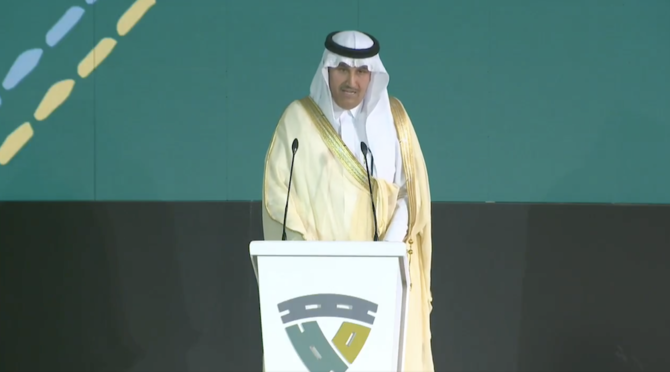
Saudi Minister of Transport and Logistics Services Saleh Al-Jasser was speaking on the first day of the Road Safety and Sustainability Conference in Riyadh. X/@RGAsaudi
2 / 2
Saudi Minister of Transport and Logistics Services Saleh Al-Jasser was speaking on the first day of the Road Safety and Sustainability Conference in Riyadh. X/@RGAsaudi
Short Url
Updated 03 November 2024
Follow

Saudi road maintenance time down 40% thanks to modern technology, transport minister says

  • Saleh Al-Jasser said cutting-edge innovations have helped reduce carbon emissions
  • Several road networks were surveyed to identify shortcomings and execute safety initiatives, minister said

RIYADH: Saudi road maintenance time has been slashed by 40 percent thanks to modern technologies, according to the Kingdom’s Minister of Transport and Logistics Services. 

During a speech on the first day of the Road Safety and Sustainability Conference taking place in Riyadh from Nov. 3—4, Saleh Al-Jasser said the cutting-edge innovations have also helped reduce carbon emissions.

This falls in line with Saudi Arabia’s Roads General Authority’s vision of enhancing the safety and sustainability of the road sector through national competencies. It also aligns with the body’s keenness to improve the quality of road networks and user experience, as well as foster innovation. 

It is also in line with the authority’s objective to reduce the number of road deaths to less than five cases per 100,000 people.

“Modern technologies have helped reduce road maintenance time by up to 40 percent while reducing carbon emissions,” Al-Jasser said. 

He added: “The Kingdom has implemented many scientific innovations such as road cooling and rubber roads and has advanced in the road quality index to fourth place among the G20 countries.”

The minister highlighted how this confirms its leadership in achieving the highest safety and quality standards on roads. 

“The Kingdom’s vision has given great attention to quality of life and road safety,” Al-Jasser said.

“The Kingdom’s road network is the world’s first in terms of connectivity, and enhances sustainable development for individuals and goods according to the highest standards of security and safety,” he also said. 

The minister went on to say a large number of road networks were surveyed to identify shortcomings and execute safety initiatives. Several measures have been implemented following the reviews. 

Speaking at the same event, the Vice Minister of Transport and Logistics Services for Road Affairs and Acting CEO of RGA, Badr Abdullah Al-Dulami, shared findings from the world’s largest road survey, which confirmed that 77 percent of the Kingdom’s roads meet safety standards. He also highlighted that protection measures in traffic diversions have risen to 95 percent.

“Expanding an advanced research study that the authority is working on to use the products of building demolition in asphalt mixtures, which contributes to preserving the environment and investing in natural resources,” Al-Dulami said. 

“Launching the Saudi Road Code, which contributes to raising the level of safety, preserving the environment, and preparing the infrastructure for self-driving vehicles,” he added. 

Chairman of the International Road Federation, Abdullah bin Abdulrahman Al-Muqbil, was also present during the event. 

“To make roads safer for travel, we have harnessed modern technologies to sustain them and raise their efficiency,” Al-Muqbil said. 

The chairman said the federation has established effective partnerships with member states, including the Kingdom, which has led to enhanced safety and sustainability in the road sector and the adoption of modern technologies.


Gold rises on Iran war safe-haven bid; firm dollar limits upside

Updated 05 March 2026
Follow

Gold rises on Iran war safe-haven bid; firm dollar limits upside

BENGALURU: Gold prices rose on March 5, lifted by safe-haven demand amid an escalating war in the Middle East, while a stronger dollar and concerns around the US Federal Reserve’s monetary policy capped gains.

Spot gold was up 0.6 percent at $5,168.43 per ounce, as of 11:55 am Saudi time. US gold futures for April delivery were up 0.9 percent at $5,179.20.

Israel launched a large wave of strikes on Tehran on March 5, targeting what it said was infrastructure belonging to the Iranian authorities, after Iranian missiles sent millions of Israelis rushing into bomb shelters.

“On the one hand, there may be greater safe-haven demand for gold given the ongoing conflict in the Middle East. On the other hand, the risk of a prolonged period of higher energy prices that takes rate cuts off the table, and adds to the chance of rate hikes, could be capping further gains,” said Hamad Hussain, a climate and commodities economist at Capital Economics.

The US dollar rose about 0.3 percent after briefly retreating from three-month highs, as the fallout from the war roiled global markets and kept sentiment fragile.

Concerns about energy supply continued to drive up oil prices and stoke inflation fears.

Gold is considered a hedge against inflation in the long run, but also tends to thrive when interest rates are lower, as it is a non-yielding asset.

President Donald Trump, on March 4, officially nominated former Federal Reserve Governor Kevin Warsh to be the US central bank’s next chair.

US economic activity grew slightly, prices continued to increase and employment levels were stable in recent weeks, the Federal Reserve said on Wednesday in its latest “Beige Book” report.

Markets expect the Fed to keep rates steady at its next policy meeting on March 18, according to CME Group’s FedWatch tool.

Investors are looking out for the weekly US jobless claims data, due later today, and the US employment report for February on March 6 for further clues on monetary policy this year.

Spot silver rose 0.5 percent to $83.80 per ounce. Platinum gained 1.1 percent to $2,172.20, while palladium lost 0.7 percent to $1,662.07.