

Saudi Arabia calls for robust action against land degradation

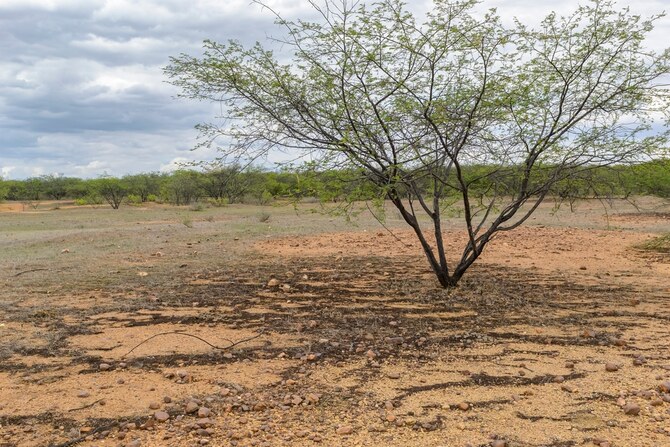
Since 2015, countries have been aligning with voluntary Land Degradation Neutrality targets as part of the UN Sustainable Development Goals. Shutterstock
Short Url
Updated 03 November 2024
Follow

Saudi Arabia calls for robust action against land degradation

  • Kingdom’s incoming UNCCD presidency aims to increase the number of participating countries and the ambition of their goals
  • More than 71,000 square km of land expected to face deterioration before the Dec. 2nd start of the conference

RIYADH: Saudi Arabia is encouraging urgent action to combat drought, as vast areas of land — larger than the size of Ireland — are projected to face degradation globally in the near future.

With less than one month remaining until the 16th session of the Conference of Parties of the UN Convention to Combat Desertification begins in Riyadh, the Kingdom’s incoming UNCCD presidency has urged the international community to take decisive measures on drought resilience and land restoration. 

Recent data underscores the urgency of this appeal, with more than 71,000 square km of land expected to face deterioration before the Dec. 2nd start of the conference, according to the UNCCD. 

“COP16 in Riyadh is a critical moment for the international community to address land degradation if we are to meet the UNCCD target of restoring 1.5 billion hectares of land by 2030,” said Osama Faqeeha, the Kingdom’s deputy minister for environment at the Ministry of Environment, Water and Agriculture. 

Faqeeha, who is also the adviser to the COP16 presidency, added: “As the hosts, we are calling for all parties to come to Riyadh ready to increase their ambition by strengthening land restoration targets, bolstering drought resilience initiatives, and enhancing land tenure rights.” 

Since 2015, countries have been aligning with voluntary Land Degradation Neutrality targets as part of the UN Sustainable Development Goals. 

Over 130 nations have engaged in the LDN Target Setting Programme, with more than 100 already defining their objectives.

Saudi Arabia’s incoming UNCCD presidency aims to increase the number of participating countries and the ambition of their goals. 

The UNCCD has estimated that more than $44 trillion in economic output, representing over half of global gross domestic product, is moderately or highly dependent on natural capital. 

Restoration investments are highlighted as economically beneficial, with projections that each dollar invested could yield up to $30 in returns, presenting a significant opportunity for a trillion-dollar restoration economy. 

COP16 in Riyadh will mark the first time the UNCCD will introduce a Green Zone, a dedicated space for businesses, scientists, and financial institutions, as well as NGOs, the public, and impacted communities to collaborate on sustainable solutions. 

The conference will also feature seven thematic days focused on key topics such as land restoration, governance, and agri-food systems, as well as resilience, finance, and advancements in science, technology, and innovation. 


Global sukuk issuance to reach $280bn in 2026: S&P Global

Updated 7 sec ago
Follow

Global sukuk issuance to reach $280bn in 2026: S&P Global

RIYADH: Global sukuk issuance is projected to hover between $270 billion and $280 billion this year, up from $264.8 billion in 2025 and $234.9 billion in 2024, an analysis by S&P Global revealed. 

In its latest report, the firm said this strong momentum in sukuk issuance will be driven by projected lower oil prices, financing needs in some Gulf Cooperation Council countries, and the Federal Reserve’s expected continuation of monetary easing. 

Sukuk are Shariah-compliant financial instruments that grant investors partial ownership in an issuer’s underlying assets and serve as an alternative to conventional bonds.

Earlier in January, Fitch Ratings echoed similar views, noting that issuance momentum in 2026 is expected to remain steady due to funding diversification strategies among GCC nations, as well as upcoming maturities and refinancing needs across sovereigns, financial institutions, and corporates.

In its latest report, S&P Global said: “In 2026, barring major volatility in the global capital markets or unexpected spikes in geopolitical risk, we expect issuance to continue increasing, supported by lower oil prices, strong economic performance in some core Islamic finance countries’ economies, particularly Saudi Arabia and the UAE, and supportive market conditions.” 

Underscoring optimism regarding sukuk issuances in 2026, S&P Global said that the entry of new countries into the market will support the overall growth of the industry. 

“We have seen interest from new issuers, with some successfully entering the market — Egypt issued $2.5 billion of sukuk in 2025. We expect additional issuers to tap the market in 2026 to further diversify their investor base and secure more competitive pricing than conventional bonds,” said the report. 

In December, a separate analysis by Kamco Invest also underscored the growth of the debt capital market, noting that the GCC region is expected to see elevated levels of fixed-income maturities over the next five years, driven primarily by the Kingdom and the UAE. 

Kamco Invest expects higher issuance levels in 2026, particularly among GCC countries facing fiscal deficits. The UAE and Qatar are also projected to see greater corporate issuance.

S&P Global, however, warned that a major spike in geopolitical risk or a sharp market correction in the US could trigger a more conservative view on emerging markets, limiting access to financing, including for sukuk issuers. 

Sukuk performance in 2025

The report indicated that global sukuk issuances increased by 12.7 percent year on year in 2025, supported by robust issuance activity in Malaysia, Saudi Arabia, Turkiye, as well as the UAE and Bahrain.

Foreign currency-denominated issuances exceeded $100 billion in 2025, almost double the volume in 2021.

Issuance was concentrated in select countries, particularly those in the GCC and Malaysia, reflecting activity in the broader Islamic finance industry. 

“Malaysia’s place as the largest contributor to issuance growth in 2025 was due to increased issuance in ringgit by government and local corporations, which leveraged the country’s broad and deep local capital market, and due to foreign currency issuance from the International Islamic Liquidity Management Corp.,” said S&P Global. 

Saudi Arabia was the second-largest contributor to the 2025 growth, with $72.5 billion worth of sukuk issuance, including $38 billion in foreign currency. 

The Kingdom’s foreign currency sukuk issuance also increased by 35 percent in 2025 compared to the previous year. 

However, Saudi Arabia’s domestic issuance declined slightly, reflecting reduced activity by both the government and the private sector and a greater focus on foreign-denominated sukuk.

Saudi banks issued more than $15 billion in sukuk, including nearly $12 billion in foreign-denominated offerings, to support Vision 2030 initiatives.

In the UAE, issuances amounted to $22.1 billion, of which $19 billion was in foreign currency.

“UAE banks and companies tapped the market to finance growing activity amid a supportive economy. Real estate developers, particularly in Dubai, were among the UAE’s top issuers as they sort funds to finance land acquisition and launch new construction projects, amid favorable demand trends,” said S&P Global. 

Local currency issuance in the UAE, however, declined due to lower federal issuance. 

Conversely, Turkiye saw a significant increase in local-currency issuance, driven by sovereign and banks issuances. In November, Turk Telecom became one of the first rated corporates in the country to issue a $600 million sukuk. 

New standards unlikely to affect market in 2026

According to S&P Global, the implementation of the Accounting and Auditing Organization for Islamic Financial Institutions’ Shariah Standard 62 remains unfinished, and it is unlikely to affect the market’s performance this year. 

“The AAOIFI did not specify the likely changes or the timeline, while the process following the amendment is also uncertain. That makes it difficult to assess the implications of adopting the new standard on market performance. Because the revision process will likely take time, we do not expect it to affect market performance in 2026,” said the report. 

In April 2025, AAOIFI said its Shariah board was in the process of amending the proposed Standard 62 after receiving industry feedback, without specifying a timeline for completion. 
The guideline aims to standardize various aspects of the sukuk market, including asset backing, ownership transfer, and trading procedures.

“A key question remains whether ownership of underlying assets in a sukuk must effectively pass to investors in the case of default, and if that might alter recourse mechanisms for sukuk holders. We continue to believe that appetite for sukuk with real transfer of asset ownership remains limited,” added the report. 

Sustainable sukuk

Citing data from Refinitiv Workspace, S&P Global said that sustainable sukuk issuance stood at $21.5 billion in 2025, representing a rise of 38 percent compared to the previous year. 
Financial institutions, including the Islamic Development Bank, accounted for nearly 50 percent of this increase, followed by some GCC and Malaysian corporates. 

Saudi issuers led sustainable sukuk issuance in 2025, representing over 40 percent, followed by the UAE and Malaysia. 

“We expect issuance to accelerate if and when GCC issuers’ climate transition efforts accelerate and when regulators offer incentives for sustainable practices,” added S&P Global. 

Green sukuk are designed to finance environmentally sustainable projects, including renewable energy, clean transportation and climate-resilient infrastructure.