

Head of UN-backed team of experts cites RSF paramilitaries in Sudan for sexual violence as war rages

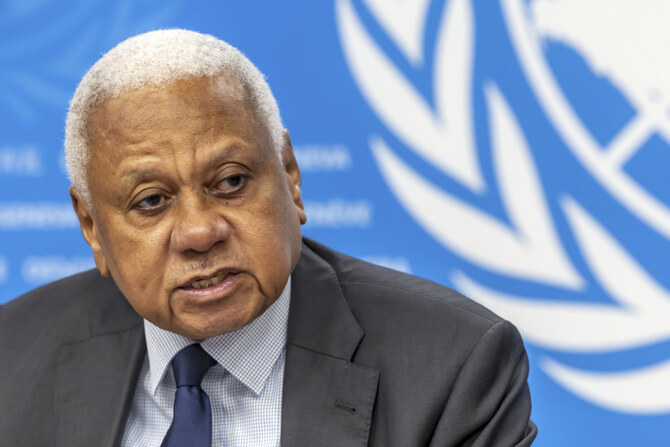
Mohamed Chande Othman, chair of the of the United Nations Fact-Finding Mission, presented its first investigative report to the media during a press conference at the European headquarters of the UN in Geneva, Switzerland, on Sept. 6, 2024. (Keystone via AP, File)
Short Url
Updated 02 November 2024
Follow

Head of UN-backed team of experts cites RSF paramilitaries in Sudan for sexual violence as war rages

  • The fact-finding mission on Tuesday released a more comprehensive version of its report presented in September to the rights council
  • Earlier this week, the UN migration agency said 14 million people have been displaced either within Sudan or abroad because of the conflict

GENEVA: The head of a UN-backed fact-finding team looking into human rights violations and abuses in Sudan said Friday it found the paramilitary Rapid Support Forces responsible for large-scale sexual violence in areas that it controls.
Mohamed Chande Othman has denounced “staggering violence” in Sudan since war broke out more than 18 months ago between the Sudanese military and the RSF, starting with open fighting in the capital, Khartoum, that later spread across the country.
“We said in our report that we attribute sexual gender-based violence to RSF in West Darfur, in Darfur, in greater Khartoum, and in Al-Gezira (state),” the Tanzanian lawyer said Friday by phone from Zimbabwe, where he was attending a conference.
However, Othman said a renewed mandate from the UN Human Rights Council would allow his team of independent experts to investigate “credible” allegations of sexual exploitation by the Sudanese armed forces as well.
Sudan plunged into conflict in mid-April 2023, when long-simmering tensions between its military and paramilitary leaders broke out in the capital Khartoum and spread to other regions including western Darfur. The war has killed more than 24,000 people so far, according to Armed Conflict Location and Event Data, a group monitoring the conflict since it started.
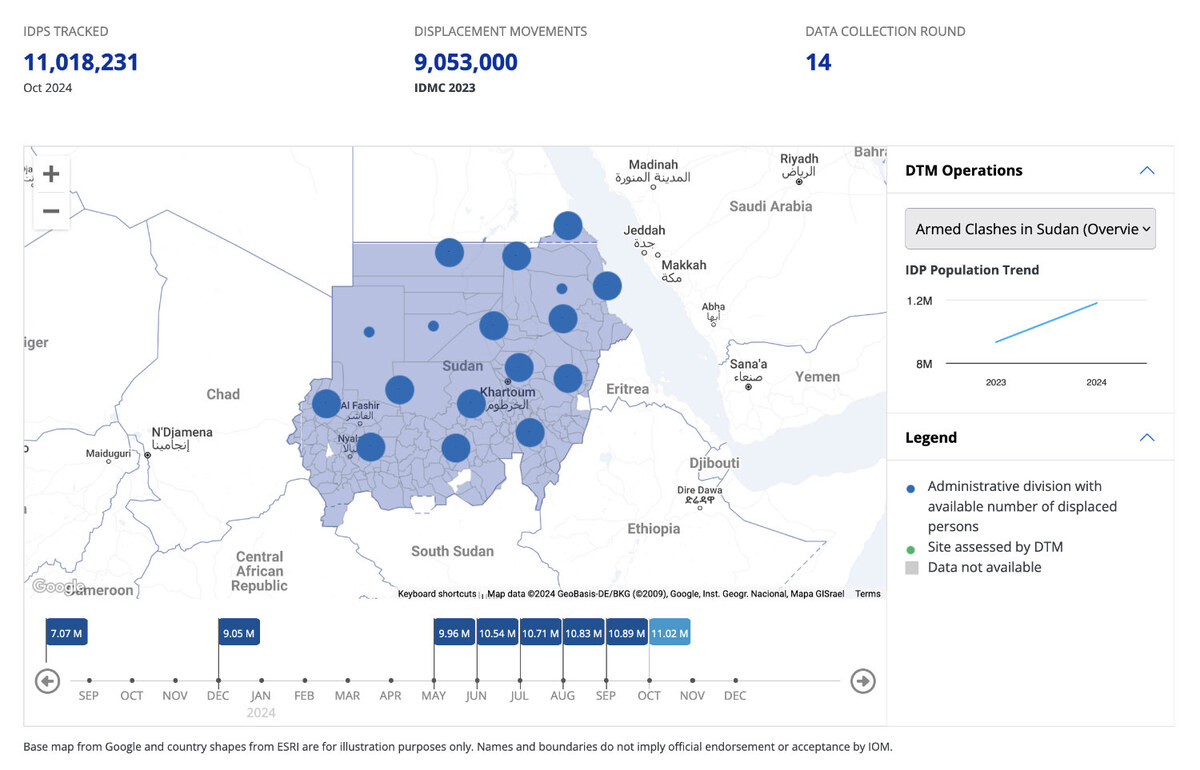


Infographic courtesy of UN International Migration Office

The fact-finding mission on Tuesday released a more comprehensive version of its report presented in September to the rights council, which has 47 member countries. The broader report cited gang rapes, sexual slavery and the abduction of victims in areas the RSF controls.
“It’s important to highlight the horrendous nature and the widespread nature — the patterns of violence — that were committed,” Othman said.
His team found the sexual violence and allegations of enforced marriages and human trafficking across borders for sexual purposes took place mostly during invasions of towns and cities.
“Victims and witnesses consistently reported that perpetrators threatened them with weapons, including firearms, knives and whips to intimidate and coerce them,” the latest report said, citing violence like punching, beatings with sticks, and lashing before and during rape.
“Men and boys were also reportedly targeted while in detention with sexual violence, including rape, threats of rape, forced nudity and beating on the genitals, requiring further investigation,” it added.
The violence in Sudan has been unrelenting. On Sunday, a doctors group and the United Nations reported that RSF fighters in east central Sudan’s Jazirah state carried out a multi-day attack that killed more than 120 people in one town.
On Tuesday, the UN migration agency said 14 million people — or over 30 percent of the country’s population — have been displaced either within Sudan or abroad because of the conflict, making it the world’s largest displacement crisis.
UN Secretary-General Antonio Guterres strongly condemned the RSF attacks in Jazirah and the appalling reports of a large number of killings, detentions and acts of sexual violence against women and girls as well as the looting of homes and markets, and the burning of farms, his spokesman said.
“Such acts may constitute serious violations of international humanitarian law and human rights law,” UN spokesman Stephane Dujarric said. “Perpetrators of such serious violations must be held accountable.”
The UN chief reiterated his call for a ceasefire, expressed alarm at the worsening humanitarian situation in Sudan and demanded that all parties facilitate the delivery of humanitarian aid, Dujarric said.


IMF approves reviews, unlocks $240m in funding for Jordan

Updated 11 sec ago
Follow

IMF approves reviews, unlocks $240m in funding for Jordan

  • The decision allows Jordan to draw about $130 million under the EFF and about $110 million under the RSF

AMMAN: The International Monetary Fund’s executive board has completed the fourth review of Jordan’s Extended Fund Facility and the first review under the Resilience and Sustainability Facility, unlocking immediate access to about $240 million to support the Kingdom’s economic program.

The decision allows Jordan to draw about $130 million under the EFF and about $110 million under the RSF, bringing total disbursements under the IMF arrangement to about $733 million.

In a statement issued on Saturday, the IMF said Jordan’s economy “remains resilient,” supported by sound macroeconomic policies and strong international backing.

Growth accelerated to 2.7 percent in the first half of 2025 and is expected to reach about 3 percent in the coming years, driven by major investment projects, deeper regional integration and continued structural reforms.

Inflation remains anchored at about 2 percent, while the current account deficit is projected to narrow to below 5 percent of GDP over the medium term. The IMF also noted that Jordan’s banking sector is stable and international reserves remain strong.

Fiscal performance continues to align with program targets, underpinned by robust revenue collection and disciplined current spending. The authorities remain committed to reducing public debt to 80 percent of GDP by 2028 through gradual fiscal consolidation, while protecting social and development spending and reducing losses at public utilities.

The IMF said progress under the RSF is ongoing, with reforms addressing vulnerabilities in the water and electricity sectors and strengthening health emergency preparedness. All reform measures scheduled for the current review have been completed.

Commenting after the board discussion, IMF Deputy Managing Director Kenji Okamura said Jordan’s continued macroeconomic stability amid persistent external headwinds reflects the authorities’ commitment to sound policies, supported by strong international assistance.

He said growth continues to recover, inflation remains low and reserve buffers are strong, stressing the importance of maintaining prudent fiscal and monetary policies amid regional tensions and global uncertainty.

Okamura added that accelerated structural reforms are essential to foster job-rich growth, improve the business environment, enhance labour market flexibility, tackle youth unemployment and low female labour force participation, and attract private investment.

He also underlined the importance of sustained donor support to help Jordan manage external challenges and the economic cost of hosting large numbers of refugees, while noting that progress under the RSF would help address long-term vulnerabilities and strengthen balance-of-payments stability.