

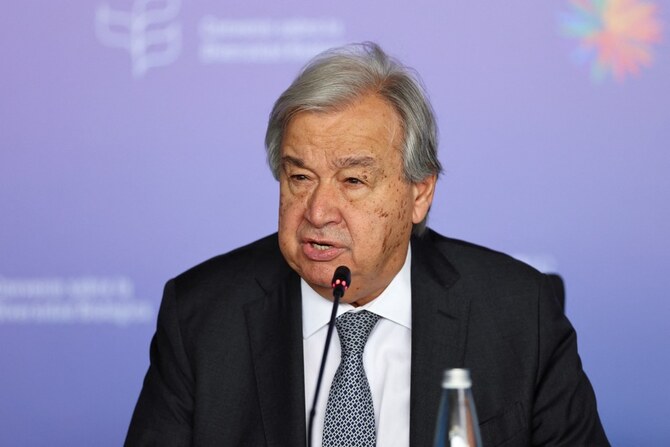

UNITED NATIONS: United Nations Secretary-General Antonio Guterres condemned on Friday reported attacks on civilians by Sudan’s paramilitary Rapid Support Forces as Britain said it would push for a UN Security Council resolution on the more than 18-month long conflict.
War erupted in mid-April 2023 from a power struggle between the Sudanese army and the paramilitary Rapid Support Forces ahead of a planned transition to civilian rule, and triggered the world’s largest displacement crisis.
The current war has produced waves of ethnically driven violence blamed largely on the RSF. The RSF has allegedly killed at least 124 people in a village in El Gezira State last month, activists said, in one of the conflict’s deadliest incidents.
The RSF has accused the army of arming civilians in Gezira. The RSF has previously denied harming civilians in Sudan and attributed the activity to rogue actors.
Guterres was appalled by “reports of large numbers of civilians being killed, detained and displaced, acts of sexual violence against women and girls, the looting of homes and markets and the burning of farms,” said a UN spokesperson.
“Such acts may constitute serious violations of international humanitarian law and human rights law. Perpetrators of such serious violations must be held accountable,” UN spokesperson Stephane Dujarric said.
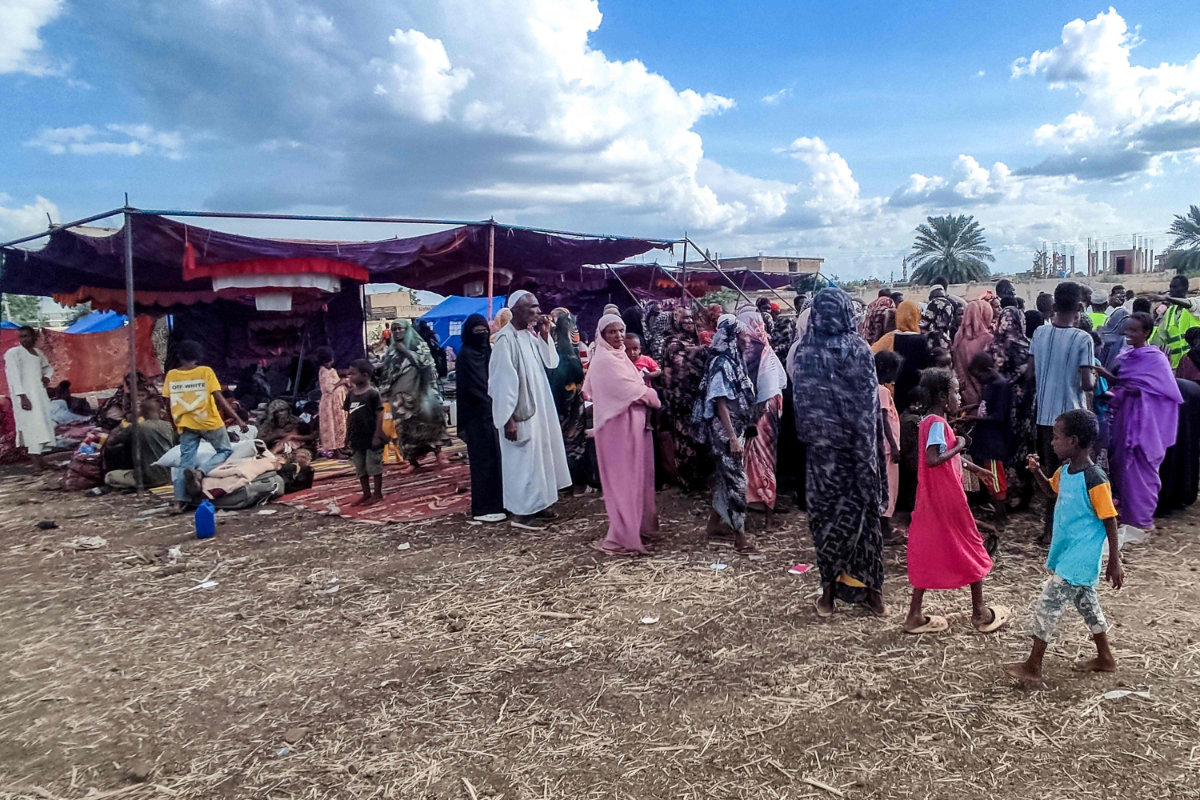
Sudanese people fleeing the Jazirah district arrive at a camp for the displaced in the eastern city of Gedaref on October 31, 2024. (AFP)
ritain, which assumed the presidency on Friday of the Security Council for November, said the 15-member body would meet on Sudan on Nov. 12 to discuss “scaling up aid delivery and ensuring greater protection of civilians by all sides.”
“We will be shortly introducing a draft Security Council resolution ... to drive forward progress on this,” Britain’s UN Ambassador Barbara Woodward told a press conference.
She said the draft would focus on “developing a compliance mechanism for the warring parties commitments they made on the protection of civilians in Jeddah over a year ago in 2023 and ways to support mediation efforts to deliver a ceasefire, even if we start local ceasefires before moving to a national one.”
A resolution needs at least 9 votes in favor and no vetoes by the US, France, Britain, Russia or China to be adopted.
The move comes as a three-month approval given by Sudanese authorities for the UN and aid groups to use the Adre border crossing with Chad to reach Darfur with humanitarian assistance is due to expire in mid-November.
The Sudanese army-backed government is committed to facilitate aid deliveries across the country, including in areas controlled by the RSF, Sudan’s UN Ambassador Al-Harith Idriss Al-Harith Mohamed said on Monday.
Russia’s UN Ambassador Vassily Nebenzia said on Monday that it was up to the Sudanese government to decide on whether the Adre crossing would remain open beyond mid-November and that it would be “inappropriate to put pressure on” the government.
“We’re categorically opposed to the politicization of humanitarian assistance,” he said. “We believe that any humanitarian assistance should be conducted and delivered solely with the central authorities in the loop.”
The UN Office for Humanitarian Affairs said more than 119,000 people had fled from the recent surge of violence in El Gezira state. The Rapid Support Forces launched their latest attacks there after a high-ranking officer from the area switched sides to the army.
War has raged in Sudan since April 2023 between the army under Abdel Fattah Al-Burhan and paramilitary forces led by his former deputy Mohammed Hamdan Dagalo.
The conflict has killed up to 150,000 people, displaced nearly eight million and caused the world’s worst humanitarian crisis. More than half the population face acute hunger.


