

Dead or alive? Scores missing after paramilitary group’s attacks in Sudan’s Al-Jazira state

1 / 3
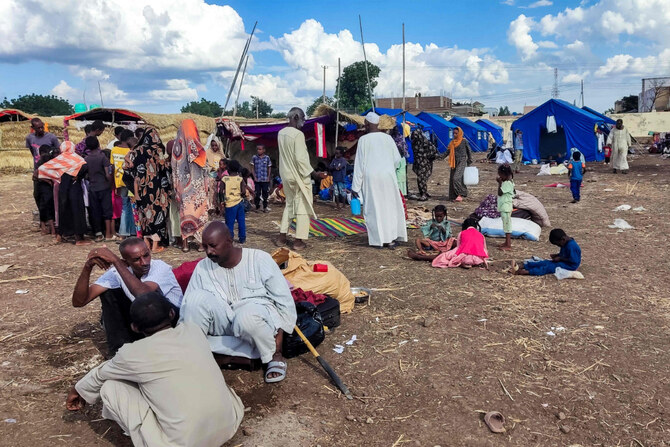
Sudanese people fleeing the Jazirah district arrive at a camp for the displaced in the eastern city of Gedaref on Oct. 31, 2024. (AFP)
2 / 3
Sudanese people fleeing the Jazirah district arrive at a camp for the displaced in the eastern city of Gedaref on Oct. 31, 2024. (AFP)
3 / 3
Students from Sudan, displaced with their families due to the war in their homeland, attend class at the Al-Takamul School for the Sudanese community in Libya, in Misrata, on Oct. 27, 2024. (REUTERS)
Short Url
Updated 01 November 2024
Follow

Dead or alive? Scores missing after paramilitary group’s attacks in Sudan’s Al-Jazira state

  • Mohamed Hamdan Dagalo's paramilitary RSF has been accused of killing people and "looting property including from markets and hospitals”
  • Amnesty International said the RSF had gone berserk in eastern Al-Jazira state after a high-ranking officer defected to the national army

NEW HALFA, Sudan: Khadir Ali and his family managed to survive a harrowing paramilitary attack in war-torn Sudan. But by the time they got to safety, he realized that one person was missing.
“We escaped in total chaos — there was gunfire coming from every direction,” said the 47-year-old civil servant of the October 22 Rapid Support Forces attack on Rufaa in Al-Jazira state.
“But once we got out of the city, we noticed my nephew wasn’t with us,” he said.
Mohammed, 17, suffers from a congenital skin condition and “needs special care.”
The teenager is among scores of people reported missing as the RSF stages major attacks across eastern Al-Jazira state after a high-ranking officer from the area defected to the army.
In retaliation, the RSF has been “killing people in their homes, in markets and on the streets, and looting property including from markets and hospitals,” rights group Amnesty International said on Wednesday.
“Six days have passed, and we know nothing about him,” Ali said, speaking in New Halfa in Kassala state.
He and his family have taken refuge there after an arduous 150-kilometer (90-mile) journey.
At least 124 people have been killed and dozens wounded in the fighting in Al-Jazira state over the past 10 days, according to the United Nations.
The death toll for the whole month is at least 200.
War has raged in Sudan since April 2023 between the army under the country’s de facto ruler Abdel Fattah Al-Burhan and the RSF, led by his former deputy Mohamed Hamdan Dagalo.
The conflict has triggered one of the world’s worst humanitarian crises. More than half the population — 25 million people — face acute hunger.

Many people missing
The UN Office for Humanitarian Affairs (OCHA) reports that more than 119,000 people have fled from Al-Jazira state amid the recent surge of violence.
Mohamed Al-Obaid from Al-Hajjilij village in the state told AFP his story.
“So far, we’ve counted 170 missing from our village. Entire families are unaccounted for,” he said from New Halfa, where some children arrive unaccompanied by family members.
Since February, communications networks and Internet services have been almost entirely severed in the state, making it practically impossible to check on someone’s whereabouts.
Activist Ali Bashir, who helps people get away from villages in eastern Al-Jazira, said “the communications blackouts are making the missing persons crisis even worse.”
Sudanese social media are filled with posts about missing persons, with activists sharing the pictures and names, many of them children or elderly.
Earlier this month, intense clashes between the army and the RSF spread to Al-Jazira’s Tamboul city.
Just hours after the army said it had taken control of Tamboul, witnesses reported that the paramilitaries were continuing to operate there, causing thousands of civilians to flee.
Among them was trader Osman Abdel Karim, who lost track of two of his sons during fighting on October 19.
“Two of my sons, one 15 and the other 13, were outside when the attack began that Saturday night, and we had to leave without them,” the 43-year-old said.
“Ten days have passed, and we don’t know if they’re dead or alive.”


UN-sanctioned migrant smuggler killed in western Libya

A boat used by migrants is seen near the western town of Sabratha, Libya March 19, 2019. (REUTERS)
Updated 13 December 2025
Follow

UN-sanctioned migrant smuggler killed in western Libya

  • In June 2018, the UN Security Council imposed sanctions on Al-Dabbashi, along with another five Libyan traffickers

CAIRO: A notorious militia leader in Libya, sanctioned by the UN for migrant trafficking across the Mediterranean Sea, was killed on Friday in a raid by security forces in the west of the country, according to Libyan authorities.
Ahmed Oumar Al-Fitouri Al-Dabbashi, nicknamed Ammu, was killed in the western city of Sabratha when security forces raided his hideout. The raid came in response to an attack on a security outpost by Al-Dabbashi’s militia, which left six members of the security forces severely wounded, according to a statement issued by the Security Threat Enforcement Agency, a security entity affiliated with Libya’s western government.
Al-Dabbashi, who was also sanctioned by the US Treasury for trafficking, was the leader of a powerful militia, the “Brigade of the Martyr Anas Al-Dabbashi,” in Sabratha, the biggest launching point in Libya for Europe-bound African migrants.
Al-Dabbashi’s brother Saleh Al-Dabbashi, another alleged trafficker, was arrested in the same raid, added the statement.
In June 2018, the UN Security Council imposed sanctions on Al-Dabbashi, along with another five Libyan traffickers. At the time, the UN report said that there was enough evidence that Al-Dabbashi’s militia controlled departure areas for migrants, camps, safe houses and boats.
Al-Dabbashi himself exposed migrants, including children, to “fatal circumstances” on land and at sea, and of threatening peace and stability in Libya and neighboring countries, according to the same report.
Al-Dabbashi was also sanctioned by the US Treasury for the same reason.
Libya has been a main transit point for migrants fleeing war and poverty in Africa and the Middle East. The country was plunged into chaos following a NATO-backed uprising that toppled and killed longtime autocrat Muammar Qaddafi in 2011.
The country has been fragmented for years between rival administrations based in the east and the west of Libya, each backed by various armed militias and foreign governments.