

Dead or alive? Scores missing after paramilitary group’s attacks in Sudan’s Al-Jazira state

1 / 3
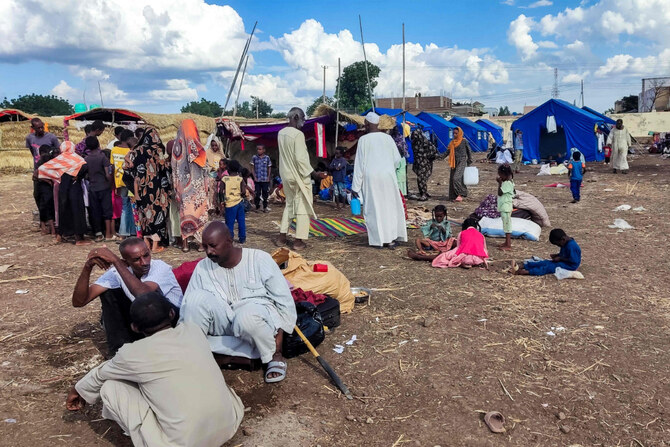
Sudanese people fleeing the Jazirah district arrive at a camp for the displaced in the eastern city of Gedaref on Oct. 31, 2024. (AFP)
2 / 3
Sudanese people fleeing the Jazirah district arrive at a camp for the displaced in the eastern city of Gedaref on Oct. 31, 2024. (AFP)
3 / 3
Students from Sudan, displaced with their families due to the war in their homeland, attend class at the Al-Takamul School for the Sudanese community in Libya, in Misrata, on Oct. 27, 2024. (REUTERS)
Short Url
Updated 01 November 2024
Follow

Dead or alive? Scores missing after paramilitary group’s attacks in Sudan’s Al-Jazira state

  • Mohamed Hamdan Dagalo's paramilitary RSF has been accused of killing people and "looting property including from markets and hospitals”
  • Amnesty International said the RSF had gone berserk in eastern Al-Jazira state after a high-ranking officer defected to the national army

NEW HALFA, Sudan: Khadir Ali and his family managed to survive a harrowing paramilitary attack in war-torn Sudan. But by the time they got to safety, he realized that one person was missing.
“We escaped in total chaos — there was gunfire coming from every direction,” said the 47-year-old civil servant of the October 22 Rapid Support Forces attack on Rufaa in Al-Jazira state.
“But once we got out of the city, we noticed my nephew wasn’t with us,” he said.
Mohammed, 17, suffers from a congenital skin condition and “needs special care.”
The teenager is among scores of people reported missing as the RSF stages major attacks across eastern Al-Jazira state after a high-ranking officer from the area defected to the army.
In retaliation, the RSF has been “killing people in their homes, in markets and on the streets, and looting property including from markets and hospitals,” rights group Amnesty International said on Wednesday.
“Six days have passed, and we know nothing about him,” Ali said, speaking in New Halfa in Kassala state.
He and his family have taken refuge there after an arduous 150-kilometer (90-mile) journey.
At least 124 people have been killed and dozens wounded in the fighting in Al-Jazira state over the past 10 days, according to the United Nations.
The death toll for the whole month is at least 200.
War has raged in Sudan since April 2023 between the army under the country’s de facto ruler Abdel Fattah Al-Burhan and the RSF, led by his former deputy Mohamed Hamdan Dagalo.
The conflict has triggered one of the world’s worst humanitarian crises. More than half the population — 25 million people — face acute hunger.

Many people missing
The UN Office for Humanitarian Affairs (OCHA) reports that more than 119,000 people have fled from Al-Jazira state amid the recent surge of violence.
Mohamed Al-Obaid from Al-Hajjilij village in the state told AFP his story.
“So far, we’ve counted 170 missing from our village. Entire families are unaccounted for,” he said from New Halfa, where some children arrive unaccompanied by family members.
Since February, communications networks and Internet services have been almost entirely severed in the state, making it practically impossible to check on someone’s whereabouts.
Activist Ali Bashir, who helps people get away from villages in eastern Al-Jazira, said “the communications blackouts are making the missing persons crisis even worse.”
Sudanese social media are filled with posts about missing persons, with activists sharing the pictures and names, many of them children or elderly.
Earlier this month, intense clashes between the army and the RSF spread to Al-Jazira’s Tamboul city.
Just hours after the army said it had taken control of Tamboul, witnesses reported that the paramilitaries were continuing to operate there, causing thousands of civilians to flee.
Among them was trader Osman Abdel Karim, who lost track of two of his sons during fighting on October 19.
“Two of my sons, one 15 and the other 13, were outside when the attack began that Saturday night, and we had to leave without them,” the 43-year-old said.
“Ten days have passed, and we don’t know if they’re dead or alive.”


First AI-aided transaction in Dubai promises to change way consumers shop

Updated 15 min 3 sec ago
Follow

First AI-aided transaction in Dubai promises to change way consumers shop

  • Artificial intelligence agent purchases movie tickets for a customer after asking a few questions

DUBAI: CEO of Mastercard Michael Miebach announced on Tuesday that the company, in conjunction with UAE retailer Majid Al-Futtaim, had successfully completed the first transaction by an AI agent in Dubai.

An AI agent purchased movie tickets for a customer after asking a few questions during the transaction.

Speaking at the Dubai Future Forum alongside UAE Minister of State for Artificial Intelligence Omar Al-Olama, Miebach said that in the future “AI agents” would guide most transactions.

Al-Olama hailed the transaction, saying it was part of a future that would streamline the way people consumed online and in person.

“I saw that transaction, I found it extremely seamless,” Olama told the crowd at the Museum of the Future. “It’s very, very convenient, and it’s like having the best personal assistant that will do everything for you, select the movie, get your best seats, find the best timing, the closest location to you, and make a payment without many instructions. And that’s why it stood out.”

While retail chatbots that help customers have been around for some time, Mastercard’s new agentic solution differs in that it is able to make the transaction directly, working like a real-life assistant with access to your finances.

Asked by Al-Olama whether this risked agentic AI going on shopping sprees without consent, likening it to giving away card details to your child, Miebach said that the risk could be mitigated through the right mix of controls and regulation.

“If you think about it from a perspective of powering a digital economy in a country like the UAE, a lot of things need to have (happened) in the background to make it safe, to make it secure, to make it intuitive,” Miebach told the forum.

“When AI starts to make decisions on your behalf for shopping, that can be very scary. So, we (have) got to put in the controls, and all of that is what Mastercard’s Agent Pay has done.”

Miebach said that he envisioned a future where agents would start to understand your preferences for groceries, movies and retail items and make purchases seamlessly when asked, which would substantially streamline the experience of customers.

But he believed that before the technology could really take off, companies and governments would have to gain the trust of individuals and communities.

“What happens if something goes wrong in the world of an AI-generated transaction? And so, what do you do as a consumer? You say, I never intended to do this transaction, and you lose trust,” Miebach said.

“So we have to build in the safeguards. We have to build in the controls. And that is what our business does for a living. That’s what regulators look at. I think it’s really important.”