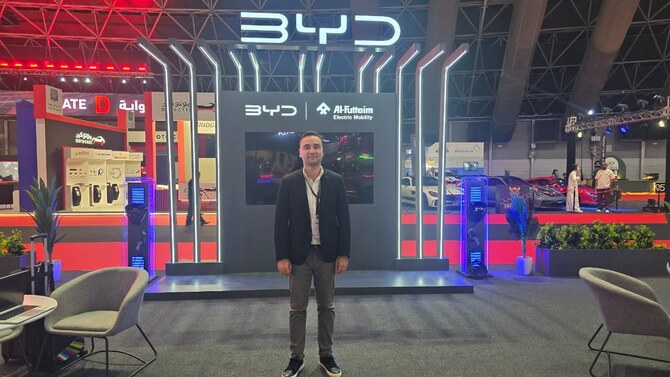

JEDDAH: Saudi Arabia’s ambitious drive to electrify its transportation sector is set to gain momentum with the entry of Al-Futtaim Electric Mobility Co., which plans to generate over 1,000 local jobs and train the Kingdom’s youth.
Speaking to Arab News during the Jeddah International Motor Show, managing director Hasan Nergiz said that any Saudi aspiring to lead in the electric vehicle industry can learn how to do so within the Kingdom.
“Previously, we had to send people to China, Dubai, or other parts of the world for training. We decided to make a local investment instead, training individuals in the Kingdom. This qualified workforce will become the future leaders of the electric vehicle market,” he said.
“This is coming through our sales force, from headquarters, master technicians, technicians, and the entire after-sales team. So, our commitment is creating job opportunities,” Nergiz added.

Saudi Arabia is hosting the eighth edition of the Future Investment Initiative summit in Riyadh. AN/Abdulrahman bin Shalhuob
He explained that these would be EV-specific jobs. “In the world, these skills are very sparse. This is exactly the reason why we are going to open our first technical center in Riyadh with the simulators that we can bring,” Nergiz said.
The executive added that Al-Futtaim Group has been exploring opportunities in Saudi Arabia’s passenger car market, having already been in the Kingdom for more than 15 years with construction equipment and commercial vehicles.
“We have our retail business here and we have our other investment, but for the passenger cars, which is the flagship of the Al-Futtaim Group, BYD was a fantastic opportunity to enter the market,” he said.
He pointed out that Saudi Arabia and the UAE account for nearly 80 percent of the Gulf Cooperation Council automotive market, and establishing a strong presence in these countries allows them to dominate the regional opportunity.
Highlighting Saudi Arabia’s ambitious Vision 2030 targets — such as converting 30 percent of Riyadh’s vehicles to electric by 2030 — Nergiz expressed confidence in the region’s commitment to an electric future.
On the topic of charging infrastructure, he explained that customers’ top barriers to adopting EV technology are price and access to charging. For this, their strategy involves partnerships with local companies.

Saudi Arabia is hosting the eighth edition of the Future Investment Initiative summit in Riyadh. AN/Abdulrahman bin Shalhuob
“There are already a lot of private companies or government-sponsored companies that have put huge investments, and they are committed, up to 2030, to build this infrastructure. So, I think the partnership is the best for the consumer because these companies, ready to build the infrastructure, need the utilization, and they need more electric vehicles on the road,” he said.
The company signed its first memorandum of understanding with Turning Point, a charging company, during the EV Auto Show 2024 held in Riyadh, and is on the verge of inking another with one of the country’s largest charging companies.
“We do not look at charging as a separate competition, because if everybody comes ... and they try to get their limited pie of the market, the market will never grow. Partnership is the right approach in the Kingdom,” he said.
Nergiz added that they are confident this approach will benefit the local economy. He stressed that charging points should be widely available, with options for home, destination, and the office, as well as along highways and key locations between major cities.
Commenting on the competitive landscape, Nergiz highlighted a two-fold view that balances future potential with present realities.
He emphasized that the long-term outlook for EVs is promising, largely due to the Saudi government’s Vision 2030, but acknowledged that technology is still relatively new in the market.
Additionally, the infrastructure to support it — particularly the charging network — is in its early stages.

Saudi Arabia is hosting the eighth edition of the Future Investment Initiative summit in Riyadh. AN/Abdulrahman bin Shalhuob
He added that only a few companies, including some legacy automakers, have launched EVs in the market, making it somewhat nascent.
Nergiz highlighted BYD’s advantage in offering both fully electric vehicles and plug-in hybrids.
“One of the good things about BYD is that we have two technologies: electric vehicles and plug-in hybrids, and if you look at the hybrid market, which is growing massively because the big market players have their hybrid models, and the customers appreciate the benefits of the fuel-saving or total cost of ownership, it’s already accepted technology,” he said.
The managing director explained the brands were launched in March 2024 with pop-up showrooms in five Cenomi malls. They currently have two in Riyadh, one in Jeddah, and two in Dammam. He stressed the importance of being present in these major cities from day one.
“In June, we opened our first discovery centers in Riyadh. Last month, we opened our first showroom in Jeddah, and, in a few months, we will also open our first showroom in Dammam,” he said.
He mentioned that the pop-up strategy, aimed at introducing the brand in high-footfall shopping malls, is transitioning to permanent locations in three cities, and they are also considering building more.
Nergiz stated that they will open their first body-and-paint facility in Riyadh next month, which will also serve as a training center for technicians. In a few months, he added, they will launch a similar workshop and training center in Jeddah while working on initiatives in Dammam, emphasizing their focus on selling technology rather than cars.
Additionally, they are establishing spare-part distribution centers in Riyadh and other regions as part of their expansion strategy in the Saudi market.
On product offerings, Nergiz highlighted BYD’s dual technologies — electric and plug-in hybrids — as well as its competitive pricing and comprehensive features, which include enhanced safety and connectivity options typically seen in luxury segments.
“BYD actually started as a battery company. They are the world’s best battery technology provider. In fact, they also sell the likes of Toyota and Tesla their batteries. So, they are dead good,” he concluded.