North Korea may launch ICBM in November, launcher ready, South Korea says

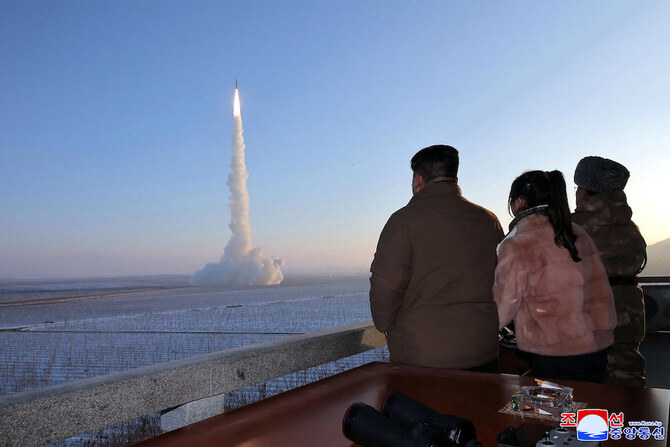
North Korean leader Kim Jong Un, left, and his daughter watch the test launch of a Hwasongpho-18 intercontinental ballistic missile at an undisclosed location in North Korea in this undated picture released on Dec. 19, 2023. (KCNA via KNS/AFP file photo)
Short Url
Updated 30 October 2024
Follow

North Korea may launch ICBM in November, launcher ready, South Korea says

  • South Korean MP Lee Seong-kweun said a mobile launcher has been deployed at a location for a possible test of the ICBM
  • Lee was briefed reporters after a closed-door parliamentary hearing with Defense Intelligence Agency officials

SEOUL: North Korea has moved a launcher in place after completing preparations to launch an intercontinental ballistic missile and may go ahead with the launch in November, South Korean members of parliament said on Wednesday citing the country’s military intelligence.
South Korean MP Lee Seong-kweun said a mobile launcher has been deployed at a location for a possible test of the ICBM and its atmospheric re-entry of a missile warhead, potentially around the time of the US presidential election Nov. 5.
Lee was briefing reporters after a closed-door parliamentary hearing with Defense Intelligence Agency officials.
Another MP Park Sun-won said the DIA did not believe a missile was yet loaded on the launcher.
South Korean officials have said the North may attempt to launch a long-range missile or conduct its seventh nuclear test around the November US election to highlight its strategic weapons development.


Indonesia threatens to ban Musk’s Grok AI over degrading images of children and women

Updated 5 sec ago
Follow

Indonesia threatens to ban Musk’s Grok AI over degrading images of children and women

  • Grok has been complying with user requests to alter images of real people  
  • Other countries, including Malaysia and France, have also threatened action against X 

JAKARTA: Indonesia’s Communications Ministry threatened on Wednesday to ban Elon Musk’s X and its artificial intelligence chatbot Grok after degrading pictures of women and children generated without consent surged on the social media platform. 

Grok has been complying with requests from X users to modify images of real women and children stripped to their underwear, creating a viral trend that has sparked concerns across the globe. 

A preliminary investigation found that Grok “does not yet have explicit and adequate regulations to prevent the production and distribution of pornographic content based on real photos” of Indonesian citizens,” Indonesia’s Ministry of Communications and Digital Affairs said in a statement. 

Indonesia has strict laws against the production and distribution of pornography, with the government regularly instructing internet service providers to block access to websites containing such content. 

“The obligation to comply with Indonesian laws and regulations applies to all digital platforms operating in Indonesia,” the ministry said. 

“Should there be non-compliance or lack of cooperation, the Ministry of Communications and Digital Affairs may impose administrative sanctions, including termination of access to Grok’s AI services and the X platform.” 

Indonesia has joined a growing list of countries, which includes Malaysia, India and France, that are calling for investigations and threatening action against Grok.

Concerns grew after a December update to the chatbot made it easier for users to post photographs of people and ask for their clothing to be removed.

In a report published on Tuesday, European non-profit organization AI Forensics said Grok is “systematically ‘undressing’ women.”  

Its analysis of 20,000 images generated by Grok between Dec. 25 and Jan.1 found that 53 percent of them contained individuals in minimal attire, with 81 percent of them being women, while two percent of the images depicted persons appearing to be 18 years old or younger. 

Indonesia’s Communications Ministry said AI service providers and users are also subject to administrative or criminal sanctions under Indonesian law if they are proven to have produced or distributed pornographic content or modified personal images without permission. 

“Every digital platform must ensure that the technology they provide does not become a medium for privacy violation, sexual exploitation or the degradation of a person’s dignity,” said Alexander Sabar, director-general of digital space at the ministry.  

“We urge all parties to use artificial intelligence technology responsibly. The digital space is not a lawless space; every citizen’s privacy and right to their image must be respected and protected.”