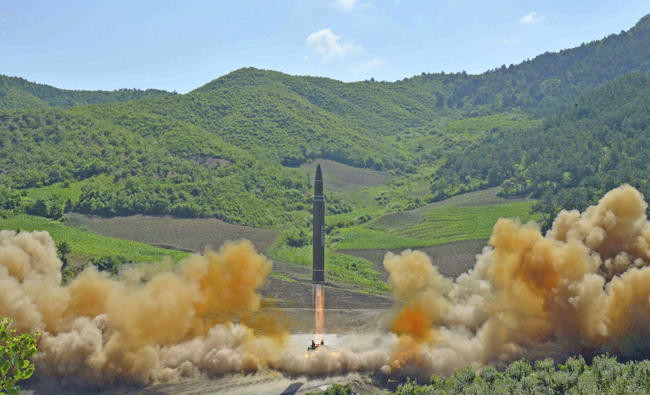
SEOUL/TOKYO: North Korea fired a missile on Friday that experts said was capable of reaching cities in the United States and US and South Korean military officials responded by discussing military options.
The unusual late-night launch added to exasperation in Washington, Seoul and Tokyo over North Korea’s continuing development of nuclear weapons and intercontinental ballistic missiles (ICBMs) to deliver them. North Korean President Kim Jong Un’s military raised alarms early this month with an ICBM launch.
“As a result of their launches of ICBM-level missiles, this clearly shows the threat to our nation’s safety is severe and real,” said Japanese Prime Minister Shinzo Abe, who planned to call a meeting of his National Security Council.
Following a meeting of South Korea’s National Security Council, South Korean President Moon Jae-in said he wanted the UN Security Council to discuss new and stronger sanctions against the North, the presidential Blue House said.
Moon also ordered discussions to be held with the United States on deploying additional THAAD anti-missile defense units, his office said.
The top US military official, Joint Chiefs of Staff Chairman Joseph Dunford, spoke by phone with his South Korean counterpart, General Lee Sun-jin, to discuss military response options to the launch. Dunford and Admiral Harry Harris, commander of US Pacific Command who was also on the call, reinforced the US commitment to the alliance with South Korea.
The launch from North Korea’s northern Jangang province took place at 11:41 p.m. (1441 GMT), an official at South Korea’s Office of the Joint Chiefs of Staff said.
Japanese Chief Cabinet Secretary Yoshihide Suga said the missile flew for about 45 minutes before apparently landing in the waters of Japan’s exclusive economic zone. Japanese broadcaster NHK, citing a military official, said the missile reached an altitude of more than 3,000 km (1,860 miles).
US cities in range
South Korean military said the missile was believed to be an ICBM-class, flying more than 1,000 km (620 miles) and reaching an altitude of 3,700 km (2,300 miles). In Washington, the Pentagon also said it had assessed that the missile was an ICBM.
Jeffrey Lewis of the California-based Middlebury Institute of International Studies said the launch showed Los Angeles was within range of a North Korean missile, with Chicago, New York and Washington, just out of reach.
“They may not have demonstrated the full range. The computer models suggest it can hit all of those targets,” he said.
The US-based Union of Concerned Scientists said its calculations showed the missile could have been capable of going as far into the United States as Denver and Chicago.
Michael Elleman of the International Institute for Strategic Studies said the window for a diplomatic solution with North Korea “is closing rapidly.”
“The key here is that North Korea has a second successful test in less than one month,” he said. “If this trend holds, they could establish an acceptably reliable ICBM before year’s end.”
US President Donald Trump spoke with Abe and Chinese President Xi Jinping about North Korea’s nuclear arsenal this month and has become frustrated that China has not reined in its ally Pyongyang. As of mid-afternoon on Friday the White House had not responded to the latest ICBM launch.
“Another advance for North Korea’s missile program amplifies the danger to the US homeland and accelerates the need for us to take steps to protect our people and our allies,” said Representative Mac Thornberry, chairman of the House Armed Services Committee. “We need a stronger approach on a faster timeline now.”
Pentagon spokesman Captain Jeff Davis said Friday’s launch had been expected and took place from Mupyong-ni, an arms plant in northern North Korea.
The European Union called it “an outright violation” of international obligations and a serious threat to international peace and security, and urged North Korea to engage in dialogue to pursue denuclearization of the Korean peninsula.
EU foreign policy chief Federica Mogherini would discuss the matter with the foreign ministers of South Korea and other partners at the ASEAN ministerial meeting in Manila on Aug. 6-7.
The data on the trajectory indicate the missile was fired at a sharply lofted angle but packed more power than the missile launched on July 4 that USand South Korean officials said was an ICBM, potentially capable of hitting the US mainland.
A Russian Defense Ministry official said Moscow’s data indicated Friday’s missile was only a medium-range ballistic missile, Russian news agency Tass reported. Diplomats say China and Russia only view a long-range missile test or nuclear weapon test as a trigger for further possible UN sanctions.
North Korea claimed after the July 4 launch it had successfully tested an ICBM that flew 933 km (580 miles), reaching an altitude of 2,802 km over a flight time of 39 minutes and able to carry a large and heavy nuclear warhead.

North Korea tests another ICBM, putting US cities in range
European military mission set to begin in Greenland
NUUK: European military personnel were due to begin arriving in Greenland on Thursday, shortly after a meeting between American, Danish and Greenlandic officials in Washington failed to resolve “fundamental disagreement” over the mineral-rich, strategic Arctic island.
US President Donald Trump has repeatedly vowed to take control of the autonomous Danish territory, arguing that it is vital for US security.
France, Sweden, Germany and Norway announced Wednesday that they would deploy military personnel as part of a reconnaissance mission to Greenland’s capital Nuuk.
“Soldiers of NATO are expected to be more present in Greenland from today and in the coming days. It is expected that there will be more military flights and ships,” Greenland’s deputy prime minister Mute Egede told a news conference on Wednesday, adding they would be “training.”
“The first French military personnel are already on their way. Others will follow,” French President Emmanuel Macron said on X.
The deployment of a 13-strong Bundeswehr reconnaissance team to Nuuk from Thursday was at Denmark’s invitation, the German defense ministry said, adding it would run from Thursday to Sunday.
The deployment was announced on the same day that the foreign ministers of Denmark and Greenland met with US Vice President JD Vance and Secretary of State Marco Rubio in Washington.
Danish Foreign Minister Lars Lokke Rasmussen, speaking after leaving the White House, said a US takeover of Greenland was “absolutely not necessary.”
“We didn’t manage to change the American position. It’s clear that the president has this wish of conquering over Greenland,” Lokke told reporters.
“We therefore still have a fundamental disagreement, but we also agree to disagree.”
Trump, speaking after the meeting which he did not attend, for the first time sounded conciliatory on Greenland, acknowledging Denmark’s interests even if he again said he was not ruling out any options.
“I have a very good relationship with Denmark, and we’ll see how it all works out. I think something will work out,” Trump said without explaining further.
He again said Denmark was powerless if Russia or China wanted to occupy Greenland, but added: “There’s everything we can do.”
Trump has appeared emboldened on Greenland after ordering a deadly January 3 attack in Venezuela that removed president Nicolas Maduro.
On the streets of Nuuk, red and white Greenlandic flags flew in shop windows, on apartment balconies, and on cars and buses, in a show of national unity this week.
Some residents described anxiety from finding themselves at the center of the geopolitical spotlight.
“It’s very frightening because it’s such a big thing,” said Vera Stidsen, 51, a teacher in Nuuk.
“I hope that in the future we can continue to live as we have until now: in peace and without being disturbed,” Stidsen told AFP.
US President Donald Trump has repeatedly vowed to take control of the autonomous Danish territory, arguing that it is vital for US security.
France, Sweden, Germany and Norway announced Wednesday that they would deploy military personnel as part of a reconnaissance mission to Greenland’s capital Nuuk.
“Soldiers of NATO are expected to be more present in Greenland from today and in the coming days. It is expected that there will be more military flights and ships,” Greenland’s deputy prime minister Mute Egede told a news conference on Wednesday, adding they would be “training.”
“The first French military personnel are already on their way. Others will follow,” French President Emmanuel Macron said on X.
The deployment of a 13-strong Bundeswehr reconnaissance team to Nuuk from Thursday was at Denmark’s invitation, the German defense ministry said, adding it would run from Thursday to Sunday.
The deployment was announced on the same day that the foreign ministers of Denmark and Greenland met with US Vice President JD Vance and Secretary of State Marco Rubio in Washington.
Danish Foreign Minister Lars Lokke Rasmussen, speaking after leaving the White House, said a US takeover of Greenland was “absolutely not necessary.”
“We didn’t manage to change the American position. It’s clear that the president has this wish of conquering over Greenland,” Lokke told reporters.
“We therefore still have a fundamental disagreement, but we also agree to disagree.”
Trump, speaking after the meeting which he did not attend, for the first time sounded conciliatory on Greenland, acknowledging Denmark’s interests even if he again said he was not ruling out any options.
“I have a very good relationship with Denmark, and we’ll see how it all works out. I think something will work out,” Trump said without explaining further.
He again said Denmark was powerless if Russia or China wanted to occupy Greenland, but added: “There’s everything we can do.”
Trump has appeared emboldened on Greenland after ordering a deadly January 3 attack in Venezuela that removed president Nicolas Maduro.
On the streets of Nuuk, red and white Greenlandic flags flew in shop windows, on apartment balconies, and on cars and buses, in a show of national unity this week.
Some residents described anxiety from finding themselves at the center of the geopolitical spotlight.
“It’s very frightening because it’s such a big thing,” said Vera Stidsen, 51, a teacher in Nuuk.
“I hope that in the future we can continue to live as we have until now: in peace and without being disturbed,” Stidsen told AFP.
© 2026 SAUDI RESEARCH & PUBLISHING COMPANY, All Rights Reserved And subject to Terms of Use Agreement.