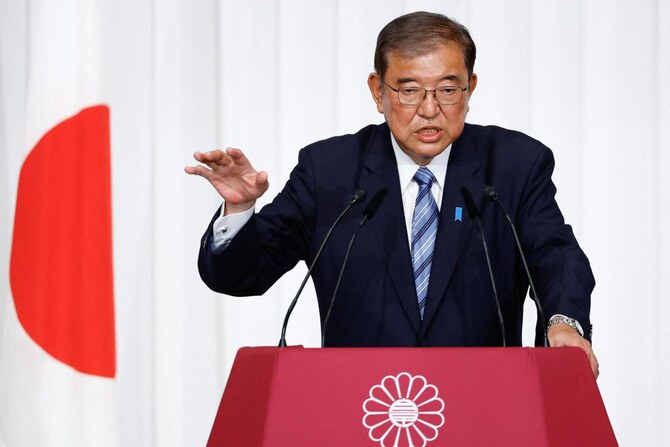
TOKYO: Support has sunk further for Japan’s embattled ruling coalition, a new poll showed Wednesday, after Prime Minister Shigeru Ishiba’s party suffered its worst election result in 15 years.
Backing for the government nosedived to 34 percent, while its disapproval rating came to 51 percent, according to the survey by the Yomiuri Shimbun daily.
In Ishiba’s short honeymoon period after taking office on October 1, the same survey found 51 percent supported his cabinet against 32 percent who didn’t.
A separate poll by Kyodo News released Tuesday had 53 percent saying they did not want the ruling coalition of the Liberal Democratic Party (LDP) and Komeito to stay in power.
Sunday’s snap election left the coalition short of a majority for the first time since 2009 — when it was booted out of power for three years — 18 seats short of the 233 needed.
Ishiba has already indicated he will seek to govern a minority administration and seek approval from other parties to get legislation through parliament.
That expectation was reinforced late Tuesday when the head of potential kingmaker the Democratic Party for the People (DPP), which has 28 seats, ruled out joining the LDP in a coalition government.
“We will give all of our strength to achieve our policies and we will not join the coalition,” DPP chief Yuichiro Tamaki said at a press conference.
However, Ishiba is still courting other parties including the centrist DPP to secure parliamentary approval to remain prime minister in a vote reportedly slated for November 11.
To win their support, analysts said that Ishiba may agree to tax cuts and stimulus spending that the DPP campaigned on in the snap election.
Also likely seeking to become premier will be Yoshihiko Noda, head of the Constitutional Democratic Party (CDP), whose seat tally rose from 96 in the last election to 148.
In a likely run-off vote, unseen in the past three decades, whoever wins the most votes will become the next leader, even if the person does not have a majority.
“The DPP is in an extremely strong position and holds a ‘casting vote’ that can decide the direction of political momentum,” Takahide Kiuchi, executive economist at Nomura Research Institute, said in a memo.

Support sinks for Japan coalition after election blow
https://arab.news/zu5k2
Support sinks for Japan coalition after election blow
- Sunday’s snap election left the ruling coalition short of a majority for the first time since 2009
- Shigeru Ishiba has already indicated he will seek to govern a minority administration
Trump says he asked Putin not to target Kyiv for 1 week during brutal cold spell
- “I personally asked President Putin not to fire on Kyiv and the cities and towns for a week during this ... extraordinary cold,” Trump said
- Zelensky, for his part, thanked Trump for his effort and welcomed the “possibility” of a pause
KYIV: US President Donald Trump said Thursday that President Vladimir Putin has agreed not to target the Ukrainian capital and other towns for one week as the region experiences frigid temperatures.
There was no immediate confirmation from the Kremlin that Putin has agreed to such a pause.
Russia has been pounding Ukraine’s critical infrastructure, hoping to wear down public resistance to the war while leaving many around the country having to endure the dead of winter without heat.
“I personally asked President Putin not to fire on Kyiv and the cities and towns for a week during this ... extraordinary cold,” Trump said during a Cabinet meeting at the White House, adding that Putin has “agreed to that.”
Kremlin spokesman Dmitry Peskov was asked earlier Thursday whether a mutual halt on strikes on energy facilities was being discussed between Russia and Ukraine, and he refused to comment on the issue.
Ukrainian President Volodymyr Zelensky late Wednesday had warned that Moscow was planning another large-scale barrage despite plans for further US-brokered peace talks at the weekend.
Trump said he was pleased that Putin has agreed to the pause. Kyiv, which has grappled with severe power shortages this winter, is forecast to enter a brutally cold stretch starting Friday that is expected to last into next week. Temperatures in some areas will drop to minus 30 degrees Celsius (minus 22 Fahrenheit), the State Emergency Service warned.
“A lot of people said, ‘Don’t waste the call. You’re not going to get that.’” the Republican US president said of his request of Putin. “And he did it. And we’re very happy that they did it.”
Zelensky, for his part, thanked Trump for his effort and welcomed the “possibility” of a pause in Russian military action on Kyiv and beyond. “Power supply is a foundation of life,” Zelensky said in his social media post.
Trump did not say when the call with Putin took place or when the ceasefire would go into effect. The White House did not immediately respond to a query seeking clarity about the scope and timing of the limited pause in the nearly four-year war.
Russia has sought to deny Ukrainian civilians heat and running water over the course of the war, which began with Russia’s full-scale invasion on Feb. 24, 2022. Ukrainian officials describe the strategy as “weaponizing winter.”
Last year was the deadliest for civilians in Ukraine since 2022 as Russia intensified its aerial barrages behind the front line, according to the UN Human Rights Monitoring Mission in the country.
The war killed 2,514 civilians and injured 12,142 in Ukraine — 31 percent higher than in 2024, it said.


