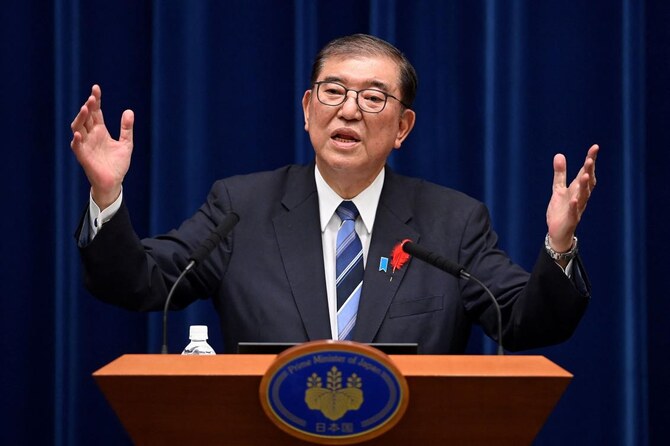
TOKYO: New Japanese Prime Minister Shigeru Ishiba’s snap election gamble could backfire this Sunday, with his ruling party at risk of losing its majority for the first time in 15 years.
Ishiba took office and called an election less than a month ago after a tough contest within the Liberal Democratic Party (LDP), which has governed for all but four of the last 69 years.
“This is an attempt to create a new Japan that will drastically change the nature of Japanese society,” he said. “To boldly carry out this major change, we need the confidence of the people.”
But polls suggest the LDP could fall short of the 233 lower house seats needed for a majority for the first time since 2009. They currently hold 256 seats.
This would be bad enough, but some polls suggest that even with its junior coalition partner, the Komeito party, Ishiba will be unable to form a government without forming other alliances.
Not helping matters is the popularity of Yoshihiko Noda, the new head of the opposition Constitutional Democratic Party and a former prime minister, who at 67 is the same age as Ishiba.
Noda’s stance “is sort of similar to the LDP’s. He is basically a conservative,” Masato Kamikubo, a political scientist at Ritsumeikan University, said.
“The CDP or Noda can be an alternative to the LDP. Many voters think so,” Kamikubo said.
Japan faces major challenges. With its population projected to drop by almost a third in the next 50 years, many sectors already struggle to fill vacancies.
The world’s fourth-biggest economy has long been flatlining, with a weak yen pushing up import prices in recent years, especially of fossil fuels which still dominate power generation.
Polls show that voters’ biggest worry is inflation, which along with a party slush fund scandal torpedoed Ishiba’s predecessor Fumio Kishida after three years in the job.
Japan already has one of the highest debt-to-GDP ratios in the world, yet the government faces a ballooning bill to care for the growing ranks of the elderly.
Another big area of spending is the military, with Kishida having pledged to double defense spending and boost US military ties as a counter to China.
Ishiba has vowed to revitalize rural areas, where more than 40 percent of municipalities risk disappearing according to a survey in April.
“If the village is left as it is now, the only thing that awaits us is extinction,” said 74-year-old Ichiro Sawayama, an official in Ichinono near Osaka, one such locality.
The community of fewer than 60 people has only one child, and staffed mannequins dot the streets to give the appearance of a bustling hamlet.
Ishiba has promised to consign deflation to history — stagnant or falling prices have stalked Japan for decades — and to boost incomes with a stimulus package.
He says he wants to hike the average national minimum wage by more than 40 percent within this decade, although this could hurt many small firms.
But after an initial honeymoon, Ishiba’s poll ratings have dipped, with a recent Kyodo News survey giving his cabinet a disapproval rating of 40 percent.
Not helping his cause with women is the nomination of just two female members to his cabinet in a country ranked 118th in the 2024 World Economic Forum’s Global Gender Gap report.
A separate poll by the Asahi newspaper found public approval for the cabinet at 33 percent and disapproval at 39 percent, worse than Kishida ahead of his first election in 2021.
But whether the opposition can capitalize and cobble together a majority instead is moot, said Yu Uchimura, a political scientist at the University of Tokyo.
“If the opposition is able to unite as a large group like the Democratic Party did in 2009, then they can win,” Uchimura said.
“But that is the problem with the opposition; they always fight among themselves and disband very quickly.”


![]()

New Japan PM Shigeru Ishiba fears for majority in snap election
Short Url
https://arab.news/nkv3q
New Japan PM Shigeru Ishiba fears for majority in snap election
- Shigeru Ishiba took office and called an election less than a month ago after a tough contest within the Liberal Democratic Party
- Polls suggest the LDP could fall short of the 233 lower house seats needed for a majority for the first time since 2009


Latest updates


© 2026 SAUDI RESEARCH & PUBLISHING COMPANY, All Rights Reserved And subject to Terms of Use Agreement.