Saudi Arabia condemns Israel’s ban on UN agency for Palestinian refugees

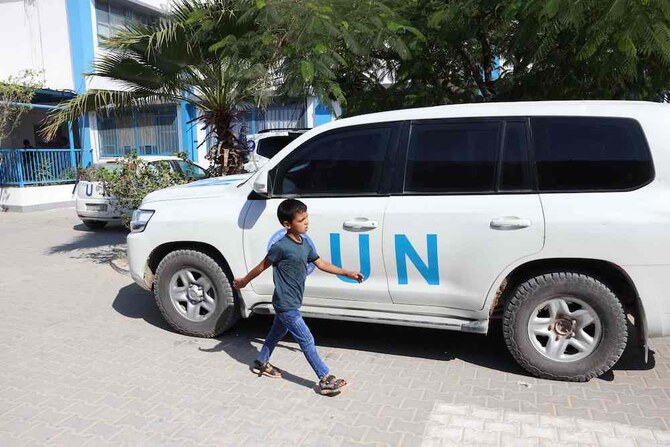
A Palestinian boy walks past a UN vehicles at the UNRWA Japanese Health Center in Khan Yunis on the southern Gaza Strip on October 29, 2024. (AFP)
Short Url
Updated 29 October 2024
Follow

Saudi Arabia condemns Israel’s ban on UN agency for Palestinian refugees

  • Foreign Ministry describes the decision as a ‘flagrant violation of international law’ and an assault on international legitimacy
  • It accuses Israel of attempting to erase the Palestinian identity through ‘ethnic cleansing,’ and of obstructing the peace process

RIYADH: Saudi authorities on Tuesday condemned a decision by the Israeli parliament that prevents the UN Relief and Works Agency for Palestine Refugees from working in Israel and occupied East Jerusalem, describing it as a “flagrant violation of international law.”

The criticism by the Saudi Ministry of Foreign Affairs came a day after Israeli lawmakers voted overwhelmingly to ban the agency’s operations in those areas.

In a statement published by the Saudi Press Agency, the Foreign Ministry said the decision was a direct assault on international legitimacy that disregards the “unprecedented humanitarian catastrophe” affecting the Palestinian people and obstructs the UN’s role in providing essential services.

“The Kingdom affirms its categorical rejection of the continuous and systematic practices of the Israeli occupation authorities in politically and militarily targeting the United Nations’ agencies and its relief organizations,” the ministry added.

It accused Israeli authorities of attempting to erase the Palestinian identity through “ethnic cleansing,” and of obstructing efforts to establish a comprehensive peace process.

It reiterated Saudi Arabia’s unwavering support for UNRWA’s humanitarian mission, and pointed out that the agency’s mandate is rooted in UN Security Council Resolution 194, adopted in 1948, which enshrines the right of return for Palestinian refugees.

UNRWA, which was established in 1949, provides vital aid, including educational, healthcare and social services, to refugees in Palestinian territories and neighboring countries.

In addition to banning UNRWA operations, the new Israeli legislation prohibits Israeli officials from cooperating with the agency or its employees.


Airbus seeks to strengthen Saudi defense ties

Updated 10 sec ago
Follow

Airbus seeks to strengthen Saudi defense ties

MALHAM: Airbus is aiming to deepen its strategic relationship with Saudi Arabia, a “core customer” in the region, according to Head of Air Power, Airbus Defense and Space Jean-Brice Dumont.

“Saudi Arabia is one of our customers in the region that we have a very strong link with,” Dumont told Arab News on the sidelines of the World Defense Show in Riyadh.

“We have a very strong link with decades of history of Airbus in the country, be it for helicopters, but in my case for military aircraft.

He said the Kingdom was “sort of a hometown for us for these flying platforms and for the maintenance, repair, and overhaul of these platforms.”

Airbus has a longstanding partnership with Saudi Arabia in both commercial and defense aircraft that dates back nearly 50 years.

“We have already invested quite significantly in the region,” Dumont said. “Notably, we have a JV (joint venture) with SAMI (Saudi Arabia Military Industries) in Saudi Arabia and that, I believe is the beginning of a longer journey. But so far, when we see what’s happening in the region, it’s already quite good.”

In 2021 SAMI, a wholly owned subsidiary of the Public Investment Fund and the National Champion of Military Industries Localization, and Airbus signed an agreement to form a joint venture on military aviation services and maintenance, repair and overhaul capabilities.

During the interview Dumont also looked ahead, detailing the strategic roadmap for 2026–2030 that moves beyond traditional hardware toward a digitally-dominant battlefield.

“I think we are reaching the end or the limits of the ‘fighter goes alone’ kind of model,” he said. “Now, the fighters need to communicate, to command drones, to be themselves receiving information by a mass, high-throughput data link so that they can play their role — their new role — in the battlefield.”

He also spoke about how the A330 aircraft was moving beyond its basic reputation as a “flying gas station” to become a high-tech “command center” in the sky.

“The A330 can be first much more automated. The air-to-air refueling can be automatic, and we have developed that capability,” he explained.

“On the other hand, it’s a big platform flying high, which can act as a command-and-control node in the system of systems that the air forces are all aspiring to.”

On the Eurofighter, he said it was “a bit symmetrical,” while speaking about the “buzz” around artificial intelligence he said that while neural networks have been embedded in Airbus platforms for nearly 20 years, the next decade would see AI move to the forefront of decision-making.

From mission preparation to real-time command, he said, the goal is to process vast amounts of data to act faster than the adversary.

“The one who gets that right has won,” he said.