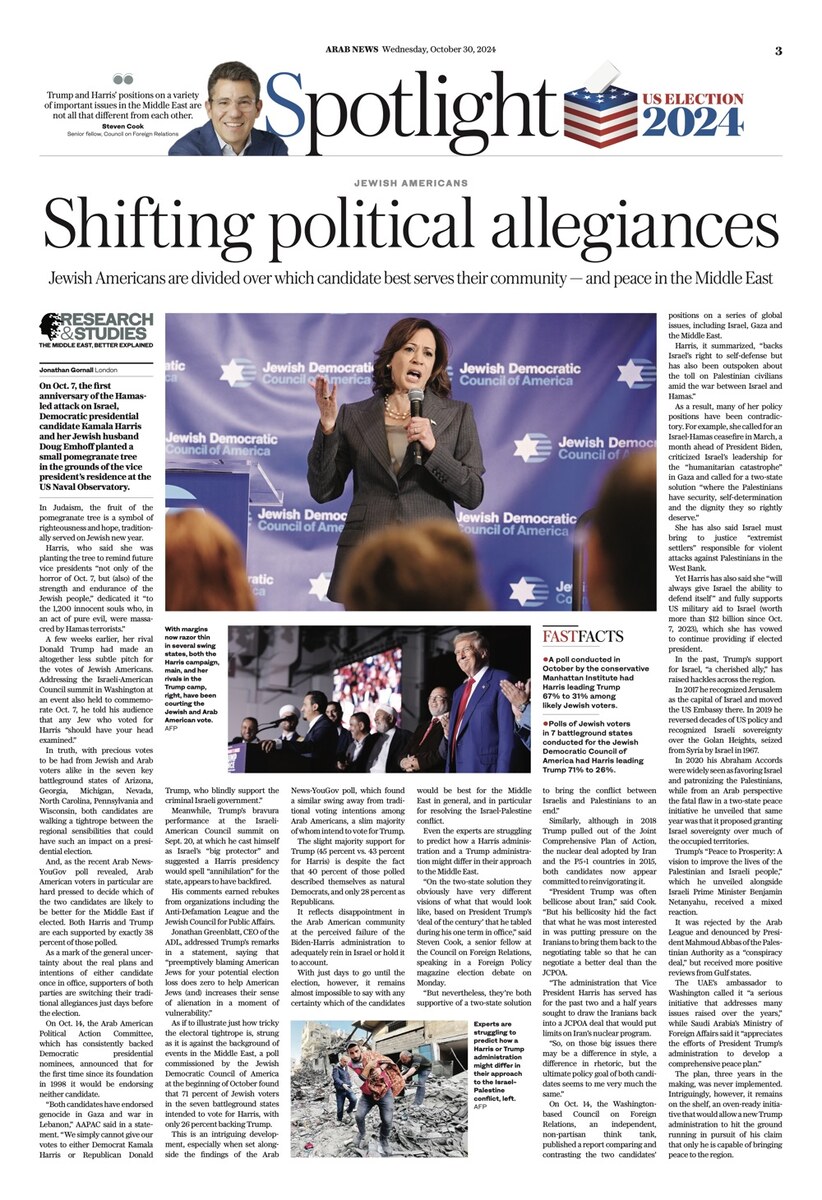
LONDON: On Oct. 7, the first anniversary of the Hamas-led attack on Israel, Democratic presidential candidate Kamala Harris and her Jewish husband Doug Emhoff planted a small pomegranate tree in the grounds of the vice president’s residence at the US Naval Observatory.
The solemn occasion, and the tree itself, was freighted with symbolic meaning.
In Judaism, the fruit of the pomegranate tree is a symbol of righteousness and hope, traditionally served on Rosh Hashanah, the Jewish new year. The fruit is said to contain 613 seeds — exactly the same number of the commandments, or mitzvot, found in the Torah, the first five books of the Hebrew Bible.
Harris, who said she was planting the tree to remind future vice presidents “not only of the horror of Oct. 7, but (also) of the strength and endurance of the Jewish people,” dedicated it “to the 1,200 innocent souls who, in an act of pure evil, were massacred by Hamas terrorists.”
A few weeks earlier, her rival Donald Trump had made an altogether less subtle pitch for the votes of Jewish Americans. Addressing the Israeli-American Council summit in Washington at an event also held to commemorate Oct. 7, he told his audience that “anybody who’s Jewish and loves being Jewish and loves Israel is a fool if they vote for a Democrat.”
In fact, he added, any Jew who voted for Harris “should have your head examined.”

Trump said: “Anybody who’s Jewish and loves being Jewish and loves Israel is a fool if they vote for a Democrat.” (AFP)
In truth, with precious votes to be had from Jewish and Arab voters alike in the seven key battleground states of Arizona, Georgia, Michigan, Nevada, North Carolina, Pennsylvania and Wisconsin, both candidates are walking a tightrope between the regional sensibilities that could have such an impact on a presidential election taking place almost 10,000 km away.
And, as the recent Arab News-YouGov poll revealed, Arab American voters in particular are hard pressed to decide which of the two candidates, with their very different rhetorical styles, are likely to be better for the Middle East in general if elected president. Both Harris and Trump are each supported by exactly 38 percent of those polled.
As a mark of the general uncertainty about the real plans and intentions of either candidate once in office, supporters of both parties are switching their traditional allegiances just days before the election.
On Oct. 14, the Arab American Political Action Committee, which has consistently backed Democratic presidential nominees, announced that for the first time since its foundation in 1998 it would be endorsing neither candidate.
“Both candidates have endorsed genocide in Gaza and war in Lebanon,” AAPAC said in a statement. “We simply cannot give our votes to either Democrat Kamala Harris or Republican Donald Trump, who blindly support the criminal Israeli government.”
Meanwhile, Trump’s bravura performance at the Israeli American Council summit on Sept. 20, at which he cast himself as Israel’s “big protector” and suggested a Harris presidency would spell “annihilation” for the state, appears to have backfired.
Opinion
This section contains relevant reference points, placed in (Opinion field)
His comments earned rebukes from organizations including the Anti-Defamation League and the Jewish Council for Public Affairs.
Jonathan Greenblatt, CEO of the ADL, addressed Trump’s remarks in a statement, saying that “preemptively blaming American Jews for your potential election loss does zero to help American Jews (and) increases their sense of alienation in a moment of vulnerability.”
As if to illustrate just how tricky the electoral tightrope is, strung as it is against the background of events in the Middle East, a poll commissioned by the Jewish Democratic Council of America at the beginning of October found that 71 percent of Jewish voters in the seven battleground states intended to vote for Harris, with only 26 percent backing Trump.
This is an intriguing development, especially when set alongside the findings of the Arab News-YouGov poll, which found a similar swing away from traditional voting intentions among Arab Americans, a slim majority of whom intend to vote for Trump.
The slight majority support for Trump (45 percent vs. 43 percent for Harris) is despite the fact that 40 percent of those polled described themselves as natural Democrats, and only 28 percent as Republicans.
It reflects disappointment in the Arab American community at the perceived failure of the Biden-Harris administration to adequately rein in Israel or hold it to account. In 2020, 43 percent of respondents had backed Biden, with only 34 percent voting for Trump.

Kamala Harris and her Jewish husband Doug Emhoff planted a small pomegranate tree in the grounds of the vice president’s residence. (AFP)
As Firas Maksad, a senior fellow at the Middle East Institute in Washington D.C., told a recent edition of the Arab News podcast “Frankly Speaking,” “the fact that they are so evenly split is surprising, particularly given what’s been happening in Gaza and now Lebanon.
“You’d think that that would have an impact and would dampen the vote for somebody who is so staunchly pro-Israel, like Donald Trump, but clearly that’s not the case.”
With just days to go until the election, however, it remains almost impossible to say with any certainty which of the candidates would be best for the Middle East in general, and in particular for resolving the Israel-Palestine conflict.
Even the experts are struggling to predict how a Harris administration and a Trump administration might differ in their approach to the Middle East.
“When you dig a little deeper into things beyond our headlines, beyond our polarized politics, President Trump’s and Vice President Harris’ positions on a variety of important issues in the Middle East — whether it’s the two-state solution, whether it’s US policy toward Iran, whether it’s regarding human rights and promotion of democratic reform in the region — are not all that different from each other,” said Steven Cook, a senior fellow at the Council on Foreign Relations, speaking in a Foreign Policy magazine election debate on Monday.
“On the two-state solution they obviously have very different visions of what that would look like, based on President Trump’s ‘deal of the century’ that he tabled during his one term in office. But nevertheless, they’re both supportive of a two-state solution to bring the conflict between Israelis and Palestinians to an end.”
Similarly, although in 2018 Trump pulled out the Joint Comprehensive Plan of Action, the nuclear deal adopted by Iran and the P5+1 countries in 2015, both candidates now appear committed to reinvigorating it.
FASTFACTS
• A poll conducted in October by the conservative Manhattan Institute had Harris leading Trump 67% to 31% among likely Jewish voters.
• Polls of Jewish voters in 7 battleground states conducted for the Jewish Democratic Council of America had Harris leading Trump 71% to 26%.
“President Trump was often bellicose about Iran,” said Cook. “But his bellicosity hid the fact that what he was most interested in was putting pressure on the Iranians to bring them back to the negotiating table so that he can negotiate a better deal than the JCPOA.
“The administration that Vice President Harris has served has for the past two and a half years sought to draw the Iranians back into a JCPOA deal that would put limits on Iran’s nuclear program.
“So, on those big issues there may be a difference in style, a difference in rhetoric, but the ultimate policy goal of both candidates seems to me very much the same.”
Speaking in the same debate, Sanam Vakil, director of the Middle East and North Africa Program at the Chatham House policy institute, said that there were still many question marks hanging over Harris’ approach to the region.
“She’s very cautious; she’s a bit of a black box and so we can read whatever we want into her,” she said. “But there’s also no guarantee as to what will come out from President Trump (on) the Middle Eastern landscape.

“Both candidates have endorsed genocide in Gaza and war in Lebanon,” AAPAC said in a statement. (AFP)
“I think there is a lot of expectation that he will stop the war, because he has implied as much, and for a lot of leaders around the region, but more broadly for citizens across multiple Middle Eastern countries, this is urgent.
“They would like to see the violence coming to an end, regular humanitarian aid being delivered to Gaza, and, of course, the violence also stopped in Lebanon, and that is the expectation, that Trump is going to pick up the phone to Prime Minister Netanyahu and put an end to this conflict.”
There is also an anticipation that Trump “will try to find some way around his previous engagement in the region to invest in an Israeli-Saudi normalization process,” she said. “But here there’s a caveat.
“Over the past year and particularly over the past few weeks the Saudi leadership have made it very clear that normalization is going to be predicated not on a process but on (Palestinian) statehood, and so there will (have to) be negotiation on what all of that means.”
On Oct. 14, the Washington-based Council on Foreign Relations, an independent, non-partisan think tank, published a report comparing and contrasting the two candidates’ positions on a series of global issues, including Israel, Gaza and the Middle East.
Harris, it summarized, “backs Israel’s right to self-defense but has also been outspoken about the toll on Palestinian civilians amid the war between Israel and Hamas.”

Even the experts are struggling to predict how a Harris administration and a Trump administration might differ in their approach to the Middle East. (AFP)
As a result, many of her policy positions have been contradictory. For example, she called for an Israel-Hamas ceasefire in March, a month ahead of President Biden, criticized Israel’s leadership for the “humanitarian catastrophe” in Gaza and called for a two-state solution “where the Palestinians have security, self-determination and the dignity they so rightly deserve.”
She has also said Israel must bring to justice “extremist settlers” responsible for violent attacks against Palestinians in the West Bank.
Yet Harris has also said she “will always give Israel the ability to defend itself” and fully supports US military aid to Israel (worth more than $12 billion since Oct. 7, 2023), which she has vowed to continue providing if elected president.
In the past, Trump’s support for Israel, “a cherished ally,” has raised hackles across the region.
In 2017 he recognized Jerusalem as the capital of Israel and moved the US embassy there. In 2019 he reversed decades of US policy and recognized Israeli sovereignty over the Golan Heights, seized from Syria by Israel in 1967.
In 2020 his Abraham Accords were widely seen as favoring Israel and patronizing the Palestinians, while from an Arab perspective the fatal flaw in a two-state peace initiative he unveiled that same year was that it proposed granting Israel sovereignty over much of the occupied territories.
Trump’s “Peace to Prosperity: A vision to improve the lives of the Palestinian and Israeli people,” which he unveiled alongside Israeli Prime Minister Benjamin Netanyahu, received a mixed reaction.
It was rejected by the Arab League and denounced by President Mahmoud Abbas of the Palestinian Authority as a “conspiracy deal,” but received more positive reviews from Gulf states.

Harris has also said she “will always give Israel the ability to defend itself” and fully supports US military aid to Israel. (AFP)
The UAE’s ambassador to Washington called it “a serious initiative that addresses many issues raised over the years,” while Saudi Arabia’s Ministry of Foreign Affairs said it “appreciates the efforts of President Trump’s administration to develop a comprehensive peace plan.”
The plan, three years in the making, was never implemented. Intriguingly, however, it remains on the shelf, an oven-ready initiative that would allow a new Trump administration to hit the ground running in pursuit of his claim that only he is capable of bringing peace to the region.
It was, perhaps, telling that in the middle of campaigning in the knife-edge presidential race, Trump took time out last week to give an exclusive interview to Saudi TV channel Al Arabiya — recalling that his first overseas trip as president in 2017 had been to the Kingdom.
“I want to see the Middle East get back to peace but peace that’s going to be a lasting peace and I feel really truly confident it’s going to happen, and I believe it’s going to happen soon,” he told Al Arabiya’s Washington bureau chief, Nadia Bilbassy-Charters.
He stressed his admiration for, and friendship with, the Saudi crown prince, adding: “I was respected over there and (had) great relationships with so many including (Crown Prince Mohammed bin Salman) and (if elected on Nov. 5) we’re going to get it done and it’s going to get done properly.”
The US election, he predicted, “is going to make a big difference.”
One way or the other, it certainly will.