

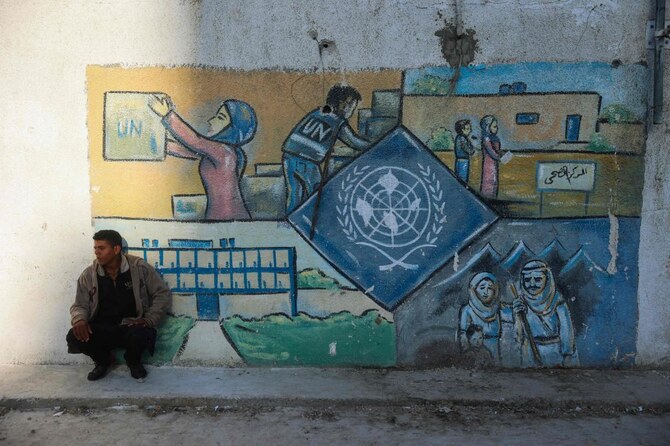

GENEVA: Israel’s decision to ban the UN relief agency UNRWA could result in the deaths of more children and represent a form of collective punishment for Gazans if fully implemented, UN agencies said on Tuesday.
A law passed by Israel on Monday to ban the UN Palestinian refugee agency from operating inside Israel has raised concerns about its ability to provide relief in Gaza after over a year of war.
“If UNRWA is unable to operate, it’ll likely see the collapse of the humanitarian system in Gaza,” said UNICEF spokesperson James Elder, who has worked extensively in Gaza since the Oct. 7 war began. “So a decision such as this suddenly means that a new way has been found to kill children.”
Other UN agencies at the same briefing said it would be impossible to fill the void. “It is indispensable and there is no alternative to it at this point,” said UN humanitarian office spokesperson Jens Laerke.
In response to a question about whether the ban represented a form of collective punishment against Gazans, he said: “I think it is a fair description of what they have decided here, if implemented, that this would add to the acts of collective punishment that we have seen imposed on Gaza.”
The head of the International Organization for Migration said IOM could not replace UNRWA in Gaza but that it could provide more relief to those in crisis. “That is a role that we are very, very keen to play, and one that we will be stepping up with the support of various stakeholders,” IOM Director-General Amy Pope said.
Qatar condemns ban
Gaza war mediator Qatar on Tuesday condemned the Israeli parliament’s decision to ban the UN agency for Palestinian refugees from operating in Israel, the Gulf emirate’s foreign ministry said.
Israeli lawmakers on Monday overwhelmingly voted to ban the agency, UNRWA, from working in Israel and annexed east Jerusalem.
The lawmakers also passed a measure prohibiting Israeli officials from working with UNRWA and its employees.
“We emphasize that stopping support for UNRWA will have disastrous consequences,” ministry spokesman Majed Al-Ansari told reporters.
“The international community cannot stand silent in the face of this disregard for its international institutions,” he added.
Keeping Gaza people ‘alive’
An official from the UN agency for Palestinian refugees said Tuesday the organization was “irreplaceable” as its network helps sustain the people of war-ravaged Gaza.
For more than seven decades, UNRWA has provided critical support to Palestinian refugees.
But the agency has faced mounting criticism from Israeli officials, escalating since the start of war in Gaza after Hamas’s October 7 attacks last year.
But Jonathan Fowler, UNRWA’s spokesman in Jerusalem, called the agency the backbone of humanitarian work in the Palestinian territories, especially in Gaza.
“UNRWA is irreplaceable, UNRWA is essential. That remains a fact, whatever the legislation that was passed yesterday,” Fowler, who called the bill “an outrage,” told AFP in an interview at the agency’s compound in east Jerusalem.
With around 18,000 staff the occupied West Bank and Gaza, including 13,000 education staff and 1,500 health care workers, UNRWA has delivered vital aid since 1949.
Fowler said UNRWA hopes the decision will be rescinded, and is “not in the mindset” of thinking of replacement.
“It is on the international community that if this moves forward, and on the Israeli authorities as members of the international community, to say what the plan B is,” should the decision be enforced in three months.
Unlike other UN agencies, which rely on external partners, UNRWA directly employs teachers and health care staff of its own, including 13,000 staff in Gaza.
“The entire UN system and other international players rely on UNRWA’s logistical networks, on UNRWA’s staff to do what is necessary to try to keep the population of Gaza alive. We are the backbone,” said Fowler.
“So the question is, who would be the people who would do this stuff?” he added.
Ireland urges EU to reconsider Israel trade
Ireland’s Prime Minister Simon Harris urged the EU to review trade ties with Israel Tuesday over Israeli lawmakers’ “despicable” ban of UNRWA.
The Irish leader criticized the Israeli parliament’s “shameful” banning of the agency, which coordinates nearly all aid to Gaza.
“The most important action that the European Union could take right now is reviewing trade relations,” Harris told reporters in Dublin before meeting incoming European Council president Antonio Costa.
“What Israel and the Israeli Knesset did last night was despicable, disgraceful and shameful. More people will die, more children will starve,” he said.
Harris added there was “no alternative” to UNRWA, and that he would discuss with Costa “how Europe now needs to find the moral courage... to act in relation to this.
“Ireland, Spain, Belgium, Slovenia and others have been calling for more actions at an EU level. I think that would be a very effective way and I’ll be continuing to make that case,” he said.
Costa replaces outgoing EU Council chief Charles Michel on December 1 and is touring European capitals prior to taking up the new post.
He did not speak to the media ahead of meeting Harris in the Irish capital.
Ireland, along with Spain, Norway and Slovenia, earlier this year formally recognized a Palestinian state comprising the Gaza Strip and the West Bank.
They have been among the most outspoken critics of Israel’s conduct since the October 7, 2023, attack by Hamas which sparked the latest rounds of violence across the region.
In February, Dublin and Madrid asked the EU to “urgently” examine whether Israel was complying with its human rights obligations in Gaza under an accord linking them to trade ties.
They noted the “EU/Israel Association Agreement... makes respect for human rights and democratic principles an essential element of the relationship.”


