

Local humanitarian workers dying in silence, Red Cross warns

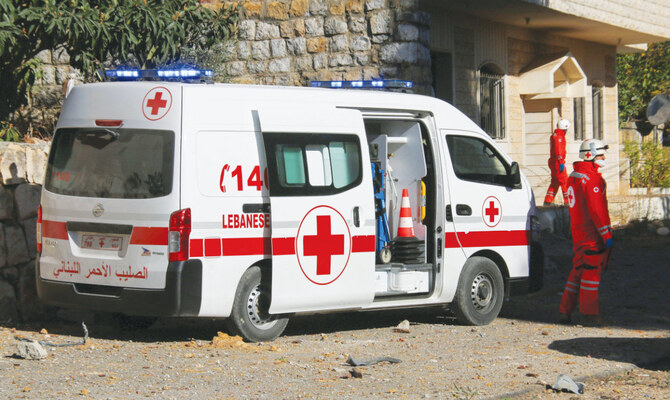
Lebanese Red Cross members stand near a site hit by an Israeli strike, amid ongoing hostilities between Hezbollah and Israeli forces, in Marjayoun, Lebabon, near the border with Israel, October 27, 2024. (Reuters)
Short Url
Updated 28 October 2024
Follow

Local humanitarian workers dying in silence, Red Cross warns

  • Their deaths are soaring amid clashes in Mideast, Sudan, Ukraine and Myanmar

GENEVA: Local staff and volunteers — the backbone of aid agencies providing help in the world’s worst conflicts — are dying in ever greater numbers. Yet few seem to notice, the head of the Red Cross said in an interview on Monday.

“Almost 95 percent of the humanitarians who are killed are actually the local staff and local volunteers,” Jagan Chapagain, the secretary-general of the International Federation of the Red Cross and Red Crescent Societies.

But while the killing of an international staff member of large humanitarian organizations can spark global outrage, there is often little attention paid when a local aid worker suffers the same fate.

“Unfortunately, when a local staffer or volunteer gets killed, it gets hardly any attention,” Chapagain said.

The issue is of particular concern this year, one of the deadliest for humanitarians, with aid worker deaths soaring as conflicts rage in the Middle East, Sudan, Ukraine and Myanmar, among others.

“It has been really the worst year for humanitarian actors, particularly the ones from the local communities,” Chapagain said.

Since the beginning of this year alone, 30 of the network’s volunteers have been killed worldwide, while within the UN system, “they have lost hundreds,” he said.

He decried a clear “erosion” in the respect for international humanitarian law and the principles requiring humanitarians to be protected.

Growing disregard for international law in conflict was significantly “increasing the situation of extreme exposures (and) risk for our humanitarian workers, (with) volunteers getting shot, ambulances getting attacked.”

Respect for the Red Cross Red Crescent emblem, and for people wearing the network’s signatory red vest has “eroded significantly,” he warned.

Asked if he believed humanitarians were being deliberately targeted, he said: “Definitely. Unfortunately, the numbers speak for themselves.”

Chapagain said the IFRC was “seriously, seriously concerned” about the growing dangers facing humanitarians and warned that more people could die if humanitarian workers are not protected.

His IFRC will along with the International Committee of the Red Cross kick off their quadrennial international conference in Geneva on Monday, which is due to focus heavily on the need to boost compliance with international humanitarian law.

It will include participants from the 191 national Red Cross and Red Crescent societies, whose staff and volunteers are frequently the ones on the frontlines in conflicts and in the communities under attack.

Chapagain said his team estimated that when “a local gets harmed compared to an international who gets harmed, the attention is one to 500 ratio.”

“Any death is appalling, and we cannot accept that. But what we would also like to see is the same outrage when any humanitarians lose their life.”

“This is something super, super important, because globally... most of the people who are on the frontline providing ... assistance are the people from the local communities,” he said.

“Their lives should be as sacred as anyone else’s.”


Belarus frees protest leader Kolesnikova, Nobel winner Bialiatski

Updated 6 sec ago
Follow

Belarus frees protest leader Kolesnikova, Nobel winner Bialiatski

  • The charismatic Kolesnikova was the star of the 2020 movement that presented the most serious challenge to Lukashenko in his 30-year rule
  • Bialiatski — a 63-year-old veteran rights defender and 2022 Nobel Peace Prize winner — is considered by Lukashenko to be a personal enemy

VILNIUS: Belarusian street protest leader Maria Kolesnikova and Nobel Prize winner Ales Bialiatski walked free on Saturday with 121 other political prisoners released in an unprecedented US-brokered deal.
Belarusian President Alexander Lukashenko has locked up thousands of his opponents, critics and protesters since the 2020 election, which rights groups said was rigged and which triggered weeks of protests that almost toppled him.
The charismatic Kolesnikova was the star of the 2020 movement that presented the most serious challenge to Lukashenko in his 30-year rule.
She famously ripped up her passport as the KGB tried to deport her from the country.
Bialiatski — a 63-year-old veteran rights defender and 2022 Nobel Peace Prize winner — is considered by Lukashenko to be a personal enemy. He has documented rights abuses in the country, a close ally of Moscow, for decades.
Bialiatski stressed he would carry on fighting for civil rights and freedom for political prisoners after his surprise release, which he called a “huge emotional shock.”
“Our fight continues, and the Nobel Prize was, I think, a certain acknowledgement of our activity, our aspirations that have not yet come to fruition,” he told media in an interview from Vilnius.
“Therefore the fight continues,” he added.
He was awarded the prize in 2022 while already in jail.
After being taken out of prison, he said he was put on a bus and blindfolded until they reached the border with Lithuania.
His wife, Natalia Pinchuk, told AFP that her first words to him on his release were: “I love you.”

- ‘All be free’ -

Most of those freed, including Kolesnikova, were unexpectedly taken to Ukraine, surprising their allies who had been waiting for all of them in Lithuania.
She called for all political prisoners to be released.
“I’m thinking of those who are not yet free, and I’m very much looking forward to the moment when we can all embrace, when we can all see one another, and when we will all be free,” she said in a video interview with a Ukrainian government agency.
Hailing Bialiatski’s release, the Nobel Committee told AFP there were still more than 1,200 political prisoners inside the country.
“Their continued detention starkly illustrates the ongoing, systemic repression in the country,” said chairman Jorgen Watne Frydnes.
EU chief Ursula von der Leyen said their release should “strengthen our resolve... to keep fighting for all remaining prisoners behind bars in Belarus because they had the courage to speak truth to power.”
Jailed opponents of Lukashenko are often held incommunicado in a prison system notorious for its secrecy and harsh treatment.
There had been fears for the health of both Bialiatski and Kolesnikova while they were behind bars, though in interviews Saturday they both said they felt okay.
The deal was brokered by the United States, which has pushed for prisoners to be freed and offered some sanctions relief in return.

- Potash relief -

An envoy of US President Donald Trump, John Coale, was in Minsk this week for talks with Lukashenko.
He told reporters from state media that Washington would remove sanctions on the country’s potash industry, without providing specific details.
A US official separately told AFP that one American citizen was among the 123 released.
Minsk also freed Viktor Babariko, an ex-banker who tried to run against Lukashenko in the 2020 presidential election but was jailed instead.
Kolesnikova was part of a trio of women, including Svetlana Tikhanovskaya who stood against Lukashenko and now leads the opposition in exile, who headed the 2020 street protests.
She was serving an 11-year sentence in a prison colony.
In 2020, security services had put a sack over her head and drove her to the Ukrainian border. But she ripped up her passport, foiling the deportation plan, and was placed under arrest.
Former prisoners from the Gomel prison where she was held have told AFP she was barred from talking to other political prisoners and regularly thrown into harsh punishment cells.
An image of Kolesnikova making a heart shape with her hands became a symbol of anti-Lukashenko protests.
Bialiatski founded Viasna in the 1990s, two years after Lukashenko became president.