
KARACHI: Ahmed Tobasi, a Palestinian theater actor who opened his eyes for the first time at the Jenin refugee camp in the West Bank, was just 17 years old when he was taken as a political prisoner by Israeli forces for four years.
Growing up at the camp in the northern West Bank, Tobasi witnessed first-hand the repercussions of the Israeli occupation of Palestine and chose to make the world aware of these atrocities through theater.
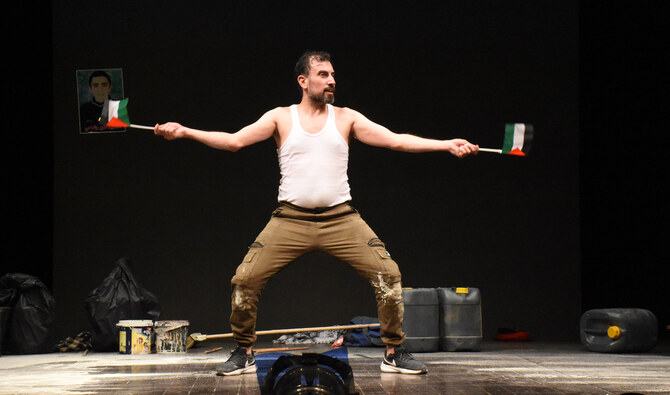
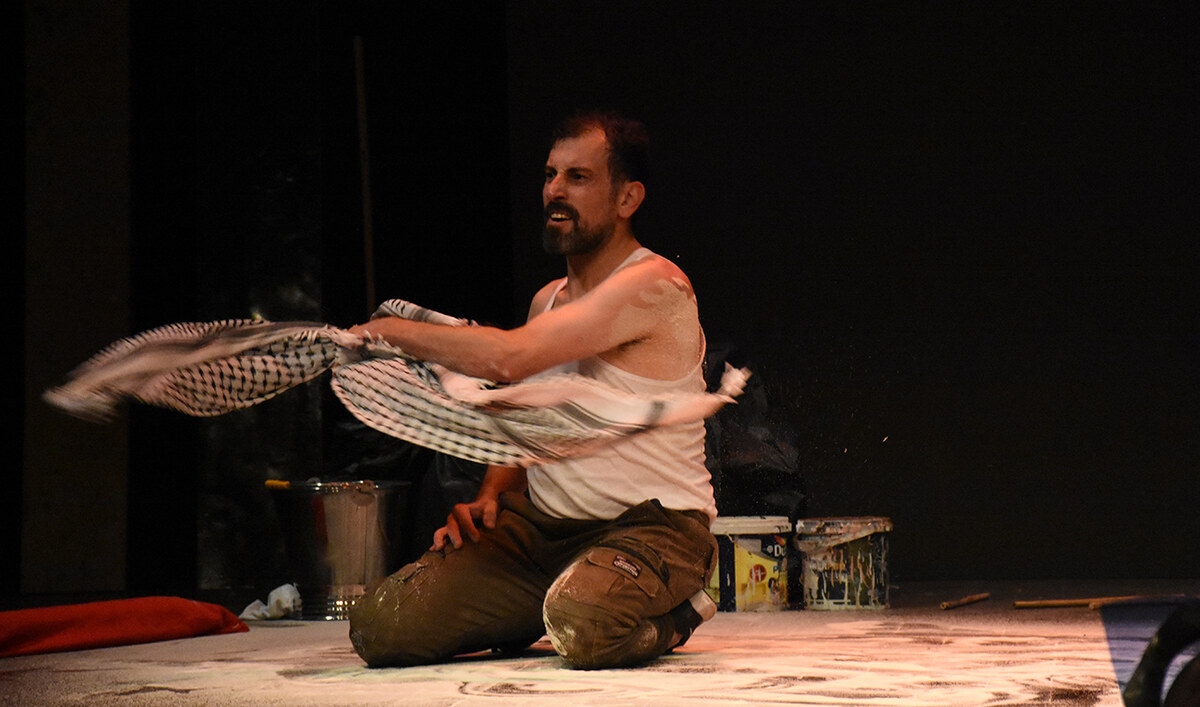
This Friday, the 40-year-old, who still lives in Jenin and calls theater a more “powerful” weapon than a gun, presented a play at the Arts Council of Pakistan in Karachi, depicting his life at the camp and the horrors of Israel’s occupation of Palestine.
“The idea is to take the Palestinian narrative [to the world] with a real actor from Palestine to make people see that Palestinians [are] also artists. We do theater and we speak the same language that this world is speaking,” Tobasi told Arab News after his performance.
“It is very important to show the human beings of Palestine [to the world].”
Ahmed Tobasi, a Palestinian theater actor, performs a play titled ‘And Here I am’ during the World Culture Festival at the Arts Council of Pakistan in Karachi on October 25, 2024. (Photo courtesy: ACP)
Titled as ‘And Here I am,’ Tobasi performed his play during the World Culture Festival in Karachi, which is running from Sept. 26 till Oct. 30 and featuring music, theater, dance and fine arts from various countries of the world.
The 40-year-old says it has been seven years since his play came to life and he has presented it in more than a dozen countries, including Palestine, UK, Norway, France and the United Arab Emirates (UAE).
In Pakistan, the most recent addition to the list, Tobasi performed the play in Arabic before a packed audience in Karachi, with subtitles in English playing in the background.
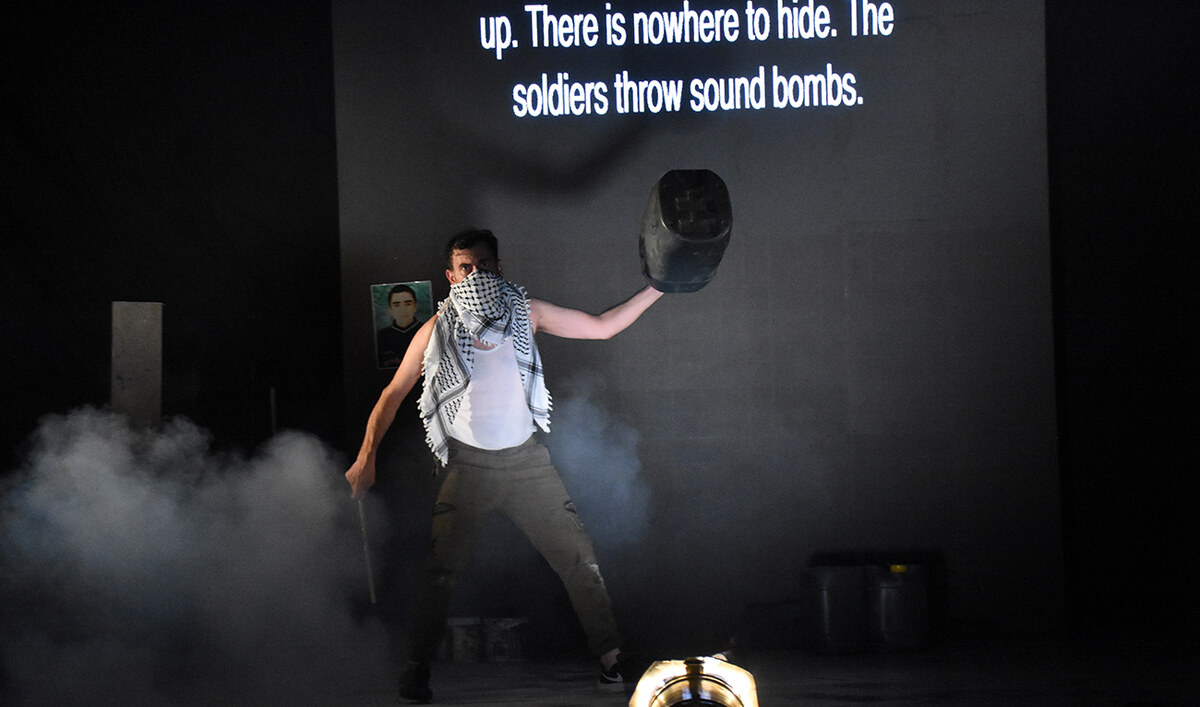
Ahmed Tobasi, a Palestinian theater actor, performs a play titled ‘And Here I am’ during the World Culture Festival at the Arts Council of Pakistan in Karachi on October 25, 2024. (Photo courtesy: ACP)
“It was an honor to be a part of the World Culture Festival [in] Karachi,” he said. “We believe there is a very unique, special relation between Pakistan and Palestine.”
Pakistan has always stood by Palestine and calls for an independent Palestinian state based on “internationally agreed parameters.”
Tobasi started performing at the age of 21 after he joined The Freedom Theatre, a theater and cultural center in the Jenin refugee camp, following his release from Israeli custody. He later went to Norway where he trained and worked with Nordic Black Theatre in Oslo.
He returned to Jenin a few years later following the assassination of Juliano Mer-Khamis, his drama coach at The Freedom Theatre, in 2013. He is currently the artistic director at the theater.

Ahmed Tobasi, a Palestinian theater actor, received a standing ovation from the audience for his play titled ‘And Here I am’ during the World Culture Festival at the Arts Council of Pakistan in Karachi on October 25, 2024. (Photo courtesy: ACP)
“I hope to tell all people, all young people that theater and culture is a very powerful weapon,” he told Arab News. “If we want to express ourselves and talk and argue, art is the way.”
Tobasi’s life story ‘And Here I am,’ penned by award-winning Iraqi playwright Hassan Abdulrazzak, has also won the award for best production at the Sharm El-Sheikh International Theatre Festival in 2019. The production combines fact and fantasy, and tragedy and comedy.
The drama captures 35 years of Tobasi’s life, according to its British director, Zoe Lafferty.
“Tobasi presents things which are very difficult, such as the murder of his friends [and] his teacher Juliano, but he also brings humor [and] he dances,” Lafferty told Arab News.
“So, it also brings the lighter and joyful moments.”
Lafferty has been working with Tobasi and his theater production team outside of Palestine for the last 15 years as the “Israelis won’t let her enter” the Palestinian territory. She directed all shows for Tobasi’s play that have been performed in various parts of the world.
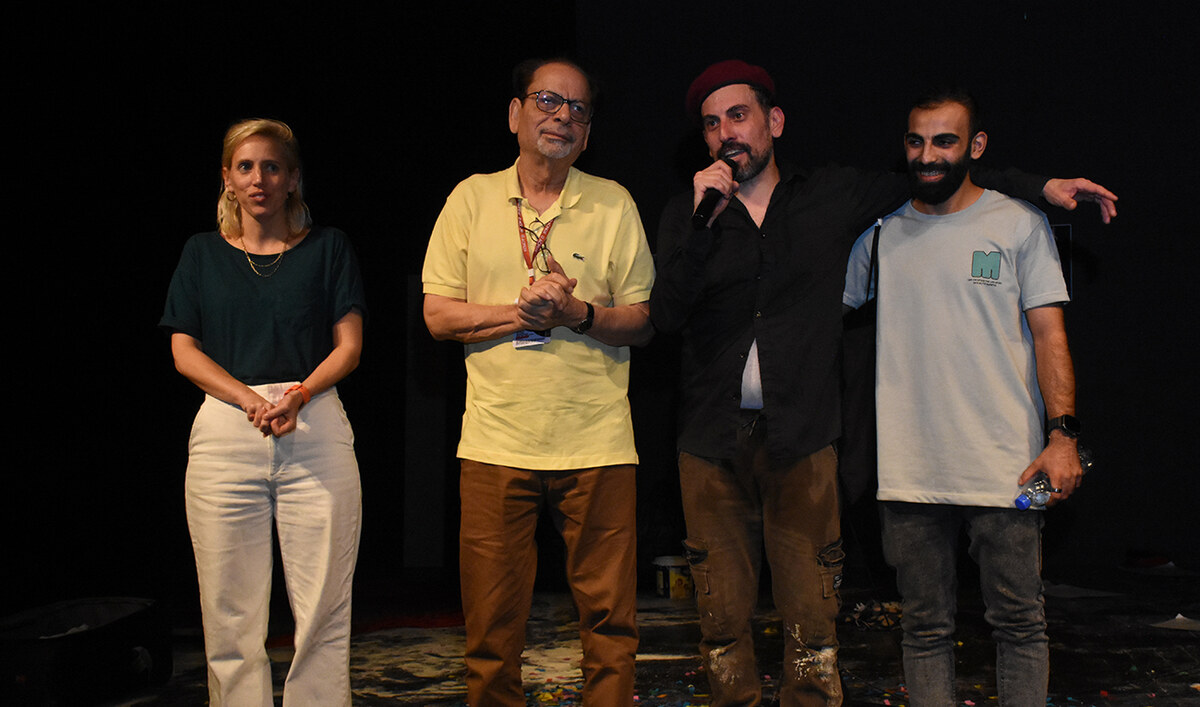
Ahmed Tobasi (2R), a Palestinian theater actor, speaks after his performance during the World Culture Festival at the Arts Council of Pakistan in Karachi on October 25, 2024. (Photo courtesy: ACP)
“We have had some really good success in other countries but also, we have been canceled in many countries,” she said, pointing to “big challenges” in terms of censorship.
“We were meant to go to Germany next week and the production was canceled. One show got canceled in France but the tour continued. We got canceled in Singapore.”
For Tobasi, it’s “extremely important” to tell personal stories that bring people closer. He says he doesn’t want anyone to agree or disagree with what he presents, and all he hopes to achieve is for the world to see that the Palestinians do not have a lot of choices because of what is being done to them.
“When they see a real story in front of their faces, all their thinking [has] been, in a way, questioned and changed,” the 40-year-old told Arab News.
“People get more close, more sensitive to the Palestinians’ story [after watching the performance] because the West, America [and] Europe, has dehumanized us while covering our story and always showed us as terrorists, Muslims, Arabs [and] Palestinians.”