KARACHI: The chief executive of Pakistan’s Sindh province on Saturday expressed his administration’s desire to bolster collaboration with Beijing in transport, energy and agriculture sectors during a meeting with a top diplomat, nearly three weeks after two Chinese engineers were killed in an explosion in the city.
The two countries jointly initiated a series of energy and infrastructure development projects under the multibillion-dollar China-Pakistan Economic Corridor (CPEC) to aid Pakistan’s development.
However, militants have persistently targeted Chinese nationals in different parts of the country, raising concerns about the safety of these workers and the prospects of the economic collaboration between the two nations.
Only a day earlier, Chinese Ambassador to Pakistan Jiang Zaidong urged the local authorities to apprehend the perpetrators of the violent attacks on Chinese citizens.
“China is a key partner in electricity, coal and other projects in Sindh,” Chief Minister Syed Murad Ali Shah was quoted in a statement circulated by his office after the meeting with Chinese Consul General Yang Yundong in Karachi.
“With China’s help, the Sindh government aims to improve agriculture, transport and other projects,” he added.
The meeting comes at a time when Pakistan has been reeling from a prolonged economic crisis and has sought to enhance bilateral trade and investment cooperation with friendly countries like China to bolster its fragile economy.
Earlier this month, Pakistani state media reported that a Chinese development association would invest up to $13 billion in a free trade zone in Pakistan in the next five years.
The Chinese consul general also noted that businesses in his country were interested in collaborating with the provincial administration on a number of projects.

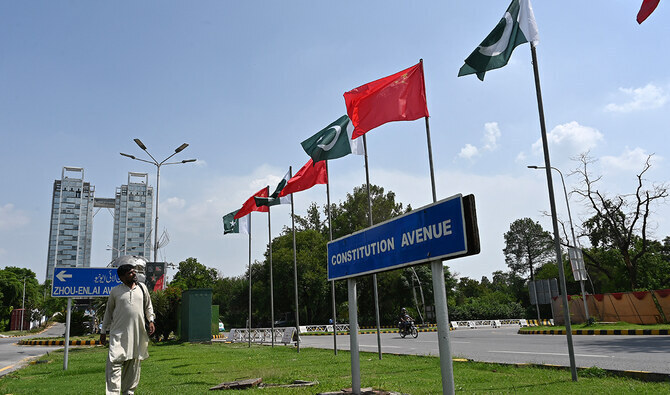
Pakistani province seeks to boost projects with Beijing amid concerns over Chinese safety
https://arab.news/2g9pd
Pakistani province seeks to boost projects with Beijing amid concerns over Chinese safety
- Sindh CM calls for greater collaboration with China in transport, energy sectors
- He meets a top diplomat from Beijing after a blast killed two Chinese in Karachi
IMF hails Pakistan privatization drive, calls PIA sale a ‘milestone’
- Fund backs sale of national airline as key step in divesting loss-making state firms
- IMF has long urged Islamabad to reduce fiscal burden posed by state-owned entities
KARACHI: The International Monetary Fund (IMF) on Saturday welcomed Pakistan’s privatization efforts, describing the sale of the country’s national airline to a private consortium last month as a milestone that could help advance the divestment of loss-making state-owned enterprises (SOEs).
The comments follow the government’s sale of a 75 percent stake in Pakistan International Airlines (PIA) to a consortium led by the Arif Habib Group for Rs 135 billion ($486 million) after several rounds of bidding in a competitive process, marking Islamabad’s second attempt to privatize the carrier after a failed effort a year earlier.
Between the two privatization attempts, PIA resumed flight operations to several international destinations after aviation authorities in the European Union and Britain lifted restrictions nearly five years after the airline was grounded following a deadly Airbus A320 crash in Karachi in 2020 that killed 97 people.
“We welcome the authorities’ privatization efforts and the completion of the PIA privatization process, which was a commitment under the EFF,” Mahir Binici, the IMF’s resident representative in Pakistan, said in response to an Arab News query, referring to the $7 billion Extended Fund Facility.
“This privatization represents a milestone within the authorities’ reform agenda, aimed at decreasing governmental involvement in commercial sectors and attracting investments to promote economic growth in Pakistan,” he added.
The IMF has long urged Islamabad to reduce the fiscal burden posed by loss-making state firms, which have weighed public finances for years and required repeated government bailouts. Beyond PIA, the government has signaled plans to restructure or sell stakes in additional SOEs as part of broader reforms under the IMF program.
Privatization also remains politically sensitive in Pakistan, with critics warning of job losses and concerns over national assets, while supporters argue private sector management could improve efficiency and service delivery in chronically underperforming entities.
Pakistan’s Cabinet Committee on State-Owned Enterprises said on Friday that SOEs recorded a net loss of Rs 122.9 billion ($442 million) in the 2024–25 fiscal year, compared with a net loss of Rs 30.6 billion ($110 million) in the previous year.


