TALISAY, Philippines: The number of dead and missing in massive flooding and landslides wrought by Tropical Storm Trami in the Philippines has exceeded 100 and the president said Saturday that many areas remained isolated with people in need of rescue.
Trami blew away from the northwestern Philippines on Friday, leaving at least 81 people dead and 34 others missing in in one of the Southeast Asian archipelago’s deadliest and most destructive storms so far this year, the government’s disaster-response agency said. The death toll was expected to rise as reports come in from previously isolated areas.
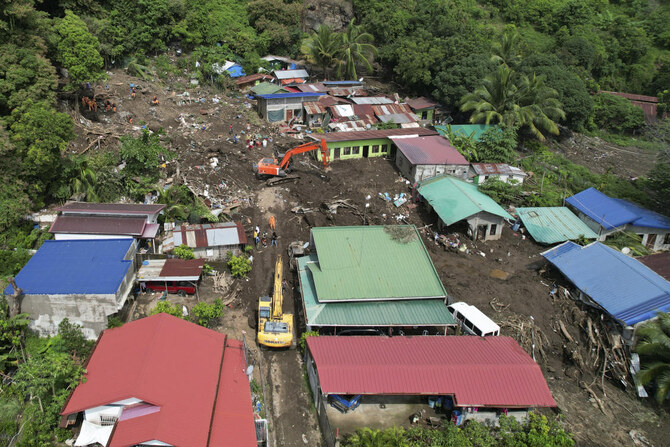
Dozens of police, firefighters and other emergency personnel, backed by three backhoes and sniffer dogs, dug up one of the last two missing villagers in the lakeside town of Talisay in Batangas province Saturday.
A father, who was waiting for word on his missing 14-year-old daughter, wept as rescuers placed the remains in a black body bag. Distraught, he followed police officers, who carried the body bag down a mud-strewn village alley to a police van when one weeping resident approaching him to express her sympathies.
The man said he was sure it was his daughter, but authorities needed to do checks to confirm the identity of the villager dug up in the mound.
In a nearby basketball gym at the town center, more than a dozen white coffins were laid side by side, bearing the remains of those found in the heaps of mud, boulders and trees that cascaded Thursday afternoon down the steep slope of a wooded ridge in Talisay’s Sampaloc village.
President Ferdinand Marcos, who inspected another hard-hit region southeast of Manila Saturday, said the unusually large volume of rainfall dumped by the storm — including in some areas that saw one to two months’ worth of rainfall in just 24 hours — overwhelmed flood controls in provinces lashed by Trami.
“The water was just too much,” Marcos told reporters.
“We’re not done yet with our rescue work,” he said. “Our problem here, there are still many areas that remained flooded and could not be accessed even big trucks.”
His administration, Marcos said, would plan to start work on a major flood control project that can meet the unprecedented threats posed by climate change.
More than 4.2 million people were in the path of the storm, including nearly half a million, who mostly fled to more than 6,400 emergency shelters in several provinces, the government agency said.
In an emergency Cainet meeting, Marcos raised concerns over reports by government forecasters that the storm — the 11th to hit the Philippines this year — could make a U-turn next week as it is pushed back by high-pressure winds in the South China Sea.
The storm was forecast to batter Vietnam over the weekend if it would not veer off course.
The Philippine government shut down schools and government offices for the third day on Friday to keep millions of people safe on the main northern island of Luzon. Inter-island ferry services were also suspended, stranding thousands.
Weather has cleared in many areas on Saturday, allowing cleanup work in most areas.
Each year, about 20 storms and typhoons batter the Philippines, a Southeast Asian archipelago which lies between the Pacific Ocean and the South China Sea. In 2013, Typhoon Haiyan, one of the strongest recorded tropical cyclones, left more than 7,300 people dead or missing and flattened entire villages.


![]()

At least 115 dead and missing in massive flooding and landslides in Philippines
Short Url
https://arab.news/rv94v
At least 115 dead and missing in massive flooding and landslides in Philippines
- Dozens of police, firefighters and other emergency personnel, backed by three backhoes and sniffer dogs, dug up one of the last two missing villagers in the lakeside town of Talisay
- More than 4.2 million people were in the path of the storm, including nearly half a million, who mostly fled to more than 6,400 emergency shelters in several provinces


Latest updates


© 2026 SAUDI RESEARCH & PUBLISHING COMPANY, All Rights Reserved And subject to Terms of Use Agreement.