

‘Hell on earth’: Bangladeshi evacuees recount Israeli attacks on Lebanon

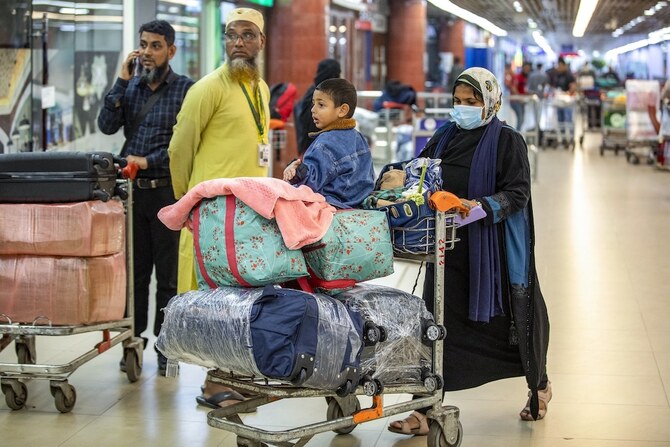
A Bangladeshi national carries luggage upon her arrival from Lebanon at the Hazrat Shahjalal International Airport in Dhaka on Oct. 21, 2024. (AFP)
Short Url
Updated 26 October 2024
Follow

‘Hell on earth’: Bangladeshi evacuees recount Israeli attacks on Lebanon

  • Up to 100,000 Bangladeshi nationals live and work in Lebanon
  • So far around 120 have been repatriated

DHAKA: As she fled Israeli airstrikes on Lebanon, Morium Begum was not sure she would ever see her family again.

The Bangladeshi mother of two was working as a housekeeper in the southern city of Nabatieh, which came under Israeli fire in late September.

“There were huge explosions everywhere and continuous bombing around me,” Begum told Arab News. “The situation had become so bad that it was no longer possible to stay there.”

She joined a group of other Bangladeshis heading to Saida, 30km away, where the Bangladeshi embassy and local NGOs are providing shelter to around 300 Bangladeshi migrant workers, according to Begum.

Begum was one of around 120 Bangladeshi nationals to have been evacuated from Lebanon in the past few days. After working abroad for 14 years, she has returned home with nothing.

“The situation was very, very dangerous. I didn’t even get the chance to bring any clothes with me,” she said. “I’m not sure if the house I lived in is still standing ... I left all my belongings in that house. I am returning home empty-handed. Still, I am grateful to Allah for being able to return.”

The death toll from Israel’s attacks on Lebanon since the beginning of October stands at more than 2,600, the Lebanese Health Ministry said on Friday. More than 12,200 people have been injured in air and ground raids, many of which have targeted civilian and medical infrastructure.

Shila Khatun, who worked as a domestic helper in the same area as Begum and also sought shelter in Saida, said the house she worked in has now been destroyed. “I would have been dead if I stayed there for two or three days more,” she added.

But staying at the shelter in Saida was no guarantee of safety. On the day she arrived, Khatun said, a bomb fell just 100 meters away.

“It was like hell on earth,” she said. “For a few minutes I couldn’t see or hear anything. Words can’t describe the horror. At one point, I lost all hope.”

There are between 70,000 and 100,000 Bangladeshi nationals living in Lebanon, many unofficially. The Ministry of Foreign Affairs says the process of their repatriation has been complicated not only by airport closures but also by lack of proper documentation.

Mohammad Uzzal, who was working at a restaurant in Nabatieh, was fortunate that his employer found him after he and the rest of the staff — along with many local residents — decided to leave and seek shelter in Saida.

“Many of us — Bangladeshi, Lebanese, and other nationals — rushed to a safer location,” Uzzal said. “I couldn’t bring any money with me. My passport was with my employer. Later on, when I reached the shelter, my employer brought my passport, and he also gave me some money. Fortunately, all of my wages got cleared by the employer. I feel lucky.”

Like Begum and Khatun, Uzzal was also evacuated last week.

“I have two small children. Every moment, I prayed to Allah to grant me a few days more on this earth to look after my children,” he said. “To me, this is like a second life.”


Prominent figures, doctors urge restoration of medical care in Gaza

Updated 38 min 1 sec ago
Follow

Prominent figures, doctors urge restoration of medical care in Gaza

  • Letter will be presented to UK, EU leaders

LONDON: Dozens of prominent figures, including Cynthia Nixon, Mark Ruffalo and Ilana Glazer, have joined doctors, human rights leaders and humanitarian organizations in calling for the immediate restoration of medical care in Gaza, in a letter addressed to Israel and world leaders.

“Israel’s systematic attacks on hospitals and unlawful blockade have collapsed Gaza’s healthcare system,” the letter says.

“Through its policies and military activities the government of Israel has deliberately inflicted conditions of life calculated to bring about the destruction of Palestinians in Gaza, and then denied the very help that could save them.”

The letter, shared with The Guardian, will be presented to UK and EU leaders this week and calls for the “immediate, unconditional, unhindered and sustained humanitarian access into Palestine,” including the entry of medical and humanitarian personnel.

The first signatory was Wesam Hamada, the mother of 5-year-old Hind Rajab, who was killed by Israeli fire in January 2024 while waiting for Palestinian paramedics whose ambulance was shelled as it tried to reach her.

Her story is told in Tunisian director Kaouther Ben Hania’s Oscar-shortlisted film “The Voice of Hind Rajab.”

Ben Hania said: “Hind Rajab did not die because help was impossible, but because it was denied.”

Human rights groups, including B’Tselem and Physicians for Human Rights, have also signed the letter, along with figures such as Brian Eno and Rosie O’Donnell.

The UN Human Rights Office estimates that 94 percent of Gaza’s hospitals have been damaged or destroyed since the conflict began in 2023, and at least 1,722 healthcare workers have been killed.

Many medical items, including wheelchairs and walkers, have been barred from entering the territory. UN experts have described the attacks on the healthcare sector as “medicide”.

Israel recently banned dozens of aid agencies, including Medecins Sans Frontieres, from working in Gaza and the West Bank.

The Coordinator of Government Activities in the Territories, also known as COGAT, the Israeli military agency that controls access to Gaza, said “the registration process is intended to prevent the exploitation of aid by Hamas,” although a US analysis found no evidence of Hamas systematically looting aid convoys.

More than 18,500 Palestinians are awaiting medical evacuation from Gaza, MSF estimated in December, with at least 1,000 people having died while waiting for care.

Dr. Thaer Gazawneh, a Chicago-based emergency physician who has signed the letter, said: “(They) are making the living conditions in Gaza so unbearable that people will be forced to be displaced again.”

Ilana Glazer said: “This call for medical access is urgent because medicine and care is the bare minimum of humanity, and when even that’s blocked, it puts every person on the planet at risk of being treated the same way: subhuman.”

Rajab’s mother said the issue was deeply personal because her daughter had dreamed of becoming a doctor.

Hamada said: “Hind never bought any ordinary toys or dolls like other children. She always chose doctor’s toys: a stethoscope, a plastic syringe, a small first-aid kit. She would treat her dolls, pat them, and promise them that everything would be all right.

“Hind’s dream is no longer to become a doctor, but for the children of Gaza to find a doctor, a hospital, medicine, and safety.”