NEW DELHI, BEIJING: India and China have begun implementing an agreement to end a military standoff on their disputed Himalayan border, the two sides said on Friday, in the biggest thaw between the Asian giants since deadly clashes between their armies four years ago.
Troops who were eyeball-to-eyeball at two points on the frontier in the western Himalayas had begun pulling back, an Indian government source said, heralding an end to the standoff.
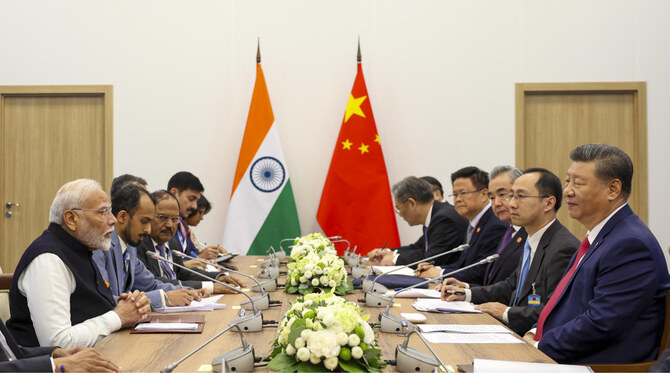
The nuclear-armed neighbors struck a deal earlier this week on patrolling the frontier, which then paved the way for the first formal talks in five years between President Xi Jinping and Prime Minister Narendra Modi on the sidelines of a regional summit in Russia.
“According to the recently agreed solution between India and China ... their frontline armies are implementing relevant work, with smooth progress so far,” Lin Jian, a spokesperson for China’s Foreign Ministry, said on Friday.
In New Delhi, a government official aware of the details said troops on both sides had started withdrawing from the areas of Depsang and Demchok, the last remaining points where they had stood face-to-face.
The source spoke on condition of anonymity as he was not authorized to speak to the media on the issue.
India’s Foreign Ministry did not immediately respond to a Reuters request for comment.
Neither side has provided details of the new pact, which is expected to help improve political and business ties damaged by a deadly military clash in 2020, when 20 Indian and four Chinese troops died in clashes in the Galwan Valley.
The two sides had earlier pulled back troops from five other face-off points, but the last withdrawal of troops took place over two years ago.
On Wednesday, Xi and Modi agreed to boost communication and co-operation in a bid to help resolve conflict.
But officials in India said that New Delhi would still be cautious and is ready to only take baby steps toward building economic ties with Beijing, given the trust deficit of the last four years.
India had blocked direct flights with China, banned hundreds of Chinese mobile applications, and added layers of vetting on Chinese investments, virtually blocking all major proposals from the likes of BYD and Great Wall Motors.
Two Indian government sources said that India would now consider opening up the skies and fast tracking visa approvals to complement the recent easing of tensions, but New Delhi is not yet ready to reverse all the steps it took against Beijing any time soon.
The Asian giants went to war in 1962 over their undemarcated border, which has been a constant irritant in ties.


India, China begin implementing new border pact, ending Himalayan face-off
https://arab.news/zseua
India, China begin implementing new border pact, ending Himalayan face-off

- The two sides had earlier pulled back troops from five other face-off points, but the last withdrawal of troops took place over two years ago


Trump administration labels 3 Muslim Brotherhood branches as terrorist organizations
- The State Department designated the Lebanese branch a foreign terrorist organization
- “These designations reflect the opening actions of an ongoing, sustained effort to thwart Muslim Brotherhood chapters’ violence,” Rubio said
WASHINGTON: President Donald Trump’s administration has made good on its pledge to label three Middle Eastern branches of the Muslim Brotherhood as terrorist organizations, imposing sanctions on them and their members in a decision that could have implications for US relationships with allies Qatar and Turkiye.
The Treasury and State departments announced the actions Tuesday against the Lebanese, Jordanian and Egyptian chapters of the Muslim Brotherhood, which they said pose a risk to the United States and American interests.
The State Department designated the Lebanese branch a foreign terrorist organization, the most severe of the labels, which makes it a criminal offense to provide material support to the group. The Jordanian and Egyptian branches were listed by Treasury as specially designated global terrorists for providing support to Hamas.
“These designations reflect the opening actions of an ongoing, sustained effort to thwart Muslim Brotherhood chapters’ violence and destabilization wherever it occurs,” Secretary of State Marco Rubio said in a statement. “The United States will use all available tools to deprive these Muslim Brotherhood chapters of the resources to engage in or support terrorism.”
Rubio and Treasury Secretary Scott Bessent were mandated last year under an executive order signed by Trump to determine the most appropriate way to impose sanctions on the groups, which US officials say engage in or support violence and destabilization campaigns that harm the United States and other regions.
Muslim Brotherhood leaders have said they renounce violence.
Trump’s executive order had singled out the chapters in Lebanon, Jordan and Egypt, noting that a wing of the Lebanese chapter had launched rockets on Israel after Hamas’ Oct. 7, 2023, attack in Israel that set off the war in Gaza. Leaders of the group in Jordan have provided support to Hamas, the order said.
The Muslim Brotherhood was founded in Egypt in 1928 but was banned in that country in 2013. Jordan announced a sweeping ban on the Muslim Brotherhood in April.
Nathan Brown, a professor of political science and international affairs at George Washington University, said some allies of the US, including the United Arab Emirates and Egypt, would likely be pleased with the designation.
“For other governments where the brotherhood is tolerated, it would be a thorn in bilateral relations,” including in Qatar and Turkiye, he said.
Brown also said a designation on the chapters may have effects on visa and asylum claims for people entering not just the US but also Western European countries and Canada.
“I think this would give immigration officials a stronger basis for suspicion, and it might make courts less likely to question any kind of official action against Brotherhood members who are seeking to stay in this country, seeking political asylum,” he said.
Trump, a Republican, weighed whether to designate the Muslim Brotherhood a terrorist organization in 2019 during his first term in office. Some prominent Trump supporters, including right-wing influencer Laura Loomer, have pushed his administration to take aggressive action against the group.
Two Republican-led state governments — Florida and Texas — designated the group as a terrorist organization this year.


