Modi and Xi agree to resolve differences, boost India-China ties

1 / 2
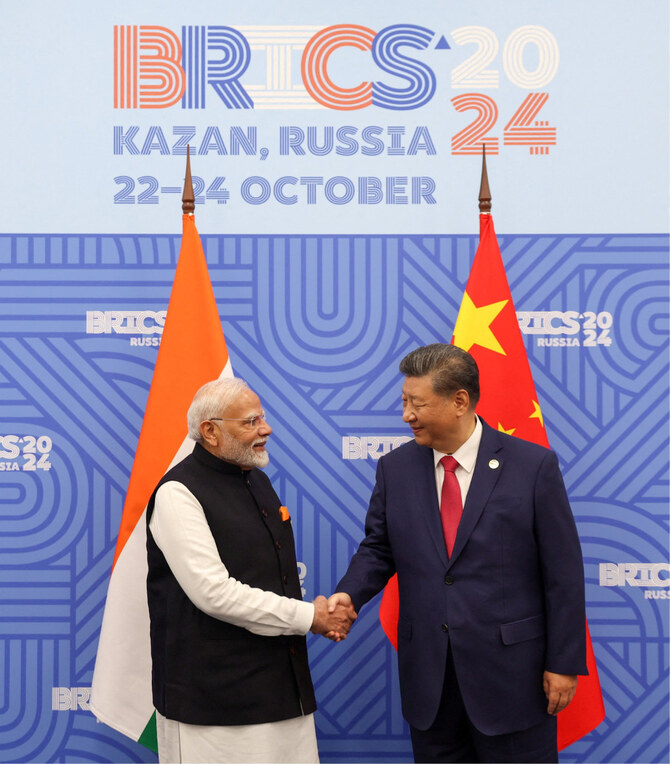
Indian Prime Minister Narendra Modi shakes hands with Chinese President Xi Jinping before their meeting on the sidelines of the BRICS summit in Kazan, Russia, October 23, 2024. (India's Press Information Bureau/Handout via REUTERS)
2 / 2
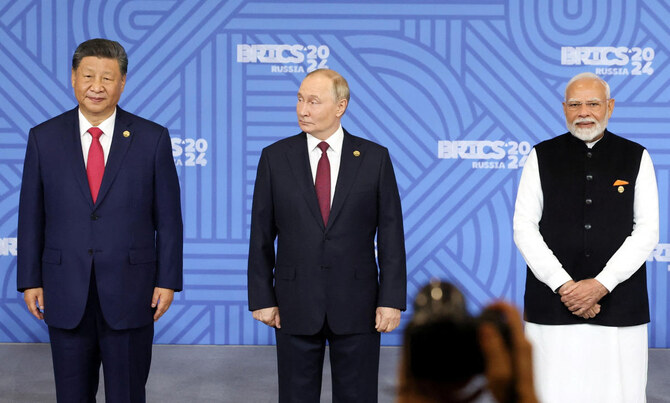
From left: Chinese President Xi Jinping, Russian President Vladimir Putin and Indian Prime Minister Narendra Modi take part in a photo ceremony before a plenary session of the BRICS 2024 summit in Kazan, Russia on Oct. 23, 2024. (Sputnik via Reuters)
Short Url
Updated 24 October 2024
Follow

Modi and Xi agree to resolve differences, boost India-China ties

  • Meeting took place on the sidelines of the three-day BRICS gathering
  • Talks expected to result in more Chinese investment into India

NEW DELHI/BEIJING/KAZAN,Russia/: Chinese President Xi Jinping and Indian Prime Minister Narendra Modi agreed on Wednesday to boost communication and cooperation between their countries and resolve conflicts to help improve ties that were damaged by a deadly military clash in 2020.
The two leaders met on the sidelines of the BRICS summit in Russia for their first formal talks in five years, signalling that ties between the Asian giants have begun to recover from the diplomatic rift caused by the clash along their disputed Himalayan frontier.
India and China, two of the world’s biggest economies, have maintained strong trade ties despite the military and diplomatic tensions. The rapprochement is expected to boost Chinese investment in India.
India said the two leaders have directed their officials to take further steps to stabilize all aspects of bilateral ties.
The Xi-Modi meeting in the city of Kazan came two days after New Delhi said it had reached a deal with Beijing to resolve the four-year military stand-off in the Himalayan region of Ladakh, although neither side has shared details of the pact.
 

The two sides should strengthen communication and cooperation, resolve conflicts and differences, and realize each other’s development dreams, Chinese state broadcaster CCTV reported Xi as telling Modi.

Modi put forward ideas for improving and developing bilateral relations, to which Xi agreed in principle, CCTV added without elaborating.
In response, Modi told Xi that peace, stability, mutual trust and respect were crucial for relations.
“We welcome the agreement on the issues that had come up over the last four years,” Modi told Xi in comments aired on India’s state broadcaster Doordarshan.
“It should be our priority to maintain peace and tranquillity on the border. Mutual trust, mutual respect and mutual sensitivity should be the basis of our relationship,” Modi said.


Path to improving ties
Relations between the world’s two most populous nations — both nuclear powers — have been strained since a clash between their troops on the largely undemarcated frontier in the western Himalayas left 20 Indian and four Chinese soldiers dead in 2020.
The neighbors have added tens of thousands of troops and weapons along the icy frontier over the last four years.
Modi and Xi had not held formal bilateral talks since then, although both participated in multilateral events. Their last bilateral summit talks were held in October 2019 in the southern Indian town of Mamallapuram.
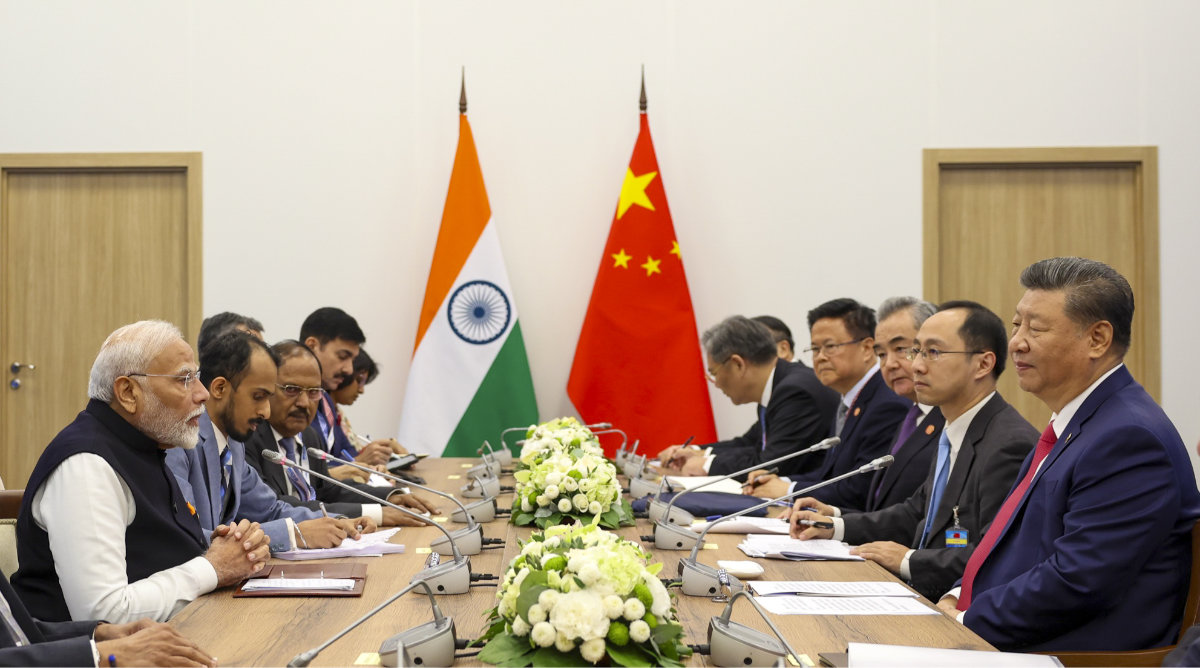


Chinese President Xi Jinping, right, at a meeting with Indian Prime Minister Narendra Modi, left, on the sidelines of the BRICS Summit in Kazan, Russia, on Oct. 23, 2024. (Indian Ministry of Information and Broadcasting on X via AP)

The two spoke briefly on the sidelines of the G20 summit in Bali in November 2022. They spoke again on the sidelines of the BRICS summit in Johannesburg in August 2023 but released different versions of the conversation, suggesting they didn’t see eye to eye.
Xi skipped the G20 summit hosted by New Delhi the following month, a decision seen as another setback to relations.
Diplomatic efforts gained momentum in recent months after the two countries’ foreign ministers met in July and agreed to step up talks to ease the border tensions.
India had made improving the wider political and damaged business ties contingent upon finding a solution to the border stand-off.
New Delhi had increased the scrutiny of investments coming from China, blocked direct flights between the two countries and had practically barred issuing any visas to Chinese nationals since the Ladakh clashes.
Speaking in Kazan, Indian Foreign Secretary Vikram Misri said there was hope for better India-China relations.
“As we have maintained during the last four years, the restoration of peace and tranquillity on the border areas will create space for ... normalization of our bilateral relations.”


Immigration agents draw guns, arrest activists following them in Minneapolis

Updated 4 sec ago
Follow

Immigration agents draw guns, arrest activists following them in Minneapolis

MINNEAPOLIS: Immigration officers with guns drawn arrested some activists who were trailing their vehicles on Tuesday in Minneapolis, a sign that tensions have not eased since the departure last week of a high-profile commander.
At least one person who had an anti-ICE message on clothing was handcuffed while face-down on the ground. An Associated Press photographer witnessed the arrests.
Meanwhile, Tuesday was the deadline for the Minnesota governor, state attorney general and the mayors of Minneapolis and St. Paul to produce documents to a federal grand jury in response to a Justice Department request for records of any effort to stifle the Trump administration’s immigration crackdown. Officials have denounced it as a bullying tactic.
Federal agents in the Twin Cities lately have been conducting more targeted immigration arrests at homes and neighborhoods, rather than staging in parking lots. The convoys have been harder to find and less aggressive. Alerts in activist group chats have been more about sightings than immigration-related detainments.
Several cars followed officers through south Minneapolis after there were reports of them knocking at homes. Officers stopped their vehicles and ordered activists to come out of a car at gunpoint. Agents told reporters at the scene to stay back and threatened to use pepper spray.
There was no immediate response to a request for comment from the Department of Homeland Security and Immigration and Customs Enforcement.
A federal judge last month put limits on how officers treat motorists who are following them but not obstructing their operations. Safely following agents “at an appropriate distance does not, by itself, create reasonable suspicion to justify a vehicle stop,” the judge said. An appeals court, however, set the order aside.
Border Patrol commander Greg Bovino, who was leading an immigration crackdown in Minneapolis and other big US cities, left town last week, shortly after the fatal shooting of Alex Pretti, the second local killing of a US citizen in January.
Trump administration border czar Tom Homan was dispatched to Minnesota instead. He warned that protesters could face consequences if they interfere with officers.
Grand jury seeks communications, records
Minneapolis Mayor Jacob Frey’s office said it was complying with a grand jury subpoena requesting documents about the city’s response to Operation Metro Surge, but it released no other details.
“We have done nothing wrong and have nothing to hide, but when the federal government weaponizes the criminal justice system against political opponents, it’s important to stand up and fight back,” spokesperson Ally Peters said.
Other state and local offices run by Democrats were given similar requests. People familiar with the matter have told the AP that the subpoenas are related to an investigation into whether Minnesota officials obstructed enforcement through public statements.
No bond for man in Omar incident
Elsewhere, a man charged with squirting apple cider vinegar on Democratic US Rep. Ilhan Omar will remain in jail. US Magistrate Judge David Schultz granted a federal prosecutor’s request to deny bond to Anthony Kazmierczak.
“We simply cannot have protesters and people — whatever side of the aisle they’re on — running up to representatives who are conducting official business, and holding town halls, and assaulting them,” Assistant US Attorney Benjamin Bejar said Tuesday.
Defense attorney John Fossum said the vinegar posed a low risk to Omar. He said Kazmierczak’s health problems weren’t being properly addressed in jail and that his release would be appropriate.
___
Raza reported from Sioux Falls, South Dakota. AP reporters Ed White in Detroit and Hannah Fingerhut in Des Moines, Iowa, contributed.