NEW DELHI, BEIJING: India and China have begun implementing an agreement to end a military standoff on their disputed Himalayan border, the two sides said on Friday, in the biggest thaw between the Asian giants since deadly clashes between their armies four years ago.
Troops who were eyeball-to-eyeball at two points on the frontier in the western Himalayas had begun pulling back, an Indian government source said, heralding an end to the standoff.
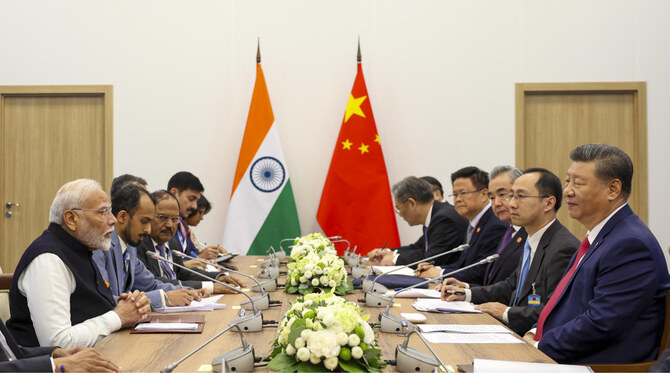
The nuclear-armed neighbors struck a deal earlier this week on patrolling the frontier, which then paved the way for the first formal talks in five years between President Xi Jinping and Prime Minister Narendra Modi on the sidelines of a regional summit in Russia.
“According to the recently agreed solution between India and China ... their frontline armies are implementing relevant work, with smooth progress so far,” Lin Jian, a spokesperson for China’s Foreign Ministry, said on Friday.
In New Delhi, a government official aware of the details said troops on both sides had started withdrawing from the areas of Depsang and Demchok, the last remaining points where they had stood face-to-face.
The source spoke on condition of anonymity as he was not authorized to speak to the media on the issue.
India’s Foreign Ministry did not immediately respond to a Reuters request for comment.
Neither side has provided details of the new pact, which is expected to help improve political and business ties damaged by a deadly military clash in 2020, when 20 Indian and four Chinese troops died in clashes in the Galwan Valley.
The two sides had earlier pulled back troops from five other face-off points, but the last withdrawal of troops took place over two years ago.
On Wednesday, Xi and Modi agreed to boost communication and co-operation in a bid to help resolve conflict.
But officials in India said that New Delhi would still be cautious and is ready to only take baby steps toward building economic ties with Beijing, given the trust deficit of the last four years.
India had blocked direct flights with China, banned hundreds of Chinese mobile applications, and added layers of vetting on Chinese investments, virtually blocking all major proposals from the likes of BYD and Great Wall Motors.
Two Indian government sources said that India would now consider opening up the skies and fast tracking visa approvals to complement the recent easing of tensions, but New Delhi is not yet ready to reverse all the steps it took against Beijing any time soon.
The Asian giants went to war in 1962 over their undemarcated border, which has been a constant irritant in ties.


![]()

India, China begin implementing new border pact, ending Himalayan face-off
Short Url
https://arab.news/zseua
India, China begin implementing new border pact, ending Himalayan face-off
- The two sides had earlier pulled back troops from five other face-off points, but the last withdrawal of troops took place over two years ago


Latest updates


© 2026 SAUDI RESEARCH & PUBLISHING COMPANY, All Rights Reserved And subject to Terms of Use Agreement.