

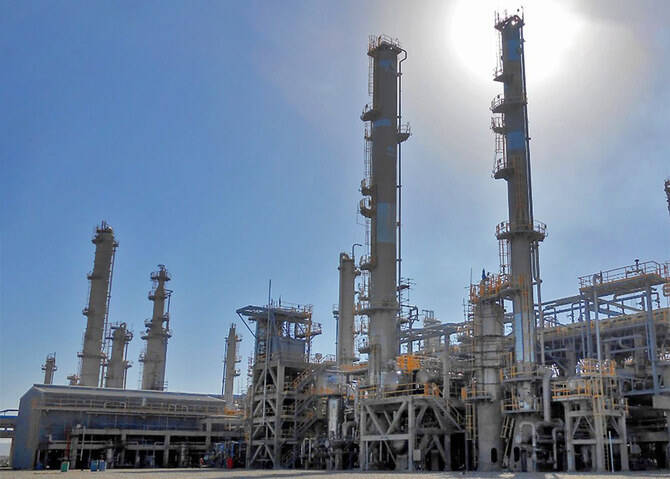

KARACHI: Pakistan’s largest oil refiner, Cnergyico Pk Limited, said on Thursday it may increase crude oil imports from the United States to as much as $1 billion by the end of the current fiscal year in June, as domestic demand rises during peak summer months.
The plan follows the completion of a $430 million commercial transaction to import six million barrels of West Texas Intermediate (WTI) light crude from the US, underscoring the growing role of private-sector energy trade in expanding economic ties between Islamabad and Washington.
“We may book cargoes worth $1 billion by the end of this fiscal year,” Cnergyico Vice Chairman Usama Qureshi told Arab News.
Pakistan has been seeking to expand bilateral trade with the United States, its largest export market, amid efforts to rebalance trade flows and avoid punitive tariffs under President Donald Trump’s trade policy. In July, Islamabad finalized a new trade arrangement with Washington that helped the cash-strapped country avert proposed reciprocal tariffs of up to 29 percent on its exports and bag a deal for 19 percent.
Cnergyico said it has already imported three million barrels of US crude under the current deal, with the remaining three million barrels scheduled to arrive at its offshore Single Point Mooring facility in February and March.
“We have already completed our bookings for March shipments, but April, May and June are the peak months in terms of demand, and we could reach the $1 billion imports if we ordered more crude,” Qureshi said.
Cnergyico operates Pakistan’s largest refinery, with a capacity of 156,000 barrels per day, and executed the US crude deal with global energy trader Vitol. The imports are expected to help Pakistan diversify its crude sourcing at a time of global supply uncertainty.
The move has also been viewed by analysts as part of Pakistan’s broader effort to narrow its roughly $3 billion trade surplus with the United States, although Cnergyico said the strategy does not signal a shift away from traditional suppliers in the Middle East.
The South Asian country has historically relied on Gulf producers, particularly Saudi Arabia and the United Arab Emirates, to meet its energy needs, importing petroleum products worth about $16 billion last year, according to data from the Pakistan Bureau of Statistics.
On Jan. 27, commodities intelligence firm S&P Global Energy cited Qureshi as saying the company was seeking to reduce reliance on Middle Eastern crude. Speaking to Arab News, however, Qureshi rejected the suggestion that US imports were intended to replace Gulf supplies.
“Increasing bilateral energy trade from negligible levels to $430 million demonstrated the capacity of private enterprise to support national economic objectives,” he said.
“Such engagement is expected to reach the $1 billion mark by the end of the fiscal year,” he added.
Qureshi said the transactions were being carried out entirely on a commercial basis, without sovereign guarantees or government financing.
“All our trade deals are being executed without any sovereign guarantees or government financing,” he said, adding that the transactions reflected a market-driven approach to trade expansion.
“Sustained commercial flows of this nature can reinforce US-Pakistan trade diplomacy and, over time, contribute to improved market access and more favorable tariff outcomes for Pakistani exports,” Qureshi said, citing energy analysts.
In November last year, Cnergyico and Vitol delivered Pakistan’s largest single shipment of very low sulfur fuel oil for ship refueling, enabling large vessels to bunker locally and strengthening Pakistan’s supply of environmentally compliant marine fuel.
Zayan Babar Khan, an investment analyst at Karachi-based Arif Habib Limited, said reaching the $1 billion import level would require sustained, large-scale shipments and would remain contingent on pricing, freight costs and refinery economics.
He said company management had highlighted the private sector’s role in supporting broader economic objectives, noting that stronger trade ties with the United States could help ease tariff pressures and support Pakistan’s exports.
From October 2025 to January 2026, Cnergyico plans to process low-sulfur crudes such as WTI and Bonny Light, reflecting a gradual shift toward cleaner fuel inputs as premiums on Middle Eastern crude grades rise.
“Traditionally, Pakistan sources nearly all of its crude from the Middle East, with US imports remaining recent and marginal. US cargoes are being procured on a spot/test basis for diversification and trade balance support,” Khan said.
“While industry commentary in 2025 suggested potential US crude imports of up to $1 billion, only a few million barrels have been booked so far.”


