

Nearly 400 authors call for boycott of Israeli cultural institutions

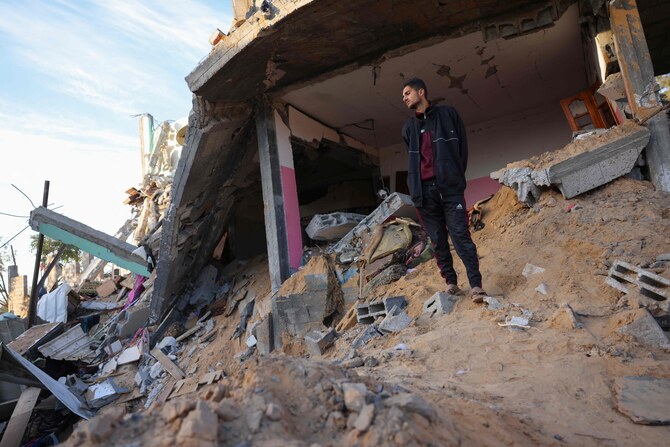
A man inspects the damage at the site of an Israeli strike that targetted an area in Khan Yunis on the southern Gaza Strip on October 25, 2024. (AFP)
Short Url
Updated 25 October 2024
Follow

Nearly 400 authors call for boycott of Israeli cultural institutions

  • Writers including Sally Rooney and Arundhati Roy say those who stay silent over Gaza are ‘complicit in genocide’
  • Author Lee Child warns boycott will hit Israel’s ‘only voices for peace and common sense’

LONDON: A group of almost 400 authors have called for a boycott of Israeli cultural institutions.

The writers, including Sally Rooney and Arundhati Roy, say Israeli publishers, book festivals and literary agencies that have not spoken out against the war in Gaza are “complicit in genocide.”

The unpublished letter, organized by the Palestine Festival of Literature, claims that the “genocide … is the biggest war on children this century.”

It adds: “Culture has played an integral role in normalizing these injustices. Israeli cultural institutions, often working directly with the state, have been crucial in obfuscating, disguising and art-washing the dispossession and oppression of millions of Palestinians for decades.

“We cannot in good conscience engage with Israeli institutions without interrogating their relationship to apartheid and displacement.”

The Fossil Free Books pressure group, which worked to get literary festivals to cut ties with sponsors such as Baillie Gifford over the war earlier this year, is supporting the letter, alongside a number of Booker prize nominees. A full list of signatories is set to be released next week.

“We will not work with Israeli cultural institutions that are complicit or have remained silent observers of the overwhelming oppression of Palestinians,” the letter, seen by The Times, said.

“We will not cooperate with Israeli institutions including publishers, festivals, literary agencies and publications that are complicit in violating Palestinian rights.”

The move to boycott Israeli cultural institutions has also been criticized, including by “Jack Reacher” author Lee Child, who said writers should not “attack the very people whose hearts are still in the right place,” including Israel’s “only voices for peace and common sense.”

Child said: “They are firm allies in the struggle for an equitable outcome, and to demonise them is to shoot the Palestinian cause in the foot. Personally, I support a full two-state solution, and I’m a pragmatic person, so my instinct is to partner with Israelis who think the same way. Building bridges with them is the way to go. Canceling them is nuts.”

Larry Finlay, a former publishing chief at Transworld books, told The Times: “The target of (the signatories’) ire is just wrong because the people who will suffer from this will be Israelis who are on the left and anti-Netanyahu.

“There is no wisdom for this boycott, which is born out of hatred and antisemitism.”


Thai villagers stay behind to guard empty homes as border clashes force mass evacuations

Updated 58 min 19 sec ago
Follow

Thai villagers stay behind to guard empty homes as border clashes force mass evacuations

  • Appointed by the local administration as Village Security Volunteers, they guarded the empty homes after many residents were forced to flee and with fewer security officials stationed nearby than usual

SURIN: Fighting that has flared along the Thai-Cambodian border has sent hundreds of thousands of Thai villagers fleeing from their homes close to the frontier since Monday. Their once-bustling communities have fallen largely silent except for the distant rumble of firing across the fields.
Yet in several of these villages, where normally a few hundred people live, a few dozen residents have chosen to stay behind despite the constant sounds of danger.
In a village in Buriram province, about 6 miles (10 kilometers) from the border, Somjai Kraiprakon and roughly 20 of her neighbors gathered around a roadside house, keeping watch over nearby homes. Appointed by the local administration as Village Security Volunteers, they guarded the empty homes after many residents were forced to flee and with fewer security officials stationed nearby than usual.
The latest large-scale fighting derailed a ceasefire pushed by US President Donald Trump, which halted five days of clashes in July triggered by longstanding territorial disputes. As of Saturday, around two dozen people had been reported killed in the renewed violence.
At a house on the village’s main intersection, now a meeting point, kitchen and sleeping area, explosions were a regular backdrop, with the constant risk of stray ammunition landing nearby. Somjai rarely flinched, but when the blasts came too close, she would sprint to a makeshift bunker beside the house, built on an empty plot from large precast concrete drainage pipes reinforced with dirt, sandbags and car tires.
She volunteered shortly after the July fighting. The 52-year-old completed a three-day training course with the district administration that included gun training and patrol techniques before she was appointed in November. The volunteer village guards are permitted to carry firearms provided by relevant authorities.
The army has emphasized the importance of volunteers like Somjai in this new phase of fighting, saying they help “provide the highest possible confidence and safety for the public.”
According to the army, volunteers “conduct patrols, establish checkpoints, stand guard inside villages, protect the property of local people, and monitor suspicious individuals who may attempt to infiltrate the area to gather intelligence.”
Somjai said the volunteer team performs all these duties, keeping close watch on strangers and patrolling at night to discourage thieves from entering abandoned homes. Her main responsibility, however, is not monitoring threats but caring for about 70 dogs left behind in the community.
“This is my priority. The other things I let the men take care of them. I’m not good at going out patrolling at night. Fortunately I’m good with dogs,” she said, adding that she first fed a few using her own money, but as donations began coming in, she was able to expand her feeding efforts.
In a nearby village, chief Praden Prajuabsook sat with about a dozen members of his village security team along a roadside in front of a local school. Around there, most shops were already closed and few cars could be seen passing once in a while.
Wearing navy blue uniforms and striped purple and blue scarves, the men and women chatted casually while keeping shotguns close and watching strangers carefully. Praden said the team stationed at different spots during the day, then started patrolling when night fell.
He noted that their guard duty is around the clock, and it comes with no compensation and relies entirely on volunteers. “We do it with our own will, for the brothers and sisters in our village,” he said.
Beyond guarding empty homes, Praden’s team, like Somjai, also ensures pets, cattle and other animals are fed. During the day, some members ride motorbikes from house to house to feed pigs, chickens and dogs left behind by their owners.
Although his village is close to the battlegrounds, Praden said he is not afraid of the sounds of fighting.
“We want our people to be safe… we are willing to safeguard the village for the people who have evacuated,” he said.