ISLAMABAD: Pakistan’s Finance Minister Muhammad Aurangzeb has invited firms in the United States (US) to explore investment opportunities in the South Asian country, the Pakistani government said late Thursday, amid Islamabad’s push to boost investment and trade to support its weak economy.
Pakistan, which recently secured a $7 billion bailout from the International Monetary Fund (IMF), has been making attempts to overcome an economic meltdown that sent its foreign exchange reserves to critically low levels, led to currency devaluation and high inflation.
The Pakistani finance minister is currently in the US to attend the annual World Bank and IMF meetings, where global finance leaders have convened to address challenges such as sluggish international growth, managing debt distress and financing the transition to green energy.
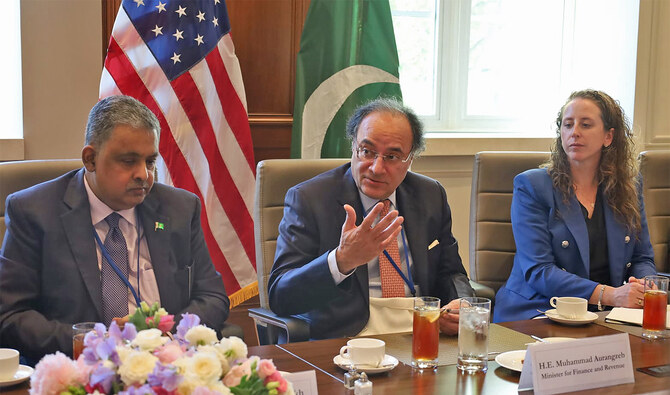
On Thursday, Aurangzeb had a luncheon with members of the US-Pakistan Business Council (USPBC), which aims to enhance trade and investment between the US and Pakistan, in Washington, according to the Press Information Department (PID) of the Pakistani government.
“The minister noted that the presence of over 80 US enterprises in Pakistan reflects the profit potential of a 240 million strong market,” the PID said in a statement. “He invited US firms to take advantage of the government’s investment-friendly policies and the one-window facility offered by the Special Investment Facilitation Council.”
The finance minister acknowledged the contributions of the USPBC in strengthening trade and investment ties between Pakistan and the US, reiterating the prime minister’s invitation to the council to lead a business delegation to Pakistan this year to explore mutually beneficial partnerships.
Pakistan has increasingly sought trade and investment cooperation with allies and beyond in recent months as it navigates the macroeconomic crisis that has drained its resources. The South Asian country has had a flurry of high-level exchanges with Saudi Arabia, Japan, Azerbaijan, Qatar and Central Asian countries in a bid to support its $350 billion fragile economy.
Separately, Aurangzeb attended a series of investor fora organized by Citibank, Standard Chartered and JP Morgan in Washington. During these interactions, he briefed the investors on the Pakistani economy’s performance for the last fiscal year.
“The minister highlighted key reforms in taxation, energy, SOEs [state-owned enterprises], privatization, and right-sizing of the government,” the PID said. “He emphasized the role of provincial governments in raising the tax-to-GDP ratio and discussed the National Fiscal Pact signed by the Federal Government.”
He also addressed investor questions about the Sovereign Wealth Fund, Special Economic Zones, and Power Purchase Agreements being negotiated with Chinese independent power producers.


![]()

Finance minister invites US firms to explore investment opportunities in Pakistan
Short Url
https://arab.news/6jqh4
Finance minister invites US firms to explore investment opportunities in Pakistan
- Muhammad Aurangzeb is currently in the US to attend the annual World Bank and IMF meetings
- Pakistan is seeking to boost trade and investment as it navigates a tricky path to economic recovery
Latest updates


Recommended


© 2026 SAUDI RESEARCH & PUBLISHING COMPANY, All Rights Reserved And subject to Terms of Use Agreement.