

Ambassador looks to expand Saudi-Hungarian cooperation in IT, healthcare and investment

1 / 3
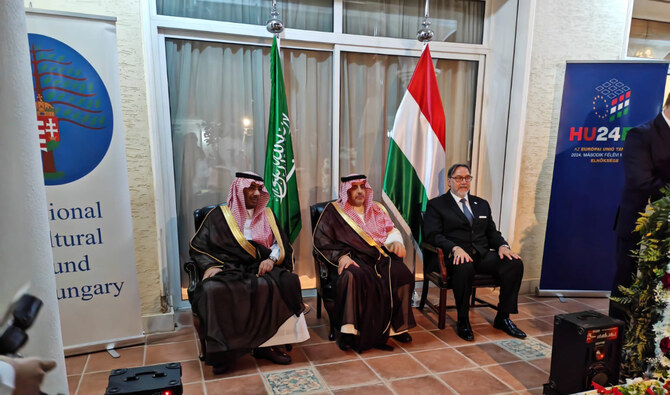
During the Hungarian National Day reception hosted recently in the embassy in Riyadh, the ambassador detailed the significance of the national day and highlighted the areas he would like to see cooperation grow between Saudi Arabia and Hungary. (Supplied)
2 / 3
During the Hungarian National Day reception hosted recently in the embassy in Riyadh, the ambassador detailed the significance of the national day and highlighted the areas he would like to see cooperation grow between Saudi Arabia and Hungary. (Supplied)
3 / 3
During the Hungarian National Day reception hosted recently in the embassy in Riyadh, the ambassador detailed the significance of the national day and highlighted the areas he would like to see cooperation grow between Saudi Arabia and Hungary. (Supplied)
Short Url
Updated 24 October 2024
Follow

Ambassador looks to expand Saudi-Hungarian cooperation in IT, healthcare and investment

RIYADH: Hungary’s ambassador to Saudi Arabia, Balazs Selmeci, aims to expand cooperation between the two countries in the fields of investment, IT, healthcare, and food products.

“We have 28 years of diplomatic relations with Saudi Arabia, which is not a long period, but we have the political trust and our cooperations in the economic sense strengthened mainly in the field of IT,” Selmeci told Arab News.

“Hungary is very advanced in the IT sector, we can bring here our know-how. With the help of Saudi people we can reach the government and private sectors here in Saudi Arabia,” he said.

During the Hungarian National Day reception hosted recently in the embassy in Riyadh, the ambassador detailed the significance of the national day and highlighted the areas he would like to see cooperation grow between Saudi Arabia and Hungary.

“We are celebrating October 23 as the revolution against the communist Soviet regime,” he said.

Selmeci said that the reception signified the importance of a peaceful life for both regions.

“In a wider sense, we are celebrating our freedom and our peaceful life, which is important also now here in Saudi Arabia as also in our region of Hungary and here in this region,” the ambassador said.

“We have unfortunately very hard and strong conflicts, so the national day here in Saudi Arabia gives us a chance to call everybody for a peaceful solution for the conflicts here in this region and our region,” he said.

When discussing the areas in which he would like to see cooperation grow between the two countries, the ambassador said that he would like to see more Hungarian investors in the Kingdom, which he hopes will result from the first Hungarian-Saudi joint venture in IT scheduled to take place next month.

“In the next month, we have here the first Hungarian-Saudi joint venture in the field of IT,” Selmeci told Arab News.

The ambassador also said that he would be happy to see more Hungarian products on the shelves in Saudi supermarkets.

On the topic of healthcare, Selmeci added that he would also like to see some development between the two countries.

The Hungarian National Day reception featured Josef Terek, a musician, composer, music director and recipient of the Hungarian Cross of Merit, who played a traditional Hungarian instrument called a tarogato. 

“He is playing a special Hungarian instrument called the tarogato which has a Middle Eastern origin,” the ambassador said.

“In the 9th century the zurna, which is a Middle Eastern instrument, arrived in Europe and this Hungarian instrument originated from that instrument.

“This is the special part of our evening here,” he said.

The ambassador also revealed that Terek would hold a tarogato masterclass in the Saudi Music Hub during his visit to the Kingdom.

“I am very proud that I can bring him to the Saudi Music Hub. This is the special part of our reception,” he said.


Saudi Food and Drug Authority pioneering digital health safety

Updated 15 December 2025
Follow

Saudi Food and Drug Authority pioneering digital health safety

  • Digital foundation enabled the development of centralized dashboards that provide real-time analysis of adverse events
  • Major improvement has been the use of Robotic Process Automation (RPA) to ensure medication safety works smoothly

TOKYO: Saudi Arabia is establishing itself as a regional leader in digital health regulation by integrating advanced technologies into the Saudi Food and Drug Authority’s (SFDA) pharmacovigilance and cosmetic safety oversight.

In line with Vision 2030’s digital goals, these projects are creating new standards for using data to protect public health, according to the SFDA.

A report by the Oxford Business Group says the transformation began with modernising the National Pharmacovigilance Centre’s adverse reaction reporting system. Moving from paper-based submissions to the fully digital “Saudi Vigilance” platform marked a significant step forward.

The introduction of smart reporting forms with structured data fields and behavioural nudges grounded in psychological principles significantly improved reporting quality and completion rates.

This digital foundation enabled the development of centralised dashboards that provide real-time analysis of adverse events, enabling early identification of safety signals and under-reporting trends.

A major improvement has been the use of Robotic Process Automation (RPA) to ensure medication safety works smoothly. By letting computers handle repetitive tasks like sorting reports and checking data, the SFDA has become more efficient.

The new RPA system for identifying safety signals has also sped things up. These technology solutions have made work easier and happier employees by eliminating boring manual tasks.

The SFDA’s digital changes also help prevent risks by using new online learning tools. The aRMMs e-learning system, with training videos about high-risk medicines, has changed how health care workers learn. Adding digital safety steps directly into hospital computer systems has also made a big difference. This new approach puts safety alerts and learning materials directly into doctors’ daily work, ensuring important information reaches them when they need it.

Digital innovation has also helped prevent medication errors. Moving from the old Phonetic and Orthographic Computer Analysis system to the new Saudi Name Registration (SNR) platform has made it easier to spot potentially confusing drug names. With better computer programs that check both Arabic and English names, plus real-time alerts and automatic updates, the SNR system is a big step forward in ensuring the safety of medicines before they reach the market.

Looking ahead, the SFDA plans to use these digital changes to make cosmetic products safer as well.

Planned projects using artificial intelligence include computer systems that spot rule-breaking, automated ingredient checks, and tools that read customer feedback to identify early warning signs.

This digital strategy puts Saudi Arabia ahead in new ways of making rules. By using artificial intelligence, automation, and data analysis in its work, the SFDA is improving how it tracks medicine safety and preparing for further progress in keeping products safe for consumers.

All these efforts support Vision 2030’s goal of building a knowledge-based economy and keeping Saudi citizens as safe as possible.