Hungary, Slovakia, Serbia vow to carry on fight against illegal migration

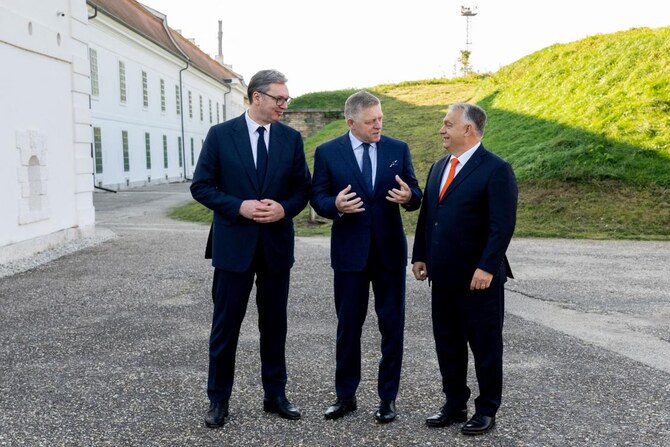
Slovak PM Robert Fico (C), Serbian President Aleksandar Vucic (L) and Hungarian PM Viktor Orban arrive for a trilateral meeting in Komarno, Slovakia on Oct. 22, 2024. (AFP)
Short Url
Updated 22 October 2024
Follow

Hungary, Slovakia, Serbia vow to carry on fight against illegal migration

  • The leaders recognized their efforts to cut the number of migrants, mainly from the Middle East and Africa
  • Migrants typically move on to richer countries in western Europe, like Germany

KOMARNO, Slovakia: Hungary, Slovakia and Serbia will continue joint efforts to curb illegal migration into the European Union, their leaders said on Tuesday, adding that more EU funds were needed.
Meeting in Komarno, Slovakia, on the Hungarian border, the leaders recognized their efforts to cut the number of migrants, mainly from the Middle East and Africa, who have come via the so-called Balkan route that passes through Serbia and into the EU via Hungary.
Migrants typically move on to richer countries in western Europe, like Germany.
“This year, there are 80 percent fewer migrants (in Serbia) than last year,” Serbian President Aleksandar Vucic said after meeting his Slovak and Hungarian counterparts Robert Fico and Viktor Orban.
“We will continue to work together and I believe that the results will be good.”
Illegal migration remains a key political problem across Europe nearly a decade after the crisis in 2015, when around 1 million people arrived in the bloc. Arrivals last year were around a third of that figure.
Orban said asylum applications must be assessed before someone is allowed to enter the EU, saying this model, used in Hungary, was the only one that worked against illegal migration.
Hotspots set up in the last safe countries for migrants, for example in Africa, could be a mass solution, he said.
Italy last week began working with EU non-member Albania by sending migrants there to have their asylum requests processed, a scheme to deter boat crossings which other EU leaders have said could be a model.
Vucic said Serbia, which is not an EU member, would never agree to create hotspots for illegal migrants on its territory.
The number of illegal crossings in the western Balkans fell 79 percent year-on-year to just under 17,000 in the first nine months of 2024, according to data from border agency Frontex.
Fico, who hosted the summit, called the fight against illegal migration an absolute priority and said illegal migration had negative effects on Europe.
“It was a topic of discussion today that in planning the next EU budget after 2027 we have to insist that a substantial part of the budget needs to be devoted to fight illegal migration, because it is seriously threatening us,” he said.


France warns of ‘provocation’ if Russian drone buzzed aircraft carrier

Updated 6 sec ago
Follow

France warns of ‘provocation’ if Russian drone buzzed aircraft carrier

  • Sweden said one of its navy vessels had spotted and jammed the drone 13 kilometers from France’s Charles de Gaulle aircraft carrier
  • Barrot stressed that the drone could never have posed any real threat to the vessel

MALMO, Sweden: France’s foreign minister said Friday that if a drone seen this week near a French aircraft carrier visiting Sweden turned out to be Russian — a claim Moscow called “absurd” — it would be a “ridiculous provocation.”
Sweden said one of its navy vessels had spotted and jammed the drone 13 kilometers (eight miles) from France’s Charles de Gaulle aircraft carrier.
On Thursday, Sweden’s Defense Minister Pal Jonson told the broadcaster SVT that the drone was “probably” of Russian origin.
“There was a Russian military vessel in the immediate vicinity at the time,” he added.
“If indeed... there is a potential Russian origin for this incident, the only conclusion I would draw is that it would be a ridiculous provocation,” French Foreign Minister Jean-Noel Barrot told journalists aboard the aircraft carrier.
Barrot stressed that the drone could never have posed any real threat to the vessel.
“The drone was neutralized away from the Charles de Gaulle aircraft carrier and in no way was the security of the aircraft carrier and its group threatened by this.”

- ‘Absurd’ accusation: Moscow -

Swedish Prime Minister Ulf Kristersson confirmed his country’s position in comments Friday.
“It is likely a Russian drone,” Kristersson told reporters during a visit to the aircraft carrier.
“We are now investigating it in more detail, but there is a lot to suggest that this is the case.”
He did not believe it was a coincidence that the incident occurred while the aircraft carrier was visiting, he added. “It is a Russian way of acting that we recognize from other places.”
Asked about the allegation, Kremlin spokesman Dmitry Peskov told journalists it was “quite an absurd statement.”
According to the Swedish authorities, its navy jammed the drone using electronic signals to attempt to break the connection between the aircraft and its operator, or disrupt its navigation tools.

- Numerous drone sightings -

The Swedish Armed Forces said Thursday that “no further drone sightings” had been made and that they were investigating the incident.
The French Navy’s flagship and its escort, made a port call on Wednesday for the first time in the Swedish port of Malmo, before joining NATO exercises.
Speaking to reporters, Alice Rufo, the number two minister at the French defense ministry, played down the incident.
“We cannot describe what happened as an incident. There was indeed a drone, which was dealt with very pro-actively by our Swedish partner,” Rufo said.
The drone had been stopped over 10 kilometers away from “the Charles de Gaulle, which in any case is fully ready to be completely protected, with every measure in place,” she added.
The nearby Baltic Sea is a theater of rivalry between Russia and the NATO alliance countries.
NATO’s easternmost countries have reported numerous drone sightings in recent months, with some pointing the finger at Russia.
Four years into Russia’s invasion of Ukraine, there is growing concern that such disruption could be part of hybrid war tactics by Moscow against the European nations which have backed Kyiv.