

Bangladesh bans student wing of Sheikh Hasina’s party under terrorism law

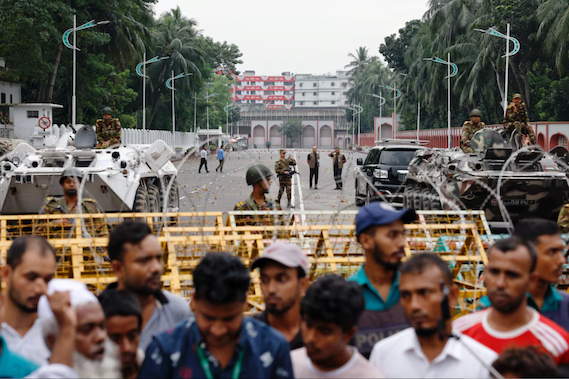
Bangladeshi security personnel stand guard in front of the residence and workplace of President Mohammed Shahabuddin after protesters demanded his resignation, in Dhaka, Oct. 23, 2024. (Reuters)
Short Url
Updated 24 October 2024
Follow

Bangladesh bans student wing of Sheikh Hasina’s party under terrorism law

  • Ban in response to pressure from student movement that toppled Hasina
  • Experts warn against banning of political groups, polarization of society

DHAKA: Bangladesh’s interim government has banned the student wing of the Awami League party of ousted prime minister Sheikh Hasina’s, citing the group’s role in the deadly violence during the recent popular uprising.

A gazette notification issued by the Ministry of Home Affairs on Wednesday night said the Bangladesh Chhatra League was banned under the Anti-Terrorism Act with immediate effect.

The ministry accused the BCL of misconduct over the past 15 years, including violence, harassment and exploitation of public resources.

The notification said there was evidence of the group’s “conspiratory, destructive and provocative acts against the nation along with various terror activities” during the nationwide protest that forced Hasina to flee to India.

Initially peaceful student-led demonstrations started in Bangladesh in early July against public-sector job quotas. Two weeks later, they were met with a violent crackdown by security forces aided by BCL activists, which according to UN estimates left more than 600 people dead.

The violence led to a nationwide uprising, which on Aug. 5 forced Hasina to leave for neighboring India and an interim cabinet led by Nobel Peace laureate Muhammad Yunus took charge.

There was no comment from the Awami League as many of its leaders have been arrested over accusations of their role in the unrest, the Bangladesh Nationalist Party — the main opposition party, whose members were persecuted during Hasina’s 15-year rule — was not enthusiastic about the ban.

“What we believe in is the rule of law. Whenever any such decision is taken, it ought to be made through a process of law. Anything that is extraordinary and beyond due process will always have some pitfalls. I believe, if a public hearing or some more clear legal process was adhered to prior to invoking such a decision, it would be more acceptable,” Nawshad Jamir, BNP’s international affairs secretary, told Arab News.

“BCL has done some most heinous crimes in the past however, even then, they are also entitled to a fair justice system.”

The banning of BCL and crackdown on Awami League comes in response to escalating demands from the student movement that organized the July protest. The movement’s members have been also calling for the removal of President Mohammed Shahabuddin — an Awami League member, who in accordance with Bangladesh’s constitution remained in office after Hasina’s resignation.

Prof. Touhidul Islam, who teaches conflict resolution at Dhaka University, warned against growing social polarization if the interim government was going to achieve national reconciliation, which was one of the first promises made by Yunus as he took office.

“This ban will have a significant influence in the broader political scenario of the country,” he said.

“When there is polarization in society, it always keeps away the concept of reconciliation. The focus should be on minimizing the differences. We are cautiously watching the political developments at the moment.”

The banning of political entities did not contribute to “healthy politics and a democratic system,” Prof. Zarina Rahman, former public administration lecturer at Dhaka University, told Arab News.

“If someone, or an organization, is found to be a terrorist or anti-social element, they should be tried. Someone should be charged with specific accusations,” she said.

“We have a common tendency to remove the head in case of a headache ... If someone violates the rules, we should hold him or her responsible for the particular misdeeds. The authorities should try this method first.”


London police using withdrawn powers to clamp down on pro-Palestine rallies: Probe

Updated 5 sec ago
Follow

London police using withdrawn powers to clamp down on pro-Palestine rallies: Probe

  • ‘Cumulative disruption’ cited to ban, reroute rallies but power granted by concept withdrawn by Court of Appeal in May
  • Network for Police Monitoring: This demonstrates ‘ongoing crackdown on protest’ that has reached ‘alarming point’

LONDON: London’s Metropolitan Police have used powers that have been withdrawn to clamp down on pro-Palestine rallies in the capital, legal experts have said.

The Guardian and Liberty Investigates obtained evidence that police officers had imposed restrictions on at least two protests based on the principle of “cumulative disruption.” But that power was withdrawn by the Court of Appeal in May, according to legal experts.

All references to cumulative disruption have been removed from relevant legislation, yet the Home Office and the Met continue to insist that police officers retain the power to consider the concept when suppressing protests.

On May 7, five days after the powers were withdrawn, the Met banned a Jewish pro-Palestine group from holding its weekly rally in north London, citing the cumulative impact on the neighborhood’s Jewish community.

Last month, the Met forced the Palestine Coalition to change the route of its rally on three days’ notice, highlighting the cumulative impact on businesses during Black Friday weekend.

Raj Chada, a partner at Hodge, Jones & Allen and a leading criminal lawyer, said: “There is no reference to cumulative disruption in the original (legislation). The regulations that introduced this concept were quashed in May 2025, so I fail to see how this can still be the approach taken by police. There is no legal basis for this whatsoever.”

The Met appeared “not to care” if it was acting within the law, the Network for Police Monitoring said, adding that the revelation surrounding “cumulative disruption” demonstrated an “ongoing crackdown on protest” that had reached an “alarming point” by police in London.

Home Secretary Shabana Mahmood announced plans in October to reintroduce the power to consider cumulative impact in toughened form.

But Nick Glynn, a retired senior officer from Leicestershire Police, said: “The police have too many protest powers already and they definitely don’t need any more. If they are provided with them, they not only use them (but) as in this case, they stretch them.

“They go beyond what was intended. The right to protest is sacrosanct and more stifling of protest makes democracy worth less.”

Cumulative disruption was regularly considered and employed in regulations if protests met the threshold of causing “serious disruption to the life of the community.”

The Court of Appeal withdrew the power following a legal challenge by human rights group Liberty.

Ben Jamal, the Palestine Solidarity Campaign’s director, was reportedly told by Alison Heydari, the Met’s deputy assistant commissioner, that her decision on imposing protest regulations “will be purely around the cumulative effect of your protests.”

She reportedly added that “this is not just about Saturday’s protest but it’s a combination of all the impacts of all the processions so far,” referencing “serious disruption” to the business community.

“You’ve used this route in November 2024, and you’ve used it a few times before then as well. So, there is an impact.”

The repeated disruption to PSC-hosted marches, the largest pro-Palestine events in London, was a “demobilizer,” Jamal said.

It also caused confusion about march starting points and led to protesters being harassed by police officers who accused them of violating protest conditions, he added.

A Met spokesperson told The Guardian: “The outcome of the judicial review does not prevent senior officers from considering the cumulative impact of protest on the life of communities.

“To determine the extent of disruption that may result from a particular protest, it is, of course, important to consider the circumstances in which that protest is to be held, including any existing disruption an affected community is already experiencing.

“We recognise the importance of the right to protest. We also recognise our responsibility to use our powers to ensure that protest does not result in serious disorder or serious disruption. We use those powers lawfully and will continue to do so.”