London police using withdrawn powers to clamp down on pro-Palestine rallies: Probe

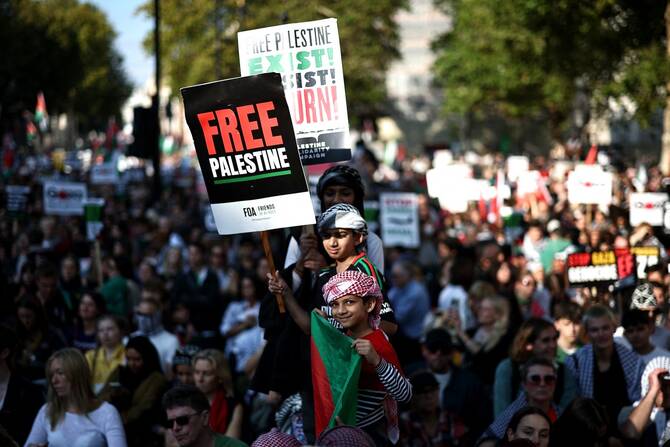
Young Pro-Palestinian supporters hold placards in central London, on October 11, 2025, as they take part in the 32nd 'National March for Palestine' since october 2023, organised by the Palestine Solidarity Campaign. (AFP)
Short Url
Updated 21 December 2025
Follow

London police using withdrawn powers to clamp down on pro-Palestine rallies: Probe

  • ‘Cumulative disruption’ cited to ban, reroute rallies but power granted by concept withdrawn by Court of Appeal in May
  • Network for Police Monitoring: This demonstrates ‘ongoing crackdown on protest’ that has reached ‘alarming point’

LONDON: London’s Metropolitan Police have used powers that have been withdrawn to clamp down on pro-Palestine rallies in the capital, legal experts have said.

The Guardian and Liberty Investigates obtained evidence that police officers had imposed restrictions on at least two protests based on the principle of “cumulative disruption.” But that power was withdrawn by the Court of Appeal in May, according to legal experts.

All references to cumulative disruption have been removed from relevant legislation, yet the Home Office and the Met continue to insist that police officers retain the power to consider the concept when suppressing protests.

On May 7, five days after the powers were withdrawn, the Met banned a Jewish pro-Palestine group from holding its weekly rally in north London, citing the cumulative impact on the neighborhood’s Jewish community.

Last month, the Met forced the Palestine Coalition to change the route of its rally on three days’ notice, highlighting the cumulative impact on businesses during Black Friday weekend.

Raj Chada, a partner at Hodge, Jones & Allen and a leading criminal lawyer, said: “There is no reference to cumulative disruption in the original (legislation). The regulations that introduced this concept were quashed in May 2025, so I fail to see how this can still be the approach taken by police. There is no legal basis for this whatsoever.”

The Met appeared “not to care” if it was acting within the law, the Network for Police Monitoring said, adding that the revelation surrounding “cumulative disruption” demonstrated an “ongoing crackdown on protest” that had reached an “alarming point” by police in London.

Home Secretary Shabana Mahmood announced plans in October to reintroduce the power to consider cumulative impact in toughened form.

But Nick Glynn, a retired senior officer from Leicestershire Police, said: “The police have too many protest powers already and they definitely don’t need any more. If they are provided with them, they not only use them (but) as in this case, they stretch them.

“They go beyond what was intended. The right to protest is sacrosanct and more stifling of protest makes democracy worth less.”

Cumulative disruption was regularly considered and employed in regulations if protests met the threshold of causing “serious disruption to the life of the community.”

The Court of Appeal withdrew the power following a legal challenge by human rights group Liberty.

Ben Jamal, the Palestine Solidarity Campaign’s director, was reportedly told by Alison Heydari, the Met’s deputy assistant commissioner, that her decision on imposing protest regulations “will be purely around the cumulative effect of your protests.”

She reportedly added that “this is not just about Saturday’s protest but it’s a combination of all the impacts of all the processions so far,” referencing “serious disruption” to the business community.

“You’ve used this route in November 2024, and you’ve used it a few times before then as well. So, there is an impact.”

The repeated disruption to PSC-hosted marches, the largest pro-Palestine events in London, was a “demobilizer,” Jamal said.

It also caused confusion about march starting points and led to protesters being harassed by police officers who accused them of violating protest conditions, he added.

A Met spokesperson told The Guardian: “The outcome of the judicial review does not prevent senior officers from considering the cumulative impact of protest on the life of communities.

“To determine the extent of disruption that may result from a particular protest, it is, of course, important to consider the circumstances in which that protest is to be held, including any existing disruption an affected community is already experiencing.

“We recognise the importance of the right to protest. We also recognise our responsibility to use our powers to ensure that protest does not result in serious disorder or serious disruption. We use those powers lawfully and will continue to do so.”


UK police seek information from ex-protection officers of king’s brother Andrew

Updated 5 sec ago
Follow

UK police seek information from ex-protection officers of king’s brother Andrew

  • Any changes to the line of succession would require consultation and agreement with other countries where King Charles is head of state
  • London’s Metropolitan Police said on Friday it was now identifying and contacting former and serving officers

SANDRINGHAM, England: British police said on Friday they were contacting former protection officers who worked for King Charles’ younger brother Andrew Mountbatten-Windsor, urging anyone with allegations of sex offenses relating to Jeffrey Epstein to come forward.
Mountbatten-Windsor was arrested on Thursday, his 66th birthday, on suspicion of misconduct in a public office.
A British official said Britain’s government would consider new legislation to remove the former prince from the line of royal succession once the police investigation into his ties with Epstein is over.
Any changes to the line of succession — Mountbatten-Windsor is eighth in line to the throne — would require consultation and agreement with other countries where King Charles is head of state, the official — who asked not to be identified — said.
OFFICERS URGED TO SHARE INFORMATION
Thursday’s arrest related to allegations Mountbatten-Windsor sent confidential government documents to the disgraced financier when he was a trade envoy.
As part of a completely separate inquiry, London’s Metropolitan Police said on Friday it was now identifying and contacting former and serving officers who may have worked closely with the royal.
“They have been asked to consider carefully whether anything they saw or heard during that period of service may be relevant to our ongoing reviews and to share any information that could assist us,” the police statement said.
“We continue to urge ⁠anyone with new ⁠or relevant information to come forward. All allegations will be taken seriously and, as with any matter, any information received will be assessed and investigated where appropriate.”
Mountbatten-Windsor has always denied any wrongdoing in relation to Epstein, a convicted sex offender whose death in a New York jail in 2019 was ruled a suicide, and said he regretted their friendship.
In 2022, the royal settled a civil lawsuit brought in the United States by the late Virginia Giuffre who accused him of sexually abusing her when she was a teenager at properties owned by Epstein or his associates.
British media reports have stated that Giuffre received around 12 million pounds ($16.2 million) from Mountbatten-Windsor. He has denied ever meeting her.
London police had previously looked into allegations of trafficking for sexual exploitation relating to Epstein and decided in 2016 not to launch any criminal investigation. That decision has since been reviewed three ⁠times, and as it stands there is no current formal investigation.
Friday’s statement said in light of the recent mass release of documents by the US government relating to Epstein, police were also looking into whether London airports were used by him to facilitate human trafficking and sexual exploitation.
“We are assessing this information and are actively seeking further detail from law enforcement partners, including those in the United States,” the statement said.
That echoed statements from three other police forces that are looking into private flight links to Epstein at other airports in Britain.

HELD FOR MORE THAN 10 HOURS
The latest development comes after Mountbatten-Windsor was released under investigation, having been held by detectives from Thames Valley police for more than 10 hours on suspicion of misconduct in a public office relating to his time as a trade envoy from 2001-2011.
He has not been charged with any offense, but looked haunted in a Reuters photograph after his release, eyes red and slumped in the back of a Range Rover.
The photograph of a man who was once a dashing naval officer and reputed favorite son of the late Queen Elizabeth was carried on the front page of newspapers in Britain and around the world, accompanied by headlines such as “Downfall.”
News of the arrest also made headlines around the world, including Australia, where Charles is ⁠head of state, Europe and the United ⁠States.
The recent release of Epstein files showed Mountbatten-Windsor had remained friends with Epstein long after the financier was convicted of soliciting prostitution from a minor in 2008.
Those files suggested he had forwarded to Epstein British government reports about investment opportunities in Afghanistan and assessments of Vietnam, Singapore and other places he had visited as the government’s Special Representative for Trade and Investment.
The arrest of the senior royal is unprecedented in modern times.
King Charles, who stripped his brother of his title of prince and forced him out of his Windsor home last year, said on Thursday he had learned about the arrest with “deepest concern.”
“Let me state clearly: the law must take its course,” the king said.
Julian Payne, Charles’ former communications chief who is now at Edelman, said by putting the statement in the king’s words, it was designed to show that he was taking the lead on the matter, and he thought the public would be supportive.
“After all, how many other leaders around the world are judged through the actions of their relatives?” he told Reuters.

POLICE SEARCHES AT WINDSOR CONTINUE
As part of its investigation, Thames Valley Police have searched Wood Farm on the king’s Sandringham estate in Norfolk, eastern England, where Mountbatten-Windsor now lives, and officers were still searching his former mansion in Windsor on Friday.
While being arrested means that police have reasonable suspicion that a crime has been committed and that the royal is suspected of involvement in an offense, it does not imply guilt.
A conviction for misconduct in public office carries a maximum sentence of life imprisonment, and cases must be dealt with in a Crown Court, which handle the most serious criminal offenses.