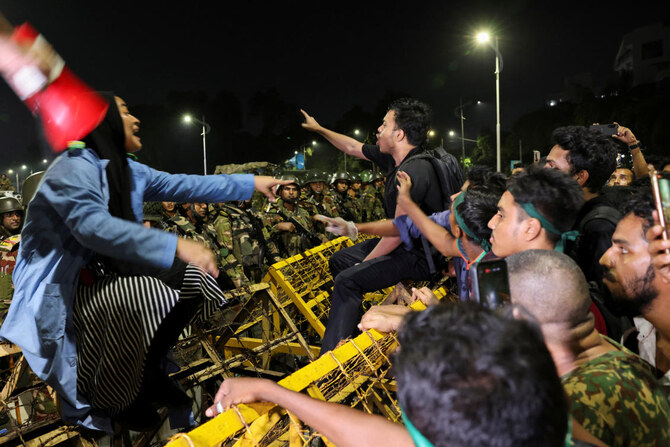
DHAKA: A protest outside the Bangladeshi president’s home demanding his resignation ended when demonstrators clashed with riot police while trying to storm the compound, with 30 injured in the melee.
President Mohammed Shahabuddin’s powers are largely ceremonial but he played a pivotal role at the height of an August student revolution that ousted autocratic ex-premier Sheikh Hasina.
Shahabuddin announced his one-time ally had quit on the day she fled the country for neighboring India, paving the way for the caretaker administration now running the South Asian country.
But last week he said in a local media interview he had not actually seen a written letter from Hasina to that effect — raising the prospect that her resignation was unlawful.
Protesters began gathering outside Shahabuddin’s compound in the capital Dhaka on Tuesday demanding he step down and accusing him of residual loyalty to Hasina and her Awami League party.
“Since the student-led protest toppled the fascist regime, there shouldn’t be a president from that regime,” Faruk Hossain, a student leader at the protest, told AFP.
“He must be replaced by a people’s president.”
Several hundred protesters attempted to break through a security cordon and storm the compound shortly before midnight on Wednesday.
Dhaka Metropolitan Police deputy commissioner Talebur Rahman said at least 25 police officers were injured by protesters.
“Nine are still undergoing treatment. The protesters threw stones and attacked them indiscriminately,” he told AFP.
“The situation is now calm, and there is adequate security in place.”
Another five people were treated at the Dhaka Medical College Hospital, police official Md Faruq told AFP.
Local media reports said that number included three protesters and two journalists.
The protest dispersed after leaders of Students Against Discrimination, the protest group credited with sparking the uprising against Hasina, visited the site and pledged to find a replacement for Chuppu.
“We will talk to political parties in front of the military chief by Thursday and then choose someone who will hold office,” student leader Hasnat Abdullah was quoted as saying the Daily Star newspaper.
His colleague Sarjis Alam reportedly told the crowd to remain calm.
“If emotion takes over strategy, the country will suffer,” he added, according to the Daily Star report.
Several top officials seen as Hasina loyalists were purged from their positions after Hasina’s ouster, including Supreme Court justices and the country’s central bank chief.
Their departures usually followed student-led protests outside their homes or offices.


![]()

30 injured in protests demanding Bangladeshi president resign
Short Url
https://arab.news/8m3hq
30 injured in protests demanding Bangladeshi president resign
- The interim government was expected to hold a Cabinet meeting to discuss the issue on Thursday
- Student group sets a two-day deadline for President Mohammed Shahabuddin to step down


Latest updates


Recommended


© 2026 SAUDI RESEARCH & PUBLISHING COMPANY, All Rights Reserved And subject to Terms of Use Agreement.