

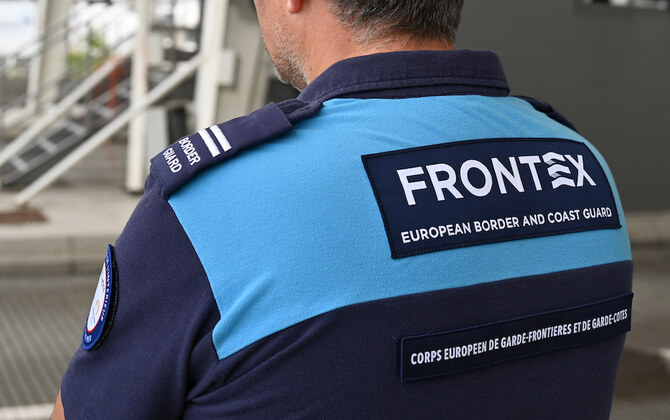
EU coast guard agency must ‘act to save refugee lives’ in Mediterranean: HRW

Short Url
Updated 24 October 2024
Follow

EU coast guard agency must ‘act to save refugee lives’ in Mediterranean: HRW

  • Frontex ‘should uphold EU and international law and our shared commitment to humanity and the protection of life’
  • More than 30,500 people have died or gone missing crossing to Europe by sea in past decade

LONDON: The EU’s coast guard agency, Frontex, should use its reconnaissance capabilities to help rescue refugee vessels in the Mediterranean, Human Rights Watch said on Thursday.

HRW launched a new campaign, #WithHumanity, calling on Frontex to help save the lives of thousands of people making the perilous journey to Europe.

Over the past decade, more than 30,500 people have died or gone missing in the Mediterranean, and this year at least 1,600 have been recorded dead or missing alone.

Judith Sunderland, HRW’s associate Europe and Central Asia director, said: “Frontex planes and drones should use their eyes on the Mediterranean Sea to save lives. With thousands dying in the Mediterranean every year, it’s vital for Frontex to do all it can to help ensure that people on unseaworthy boats are rescued and brought to safety.”

Coordination issues between Frontex, national coast guards in Europe and NGOs must be resolved, HRW said.

“By focusing on the aspirations of people taking these dangerous journeys, we hope that people across Europe will join us in urging Frontex to prioritize saving lives at sea,” Sunderland said.

“Europe’s coast guard should uphold EU and international law and our shared commitment to humanity and the protection of life.”

As it stands, when Frontex staff sight refugee vessels in the Mediterranean using aircraft, it informs rescue centers in EU member states as well as Libya and Tunisia.

But nearby NGO rescue ships are often left out of the communication loop, as are nearby vessels, which HRW said should receive emergency alerts.

In many cases, Libyan and Tunisian forces have received alerts and interdicted the refugee vessels, returning passengers to countries where they “face serious human rights abuses.”

A 2022 report by HRW found that Frontex’s decisions make the agency complicit in abusive and indefinite arbitrary detention practices in Libya.

Last month, 11 people rescued from Libya on the Medecins Sans Frontieres ship Geo Barents were interviewed by HRW.

All had suffered abuse — including claims of sexual violence, forced labor and physical assault — while in Libyan detention centers or smuggler captivity.

The Pylos shipwreck in 2023 “demonstrated the fatal consequences” of failing to respond appropriately to refugee vessels, HRW said.

More than 600 people died after the severely overcrowded ship capsized in Greece’s search-and-rescue region.

Frontex informed coastal authorities but failed to issue an emergency alert to nearby ships on the basis that there was no “imminent risk of loss of life.”

NGO rescue staff told HRW that Frontex coordination can prove crucial to saving the lives of refugees.

Last October, Geo Barents performed a nighttime rescue, saving 64 people including women and children, after receiving the coordinates of an overcrowded raft in the Mediterranean.

Fulvia Conte, MSF’s search-and-rescue team leader, said: “To have precise coordinates, taken from the sky, with a thermal camera, of course it helps when searching for a boat.”

Frontex must ensure that the locations of vessels in distress are automatically transmitted to NGO rescue ships in the vicinity, HRW said.

“Through the #WithHumanity campaign, Human Rights Watch is asking the public to take a closer look at the lives and rights at risk in the Mediterranean Sea and their shared humanity with those making the crossing, and to demand action by the responsible authorities,” the organization added.

China’s top diplomat to visit Somalia on Africa tour

Updated 6 sec ago
Follow

China’s top diplomat to visit Somalia on Africa tour

  • Stop in Mogadishu provides diplomatic boost after Israel became the first country to formally recognize breakaway Somaliland
  • Tour focusses on Beijing's strategic trade ​access across eastern and southern Africa
BEIJING: China’s top diplomat began his annual New Year tour of Africa on Wednesday, focusing on strategic trade ​access across eastern and southern Africa as Beijing seeks to secure key shipping routes and resource supply lines.
Foreign Minister Wang Yi will travel to Ethiopia, Africa’s fastest-growing large economy; Somalia, a Horn of Africa state offering access to key global shipping lanes; Tanzania, a logistics hub linking minerals-rich central Africa to the Indian Ocean; and Lesotho, a small southern African economy squeezed by US trade measures. His trip this year runs until January 12.
Beijing aims to highlight countries it views as model partners of President Xi Jinping’s flagship “Belt and Road” infrastructure program and to expand export markets, particularly in young, increasingly ‌affluent economies such ‌as Ethiopia, where the IMF forecasts growth of 7.2 percent this year.
China, ‌the ⁠world’s ​largest bilateral ‌lender, faces growing competition from the European Union to finance African infrastructure, as countries hit by pandemic-era debt strains now seek investment over loans.
“The real litmus test for 2026 isn’t just the arrival of Chinese investment, but the ‘Africanization’ of that investment. As Wang Yi visits hubs like Ethiopia and Tanzania, the conversation must move beyond just building roads to building factories,” said Judith Mwai, policy analyst at Development Reimagined, an Africa-focussed consultancy.
“For African leaders, this tour is an opportunity to demand that China’s ‘small yet beautiful’ projects specifically target our industrial gaps, ⁠turning African raw materials into finished products on African soil, rather than just facilitating their exit,” she added.
On his start-of-year trip in 2025, ‌Wang visited Namibia, the Republic of Congo, Chad and Nigeria.
His visit ‍to Somalia will be the first by a Chinese foreign minister since the 1980s and is ‍expected to provide Mogadishu with a diplomatic boost after Israel became the first country to formally recognize the breakaway Republic of Somaliland, a northern region that declared itself independent in 1991.
Beijing, which reiterated its support for Somalia after the Israeli announcement in December, is keen to reinforce its influence around the Gulf of Aden, the entrance ​to the Red Sea and a vital corridor for Chinese trade transiting the Suez Canal to Europe.
Further south, Tanzania is central to Beijing’s plan to secure access to Africa’s ⁠vast copper deposits. Chinese firms are refurbishing the Tazara Railway that runs through the country into Zambia. Li Qiang made a landmark trip to Zambia in November, the first visit by a Chinese premier in 28 years.
The railway is widely seen as a counterweight to the US and European Union-backed Lobito Corridor, which connects Zambia to Atlantic ports via Angola and the Democratic Republic of the Congo.
By visiting the southern African kingdom of Lesotho, Wang aims to highlight Beijing’s push to position itself as a champion of free trade. Last year, China offered tariff-free market access to its $19 trillion economy for the world’s poorest nations, fulfilling a pledge by Chinese President Xi Jinping at the 2024 China-Africa Cooperation summit in Beijing.
Lesotho, one of the world’s poorest nations with a gross domestic product of just over $2 billion, ‌was among the countries hardest hit by US President Donald Trump’s sweeping tariffs last year, facing duties of up to 50 percent on its exports to the United States.